Every litre of milk that the end-consumer receives has survived the race against time and temperatures. The clock starts rushing the very moment the milk is extracted, and a robust cold chain system becomes essential to avoid any spoilage.
The initiatives and investments by the Indian government, for instance - Pradhan Mantri Kisan SAMPADA Yojana - subsidise infrastructure development. Developing a comprehensive cold chain infrastructure requires an estimated INR 25000 crores (approximately USD 3 billion) to actively combat the issue of food wastage and advance the supply chain efficiency.
Dairy and frozen desserts comprise a significant portion of the cold chain logistics market, with industry giants such as Gujarat Co-operative Milk Marketing Federation Limited, aka Amul, procuring approximately 35 million litres of milk per day, sourced from 18600 village milk co-operative societies, spanning 18 member unions in 33 districts. With such widespread presence, the pressure on cold chain operations is rising at an unprecedented rate, and the cost of even minor errors is too high.
This guide illustrates the on-ground realities of the cold chain logistics for dairy, focusing on the vulnerabilities, the ways to overcome those, and safeguarding the product integrity, starting from the farm till it reaches the shelf.
- Dairy cold chain logistics keeps milk between 2°C and 6°C during transportation and storage.
- Raw milk should be cooled below 4°C within two hours of collection.
- Reefer trucks, IoT temperature sensors, and GPS monitoring help reduce spoilage risks.
- FSSAI requires documented temperature tracking for dairy transportation.
- Real-time monitoring improves compliance and prevents temperature excursions.
What role does cold chain logistics play in India's dairy sector?
Milk is one of the most perishable items in the food supply chain. Temperature rise over 4°C accelerates bacterial growth, ruining a perfectly healthy batch within hours. Milk is a dietary staple in several Indian regions due to its rich nutritional value that comprises a variety of proteins, vitamins, and minerals, but this enriched composition makes it a breeding ground for rapid bacterial growth if not stored in proper conditions. It’s not just a quality issue, but it encompasses compliance, cost, and customer trust issues.
The industry suffers losses worth billions annually due to supply chain disruptions, and that leads to the continuous process of strengthening the dairy regulatory system. Moreover, urban demand growth has resulted in the rapid expansion of the Indian e-commerce scenario, the food delivery market is estimated to surpass USD 28 billion by 2025, pushing logistics companies to scale their cold chain capabilities for fresh produce and temperature-sensitive items.
Retailers ask for proof of dairy logistics temperature control compliance, regulators demand documented cold chain trails, and consumers expect the claims on the label to be accurate to-the-dot. These are the reasons why dairy cold chain management is not an option but the absolute backbone of the dairy distribution business chain.
What are the cold chain compliance requirements for dairy in India?
Ideal Temperature Ranges for Dairy Cold Chain Logistics
| Supply Chain Stage | Recommended Temperature |
|---|---|
| Raw milk collection | Below 4°C |
| Chilling centre storage | 3°C–4°C |
| Reefer transportation | 2°C–6°C |
| Retail refrigeration | 2°C–5°C |
| Frozen dairy products | -18°C or below |
Now, it’s critical to understand the global cold chain logistics environment that consists of several complex operations running at scale.
Regulatory institutions such as the US Food and Drug Administration (FDA) and the Canadian Food Inspection Agency (CFIA) are significant contributors to setting and monitoring the standards of global food production and supply chains and play a significant role in milk spoilage prevention. International bodies like the WHO and the FDA share the Good Distribution Practices (GDP) guidelines.
In India, the Food Safety and Standards Authority of India (FSSAI) makes it mandatory to document cold chain transportation for milk compliance for all licensed dairy processors and distributors.
For dairy operations, compliance is no longer a back-office function - it requires real-time data, automated validation, and audit-worthy temperature trails - every step of the way.
How does dairy move through the cold chain - farm to shelf?
The cold chain logistics comprises several stages and the compounded temperature risks associated with each.
Stage 1: Farm-Based Collection
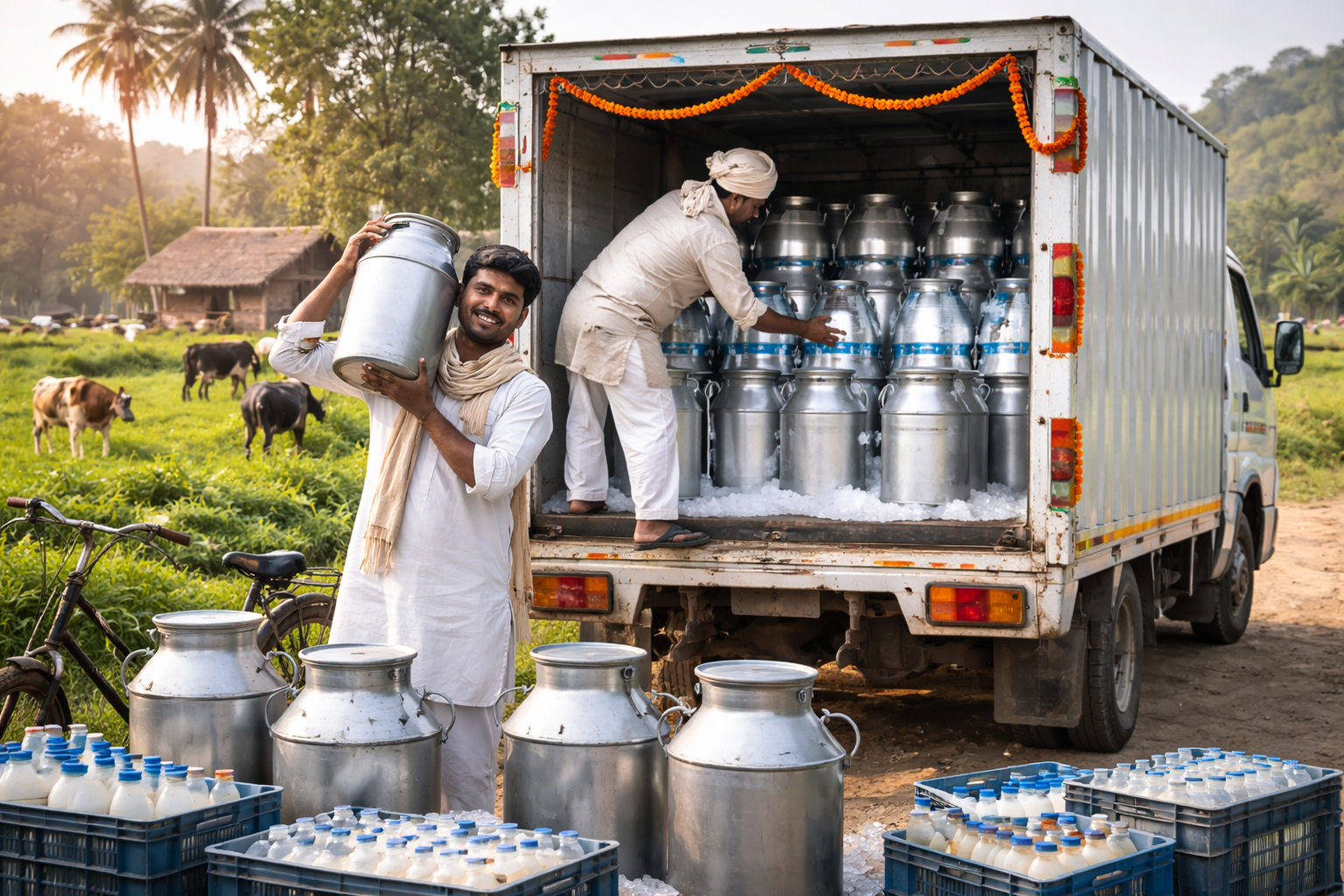
The process begins at the farm where raw milk is collected from multiple small, medium, and large dairy farmers, often in rural areas with restricted infrastructure. In India, such routes span from 30 to 80 kilometres and the product is collected twice daily. Milk has to be stored at the appropriate temperature immediately after collection due to the rapid tendency of bacterial growth.
Bulk Milk Coolers (BMCs) are the ideal solutions for large-scale farms and dairy cooperatives, while instant milk chillers are suitable for small and medium operators. Farms that still operate without electricity make their way with ice pack-equipped insulated milk cans that offer a cost-effective alternative.
On-Ground Reality - Northern and central India experience ambient temperatures higher than 42°C, and it’s a short window between milking and transporting the raw material to effective storage conditions. On a hot, summer day, a collection vessel operating late by 45 minutes makes the difference between quality-rich milk and a rejected batch.
Stage 2: Chilling Centres & Bulk Storage
After collection, the raw milk is shifted to chilling centres or dairy processing plants. These facilities store the milk in refrigerated silos at 3°C to 4°C before it’s processed further. The cold storage for milk infrastructure becomes critical at this juncture - insulation level, refrigeration capacity, and system efficiency directly impact the storage duration of the milk.
Milk cold chain logistics storage facilities with integrated IoT sensors ensure real-time temperature and humidity level monitoring to maintain optimal storage conditions for dairy produce. Automated storage and retrieval systems simplify inventory management by enhancing efficiency and reducing labour costs.
On-Ground Dairy Supply Chain Challenges - Reliable power source at chilling centres is a common issue in India. Without swift backup systems or real-time alerts, a compressor failure goes unnoticed for hours, resulting in a batch that’s unrecoverable due to inadequate milk transportation temperature. In such scenarios, integrated monitoring platforms like Fleetx can help surface early alerts and ensure that temperature deviations don’t go unnoticed for extended periods.
Stage 3: Processing & Packaging
Pasteurization, homogenization, and packaging are executed at the processing plants where the temperatures are strictly supervised. However, the risk reappears during loading - the point where the processed milk is transferred from the controlled plant environment into the reefer vehicle.
On-Ground Operational Challenge - The crucial step of pre-cooling the refrigerated trucks is often skipped due to time constraints, whereas industry standards require the storage trailers to be pre-cooled for a minimum of one or two hours before pickup, and the reefer unit has to run in the same mode while the vehicle is in transit. Under conditions where pre-cooling is skipped leads to a temperature rise by 2°C to 3°C while it’s being loaded - a deviation that compounds in the subsequent stages.
Stage 4: Transporting the Milk
The most complex part of the whole process is the cold chain transportation for milk. Processed dairy goods are shifted from the plant to regional distribution hubs for the onward transfer to retail outlets, departmental stores, and e-commerce dark stores - involving multiple vehicle transfers.
Every handoff requires checks and controls for ensuring optimal quality, despite the scope of external temperature exposure beyond the permissible range. Strict coordination is required across the entire cold chain logistics operation for quality assurance.
On-Ground Essentials - The most challenging stage of dairy product movement needs a host of facilities:
- Reefer vehicles with consistent cooling between 2°C and 6°C
- In-transit, real-time temperature logging
- Vehicle tracking to arrest route deviations and unplanned stoppages
- Driver behavior monitoring for door management and idling
Stage 5: Last-Mile Delivery
The final leg of the journey involves recurring stops, loading wait times, and exposure to ambient temperatures while unloading. Cold storage warehousing follows just-in-time delivery practices for dairy producers to stock optimal inventory levels and mimimize storage costs while ensuring end-to-end visibility across the supply chain for enhanced compliance.
Retail grocery chains have to maintain a consistent cold chain integrity right up to the refrigerated display unit. A delivery that occurred at the optimum temperature but sits on the dock for 40 minutes before being shelved is still a quality and compliance risk.
What technology is driving modern dairy cold chain management?
The gap between a high-performing and just-average dairy operation is determined by the widening technology inconsistency. Management systems such as ERP and TMS optimize transport operations such as route planning, inventory control, and distribution efficacy. Moreover, AI helps in monitoring the product conditions in real-time while in storage or in transit. The state-of-the-art technology stack that ensures seamless dairy operations includes:
IoT-Enabled Temperature Sensors
Such sensors track the temperature and humidity levels during the transport, notifying teams of potential issues that can lead to quality issues in the product.
Reefer Tracking Integrations
Comprehensive dashboards that integrate GPS-based location, cargo temperatures, door alerts, and idling time offer a bird ’s-eye view of the entire operation. Fleet managers don’t need to rely on delivery reports and can intervene whenever needed.
Predictive Analytics
Predictive tools ease warehouse operations and inventory management by analyzing and reporting on demand, seasonal change, and lead time patterns, enabling companies to maintain optimal inventory levels across regions.
Automated Compliance Adherence
Digital temperature trails that can be shared with retailers and regulators, without any manual effort, have stopped being mere differentiators and have become the bare minimum.
How Dairy Cold Chain Management Failures Impact Dairy Businesses
Preventing milk spoilage is not just about maintaining the product integrity, it’s about protecting margins and the business reputation. Cold chain failures result in
- Retailer charges paid for non-compliant deliveries
- Regulatory penalties under FSSAI and equivalent frameworks
- Damage to the brand name with consumer complaints about inferior-quality products
- Operational disruption from rejected batches, returns, and unplanned rerouting
These are not theoretical risks but daily operational realities for dairy supply chains.
Sustainability - The Latest Cold Chain Mandate
Dairy brands and cooperatives are increasingly facing the pressure of implementing sustainability into their operations, and cold chain logistics are under the spotlight. Inefficient cold chains not only result in financial losses but the carbon emission levels also breach the environmental standards through surplus refrigeration energy use, wastage of food, and fuel-heavy routing.
Comprehensive digital transformations within the dairy sector can reform the operations, enabling real-time tracking of products across the entire chain - facilitating data transparency, eliminating operational hurdles, and reducing waste significantly.
Fleet digitization, route control, and smarter load planning - all are reducing the carbon footprint of the dairy cold chain operations while reducing fuel and operational overheads. Sustainability and efficiency are not opposing priorities anymore, but are at the same level.
What are the vital elements of an advanced dairy cold chain operation?
In this industry, dairy logistics temperature control is a mandate, and the relevant features include -
- End-to-end sensor coverage encompassing the chilling centre, transit vessels, and delivery points
- Real-time alerts for all deviations for the operations team’s timely intervention
- An integrated fleet and cold chain management system
- Automated compliance documentation
- A scalable infrastructure that offers flexibility in different environments
What Does the Future Hold
The complexity of the dairy supply chain is expected to only scale up, more routes, more vehicles, more deliveries, and tighter delivery windows - all increasing the cold chain vulnerabilities. Businesses that would scale successfully will be the ones that treat cold chain logistics for dairy as a core operational need and not a mere compliance checkbox - one that’s actively monitored, continuously optimized, and supported by the right technology stack.
From the farm’s bulk milk cooler to the retailer’s refrigerated shelf, every single point in the dairy supply chain matters. In a product category where financial loss is equivalent to the extended hours, the margin for errors is zero.