When the Cold Chain Breaks, Everything Breaks
A pharmaceutical distributor in Ahmedabad dispatches a consignment of insulin vials to a hospital network in Surat. The reefer truck leaves at 6 AM on a Tuesday in May, when ambient temperatures in Gujarat are already touching 42 degrees Celsius. The compressor unit on the reefer body has a slow refrigerant leak that the driver is unaware of. By the time the truck arrives four hours later, the internal temperature has climbed from the prescribed 4 degrees to 14 degrees Celsius. The cargo is compromised. It cannot be used. It cannot be resold.
The value of the consignment is 8 lakh rupees. The cost of the recall, the replacement dispatch, the reputational damage with the hospital client, and the regulatory paperwork that follows is considerably more.
The temperature excursion was not caught because nobody was watching the temperature in real time. A driver who did not know there was a problem could not report one. A fleet manager watching GPS coordinates on a screen had no way of knowing that the cargo was slowly warming to an unsafe level inside a truck that, from the outside, looked perfectly normal.
This is the cold chain failure that temperature sensors for fleet vehicles exist to prevent.
The Cold Chain Challenge in India: Why It Is Harder Here Than Anywhere Else
India's cold chain logistics sector is one of the most demanding operating environments in the world for temperature-sensitive cargo. The reasons are structural, climatic, and infrastructural, and they combine in ways that make cold chain failures both more likely and more costly than in comparable markets.
Extreme and variable ambient temperatures. India's geography produces temperature ranges that stress refrigeration equipment relentlessly. A reefer truck running from Chennai to Delhi in June passes through multiple climatic zones, from coastal humidity to semi-arid heat, with ambient temperatures that can exceed 45 degrees Celsius in the interior. Maintaining a stable internal temperature of 2 to 8 degrees Celsius for pharmaceuticals, or minus 18 degrees for frozen food, requires refrigeration equipment that is in excellent condition and being actively monitored.
Long transit distances with limited service infrastructure. Unlike European cold chain networks where a refrigeration unit can fail and a replacement vehicle can be dispatched within hours, Indian long-haul cold chain routes frequently pass through areas where specialist reefer maintenance is unavailable. A compressor failure on NH48 between Bengaluru and Mumbai at 2 AM is not a problem that resolves quickly. Without real-time temperature monitoring, the failure may not even be noticed until the cargo arrives compromised.
Underinvestment in last-mile cold chain. While large reefer truck fleets have historically received more investment in refrigeration equipment quality, the last-mile segment, the three-tonne and five-tonne refrigerated vehicles that make urban deliveries, is chronically underequipped. Temperature monitoring is rare in this segment. Failures are common.
Regulatory pressure that is growing. The Food Safety and Standards Authority of India (FSSAI) has progressively tightened cold chain compliance requirements for food-grade transport. CDSCO regulations for pharmaceutical transport increasingly require documented temperature logs throughout transit. Exporters supplying to European or North American buyers face even stricter contractual chain of custody requirements. The era of delivering perishable cargo on goodwill and an assumed cold chain is ending.
A market growing faster than its infrastructure. India's cold chain logistics market is expanding rapidly, driven by modern retail, quick commerce, pharmaceutical exports, and changing consumer food preferences. The infrastructure is not keeping pace, which means more perishable cargo is moving through a cold chain that has more gaps in monitoring than the volume growth warrants.

What Is at Risk: The Categories of Perishable Cargo on Indian Roads
Before examining how temperature sensors work, it is worth understanding the breadth and value of the cargo that depends on cold chain integrity every day across Indian highways.
Pharmaceuticals - Vaccines, insulin, biologics, blood products, and a growing range of specialty medicines require strict temperature control throughout their journey from manufacturer to patient. The World Health Organisation estimates that a significant proportion of vaccines globally are compromised before they reach their point of use due to cold chain failures. In India, where vaccine logistics form a critical public health function, temperature excursions are not just commercial losses. They are patient safety events.
Fresh produce - Fruits, vegetables, and flowers moved from agricultural regions to urban markets and export hubs represent enormous value that disappears within hours of a temperature excursion. A reefer load of mangoes from Ratnagiri, grapes from Nashik, or roses from Pune is worth lakhs of rupees. The shelf life of the cargo is the business model.
Dairy and processed food - Milk, paneer, cheese, and processed food products have tight temperature windows and zero tolerance for excursions that take them above the threshold for bacterial growth. A single compromised batch that reaches consumers can trigger recall events and brand damage that far exceeds the value of the cargo itself.
Meat, poultry, and seafood - Among the most temperature-sensitive cargo categories, with shelf life that can be measured in hours once the cold chain is broken. The growth of organised retail in meat and seafood distribution has dramatically increased the volume of this cargo type on Indian roads, and with it the stakes of cold chain failure.
Ice cream and frozen confectionery - Maintaining minus 18 to minus 22 degrees Celsius through Indian summer conditions requires refrigeration equipment that is not just functional but performing at specification. Temperature excursions that thaw and refreeze product are detectable by consumers and result in returns and brand damage.
Chemical and industrial perishables - Certain industrial chemicals, adhesives, reagents, and biological samples also require temperature-controlled transport, a segment that is growing as India's pharmaceutical manufacturing and biotechnology sectors expand.
| Cargo type | Required range | Recommended sensor | Alert threshold | Regulatory standard |
|---|---|---|---|---|
| Vaccines & biologics | +2°C to +8°C | RTD (±0.3°C) | ±1°C from setpoint | CDSCO GDP, WHO PQS |
| Insulin & liquid pharma | +2°C to +8°C | RTD (±0.3°C) | ±1°C from setpoint | CDSCO GDP |
| Fresh produce (fruits, vegetables) | +2°C to +10°C | RTD or thermocouple | ±2°C from setpoint | FSSAI Food Safety |
| Dairy (milk, paneer, cheese) | 0°C to +4°C | RTD (±0.3°C) | ±1°C from setpoint | FSSAI Food Safety |
| Meat, poultry & seafood | 0°C to +4°C | RTD or thermocouple | ±1°C from setpoint | FSSAI Food Safety |
| Ice cream & frozen confectionery | −18°C to −22°C | Thermocouple | Above −15°C | FSSAI Food Safety |
| Frozen seafood (export) | −18°C or below | Thermocouple | Above −15°C | FSSAI + EU import regs |
| Chemical & lab reagents | Varies (+2°C to +25°C) | RTD (±0.3°C) | Per product spec | Manufacturer SOP |
How Temperature Sensors for Fleet Vehicles Work
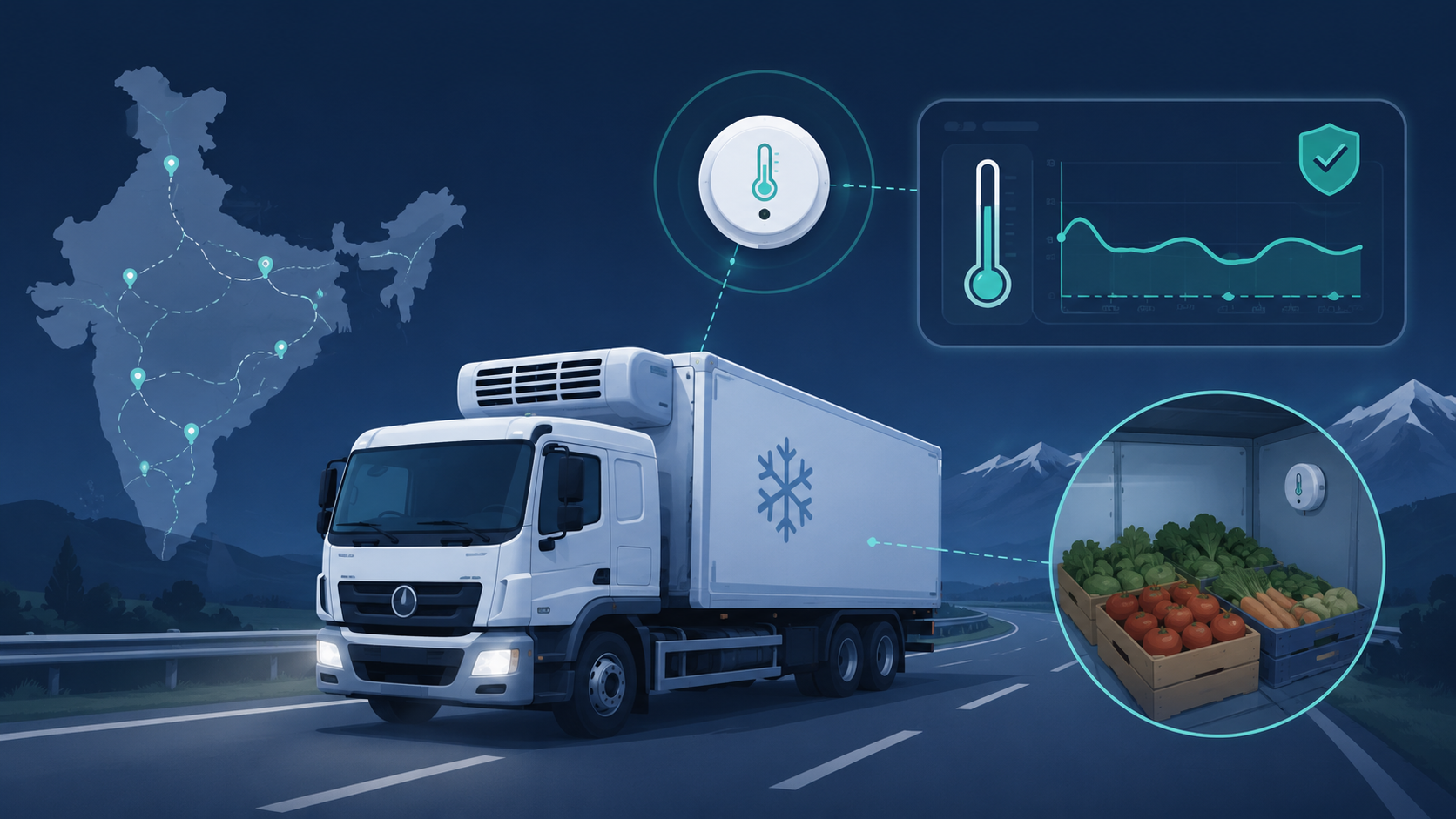
A temperature sensor for fleet vehicles is a hardware device installed in the cargo compartment of a refrigerated or temperature-controlled vehicle. It continuously measures the internal air temperature (and in some configurations, the surface temperature of the cargo itself) and transmits readings at regular intervals to the fleet management platform via the vehicle's GPS tracker.
Modern fleet temperature sensors use one of two core technologies.
Thermocouple sensors measure temperature by detecting the voltage difference between two dissimilar metals at the sensing tip. They are robust, accurate across a wide temperature range, and well-suited to the demanding conditions of a reefer cargo compartment.
Resistance Temperature Detectors (RTDs) measure temperature by correlating electrical resistance with temperature. They are highly accurate, particularly in the 0 to 100 degree Celsius range that covers most food and pharmaceutical cold chain requirements, and are the preferred choice for precision-critical deployments.
In multi-zone reefer trucks (vehicles with two or three temperature-controlled compartments carrying different cargo types simultaneously), multiple sensors are installed, one per zone, each transmitting independently. The fleet management platform displays each zone as a separate temperature channel, so a deviation in one zone is immediately distinguishable from stable conditions in the others.
The sensor data is transmitted at configurable intervals, typically every one to five minutes, and is plotted as a continuous temperature graph on the platform. This graph, correlated with GPS location and time, constitutes a complete, auditable temperature log for the entire journey.
Real-Time Monitoring and Alerts: The Operational Core
The temperature graph is useful for historical analysis and compliance documentation. Real-time alerts are what prevent cargo loss.
Fleetx's temperature monitoring module allows fleet operators and logistics managers to define temperature thresholds for each vehicle, each cargo compartment, and each trip type. When the sensor reading crosses a defined upper or lower boundary, the platform triggers an immediate alert with the vehicle's identity, location, current temperature, and the rate of temperature change.
This alert architecture enables a layered response protocol.
Early warning alerts fire when the temperature approaches the threshold but has not yet crossed it. This is the most valuable alert in terms of preventing cargo loss, because it creates an intervention window before the cargo is actually compromised. A reefer running at 7 degrees when the upper limit is 8 degrees is not yet a problem. It is a warning that the refrigeration unit needs attention in the next stop or service.
Threshold breach alerts fire when the temperature exceeds the defined limit. The response protocol at this point involves contacting the driver, assessing the condition of the refrigeration unit, and deciding whether the cargo can be salvaged by reaching the destination quickly or whether a vehicle swap is necessary.
Rapid temperature change alerts fire when the rate of temperature change indicates a sudden equipment failure rather than gradual drift. A temperature that climbs from 4 degrees to 12 degrees in 20 minutes indicates a compressor failure or a door left open, and demands an immediate response.
Door open detection in sensor systems that integrate door status monitoring flags when the cargo compartment is opened at an unauthorised location or at an unexpected time during transit. Combined with temperature data, this provides both a security and a cold chain integrity alert from a single event.
Data gap alerts flag when sensor transmissions stop, which may indicate a hardware fault, a power disconnection, or a deliberate attempt to disable monitoring. A fleet manager who cannot see temperature data from a vehicle carrying temperature-sensitive cargo needs to know about the gap immediately.
Compliance Documentation: The Audit Trail That Protects Your Business
Beyond real-time operations, temperature sensors generate something that is increasingly valuable in a regulatory and commercial context: an irrefutable, tamper-proof record of every temperature condition experienced by the cargo throughout its journey.
For pharmaceutical shipments, CDSCO and WHO guidelines on Good Distribution Practice (GDP) require documented evidence that the cold chain was maintained from origin to point of delivery. A paper temperature log filled in by a driver is not GDP-compliant evidence. A sensor-generated, time-stamped, GPS-correlated log transmitted directly to a fleet management platform is.
For food exporters supplying to European or North American markets, import regulations often require continuous temperature monitoring records for the entire cold chain journey. Without sensor-generated documentation, the cargo is simply not exportable to these markets.
For FSSAI-regulated businesses, the direction of regulatory development is clearly toward stricter temperature documentation requirements. Fleet operators who already have sensor-based logging in place are ahead of compliance requirements that their competitors will scramble to meet.
Fleetx generates automatic end-of-trip temperature reports that compile the complete sensor log, annotated with trip details, GPS track, and any alert events, into a single downloadable document. This report can be shared with clients, auditors, or regulatory authorities as evidence of cold chain compliance without any manual compilation.
For fleet operators who manage cargo for multiple clients, the ability to generate client-specific temperature compliance reports for every shipment is a commercial differentiator. It is documented proof of service quality that builds trust and justifies premium pricing.
Multi-Zone Reefer Management: Serving Multiple Clients per Trip
One of the most commercially significant features of advanced temperature monitoring for fleet vehicles is its support for multi-zone reefer operations, where a single truck carries cargo for different clients or different product categories in separately maintained temperature compartments.
A typical multi-zone setup might carry vaccines at 2 to 8 degrees Celsius in the front zone, chilled dairy at 0 to 4 degrees Celsius in the middle zone, and frozen seafood at minus 18 degrees Celsius in the rear zone. Each zone requires independent temperature monitoring, independent alerting, and independent compliance documentation for the respective client.
Without multi-sensor monitoring, managing this complexity is either done through manual driver checks (which are infrequent and undocumented) or by running separate vehicles for each cargo type (which is commercially inefficient). Real-time multi-zone temperature monitoring makes consolidated loads viable, profitable, and compliant.
Fleetx supports multi-sensor configurations with independent alert thresholds per zone, separate compliance reports per cargo type, and a unified dashboard view that lets the operations team see all zones across all vehicles in a single screen.
The Financial Case: What Cold Chain Failures Actually Cost
Fleet operators evaluating temperature sensor deployment often frame the decision as a cost question. The sensor hardware, installation, and platform subscription cost money. What does the investment return?
The answer requires looking honestly at what cold chain failures actually cost, because most fleet operators underestimate the true figure.
Direct cargo loss is the most visible cost. A rejected or recalled consignment is a quantifiable loss, typically borne partly by the fleet operator as a liability claim and partly by the shipper depending on contractual terms. For high-value pharmaceutical or fresh produce loads, a single rejection event can equal the cost of monitoring an entire fleet for a year.
Claim and dispute costs extend beyond the cargo value itself. Documenting what happened, defending against a claim, negotiating settlements, and managing the relationship with the affected client consume management time and legal resources that never appear on the same line as the cargo loss but are real costs nonetheless.
Client retention costs are the most underestimated. A consignor who experiences a cold chain failure has a choice of logistics partners. Losing a regular pharmaceutical or FMCG client to a better-equipped competitor represents a recurring revenue loss that compounds for as long as the client is gone.
Insurance premium impact. Fleets with documented cold chain failure histories pay higher insurance premiums on temperature-sensitive cargo coverage. Fleets with sensor-based monitoring records and low claim rates have grounds to negotiate meaningfully better terms.
Regulatory penalty exposure. FSSAI and drug regulatory authorities are increasingly empowered to impose penalties for cold chain documentation failures. The penalty value is secondary to the reputational consequence of a regulatory action in a market where enterprise clients conduct vendor audits.
When these costs are assembled honestly, the temperature sensor investment becomes not a cost question but a risk management question with a clear financial answer.
Fleetx Temperature Monitoring: End-to-End Cold Chain Visibility
Fleetx's temperature monitoring capability is designed around the operational reality of Indian cold chain logistics, where the same platform needs to manage a 32-tonne reefer trailer on a 1,200-kilometre highway run and a one-tonne last-mile chiller van making 15 drops across a metro city.
The platform connects temperature sensor data with GPS tracking, trip management, driver alerts, and compliance reporting in a single unified view. Operations teams see every temperature event in context: where the truck was when the alert fired, how long the excursion lasted, what the rate of change was, and what action was taken.
For fleet operators managing cargo for large enterprise clients, Fleetx's client portal allows consignors to access temperature data for their specific consignments in real time, reducing inbound calls to the operations desk and building the kind of operational transparency that underpins long-term client relationships.
Maintenance integration means that a pattern of refrigeration unit performance degradation, visible in the temperature sensor data as increasing difficulty maintaining setpoint temperatures, can trigger a preventive maintenance work order before the unit fails on a live trip. This predictive approach to reefer maintenance reduces both cargo loss and the emergency repair costs that come with in-transit failures.
Deployment Considerations for Indian Fleet Operators
Sensor placement matters - In a fully loaded reefer truck, the air temperature near the evaporator unit may differ from the temperature in the cargo stack. Sensor placement should reflect where the cargo sits, not where it is easiest to mount the hardware. For high-value pharmaceutical loads, cargo probe sensors that measure temperature at the product surface level are worth the additional investment.
Calibration and certification - For GDP-compliant pharmaceutical cold chain and FSSAI-regulated food transport, the temperature sensors must be calibrated against a certified reference and the calibration documented. Calibration certificates should be renewed at the frequency specified by the relevant regulatory standard.
Power source resilience - Temperature sensors should be wired to a power source that remains active when the vehicle is parked and the ignition is off. Pre-loading and post-delivery periods are frequent windows for temperature excursions, particularly in Indian summer conditions where ambient temperatures accelerate cargo warming once refrigeration is cut.
Driver training - Drivers should understand what temperature alerts mean, how to respond to an in-cab notification of a temperature excursion, and what actions they can take (checking that doors are properly sealed, verifying compressor operation, pulling over to call the operations desk) before cargo damage becomes irreversible.
Conclusion: The Cold Chain Is Only as Strong as Its Weakest Unmonitored Kilometre
Every kilometre that temperature-sensitive cargo travels without real-time monitoring is a kilometre where a failure can begin and progress undetected. In a country the size of India, with the route distances, ambient temperatures, and infrastructure gaps that Indian cold chain logistics involves, that unmonitored exposure is not a theoretical risk. It is a regular occurrence for fleets that have not yet deployed sensor-based temperature monitoring.
The technology to close this gap is mature, accessible, and integrates directly into the fleet management platforms that progressive Indian operators are already using. Temperature sensors for fleet vehicles are not a specialised upgrade for a niche market. They are a baseline operational requirement for any fleet carrying perishable cargo that takes its client obligations and its own financial health seriously.
The cold chain does not take care of itself. A sensor is the simplest, most cost-effective tool available to make sure that it is being taken care of on every trip, across every kilometre, in real time.
FAQs
Where can I find a comprehensive guide on India's cold chain logistics?
India's cold chain logistics covers a wide range of operational, regulatory, and technology requirements — from reefer vehicle specifications and FSSAI food transport compliance to CDSCO GDP documentation for pharmaceutical cargo.
A comprehensive guide should cover temperature monitoring technology (sensor types, placement, calibration), regulatory requirements under FSSAI and CDSCO, route-specific challenges across Indian highway corridors, and last-mile cold chain gaps in urban delivery.
Platforms like Fleetx publish in-depth operational resources specifically covering the Indian context. For regulatory documentation, the primary sources are fssai.gov.in for food transport standards and cdsco.gov.in for pharmaceutical GDP guidelines.
What separates top cold chain logistics companies in India from the rest?
The defining difference between leading and average cold chain logistics companies in India is real-time temperature visibility across every kilometre of transit — not just at origin and destination.
Top-tier operators use sensor-based fleet management platforms that provide continuous cargo temperature data, multi-zone reefer monitoring for consolidated loads, and automated compliance documentation. In a market where FSSAI and CDSCO requirements are tightening, sensor-equipped fleets are becoming the baseline expectation for enterprise consignors shipping pharmaceuticals or food-grade cargo.
When evaluating a provider, ask to see a sensor-generated temperature compliance report from a completed trip — operators using platforms like Fleetx can produce GPS-correlated, time-stamped logs as standard. If a provider cannot produce this documentation, their cold chain monitoring is likely manual or absent.
How do I find a reliable cold chain logistics provider in India for temperature-sensitive cargo?
When evaluating a cold chain logistics provider in India for pharmaceutical, fresh produce, dairy, or frozen cargo, the most important question is not whether they operate refrigerated vehicles — it is whether those vehicles carry real-time temperature sensors that generate auditable logs throughout transit.
A reliable provider should be able to share a sensor-generated temperature compliance report from a completed trip, showing continuous readings correlated with GPS location and time. For pharmaceutical cargo, confirm that their documentation meets CDSCO GDP requirements. For food cargo, verify FSSAI compliance.
Providers using fleet management platforms such as Fleetx generate these reports automatically at the end of each trip. Request a sample report before committing — a provider who hesitates or offers only driver logs is not operating a verifiable cold chain.
What are the biggest gaps in cold chain infrastructure in India, and how does technology help bridge them?
India's cold chain infrastructure faces three compounding structural challenges.
First, extreme ambient temperatures — reaching 45°C or above in interior regions — place heavy strain on refrigeration equipment, particularly on long highway corridors where service support is sparse. Second, transit distances between production centres and consumption markets are long, with limited refrigeration maintenance facilities along major routes. Third, last-mile refrigerated vehicles are chronically underequipped, especially the three- and five-tonne segment serving urban delivery.
Real-time temperature sensors address the monitoring gap that infrastructure investment alone cannot close. When a compressor begins failing on NH48 between Bengaluru and Mumbai at 2 AM, no infrastructure improvement puts a technician at that location — but a sensor alert gives the operations team an intervention window that manual checks cannot provide.
Fleet management platforms with temperature monitoring capability, including solutions like Fleetx, make continuous monitoring accessible without requiring infrastructure overhaul. The practical starting point is deploying sensors on existing reefer vehicles before investing in physical infrastructure upgrades.
What equipment should a cold chain transport vehicle in India have for pharmaceutical or food-grade cargo?
A properly equipped cold chain transport vehicle in India requires four core components.
First, a calibrated refrigeration unit capable of maintaining the required temperature setpoint under Indian summer ambient conditions — not just in moderate weather. Second, a temperature sensor installed in the cargo zone, not near the evaporator unit, where readings reflect actual cargo conditions rather than cooled air at the unit outlet. Third, a GPS-linked fleet management platform that transmits sensor readings at regular intervals and triggers alerts when thresholds are breached. Fourth, a calibration certificate for the sensor, renewed at the interval specified by the relevant regulatory standard.
For multi-zone reefer trucks carrying different cargo types simultaneously, independent sensors per compartment with separate alert thresholds are essential. Sensors should be wired to a power source that remains active when the ignition is off, since pre-loading and post-delivery periods are among the most common windows for temperature excursions in high-ambient conditions.
Platforms like Fleetx integrate sensor data, GPS tracking, and compliance reporting into a single interface that meets FSSAI and CDSCO documentation requirements.
What does it take to run a profitable cold chain logistics business in India?
Running a profitable cold chain logistics business in India requires managing a risk profile that general freight operators do not face. A single rejected pharmaceutical consignment or compromised fresh produce load can equal the annual monitoring cost of an entire fleet — making cargo loss prevention a direct profitability lever, not just a compliance obligation.
The businesses that sustain margins in this segment consistently do three things. They monitor temperature in real time on every trip so that excursions are caught before delivery rather than discovered on arrival. They generate sensor-based compliance documentation that satisfies FSSAI, CDSCO, and export market requirements without manual effort — removing a high administrative cost. And they use historical temperature data to identify refrigeration units whose performance is degrading before those units fail on a live trip, converting reactive repair costs into planned maintenance.
Fleet management platforms with integrated temperature monitoring — such as Fleetx — combine all three functions. Before investing in additional vehicles or cold storage, operators should evaluate whether their existing fleet is monitored well enough to protect the revenue they already have.