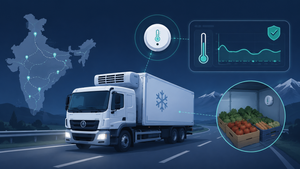
If your cold chain management is still “trusting the reefer and hoping for the best,” you’re gambling with product integrity, compliance, and margins. Temperature sensors make the difference between intact payloads and expensive write-offs. Here’s a guide to why they matter, what to look for, and how IoT turns a messy, multi-stakeholder chain into a monitored, auditable, and efficient system—end to end.
Why Is Temperature Monitoring Critical in Cold Chain Logistics?
Cold chains are not single links; they’re relay races—first mile, hub, long-haul, cross-dock, last mile, handoff to store or clinic. Every transfer point is a risk of thermal abuse. Temperature sensors (and the data discipline behind them) give you continuous proof that perishable goods stayed within specifications - from warehouse to pallet to truck to door.
Let’s talk hard realities:
- Food loss due to weak refrigeration is massive - A UN FAO/UNEP analysis finds that the lack of effective refrigeration caused the loss of about 12% of total food production (≈526 million tonnes) in 2017.
- Healthcare isn’t spared - Community pharmacy data show 50% of pharmacies experienced 1–4 temperature excursions in 12 months, underscoring how common breaches are without robust monitoring.
- Vaccine wastage can spike when temperature control falters - Analyses during COVID-19 reported wastage rates as high as 30% in some contexts.
For Indian cold-chain trucking, this translates to fewer rejected loads, stronger service-level reliability for pharma/agrifresh clients, lower insurance friction, and a compliance trail that stands up to audits. Temperature sensors aren’t “nice to have”; they’re your early warning systems.
What Features Should a Cold Chain Temperature Monitoring System Have?
Buy the sensor; buy the system around it. Hardware is only step one. A production-grade stack should deliver signal quality, context, and decisions—not just numbers.
- Calibrated sensors with NIST/traceable certificates: Accuracy (±0.3–0.5 °C typical for pharma-grade) and stability across ambient shocks.
- Granular logging & real-time streaming: High-frequency logging (e.g., 1–5 min) with cellular/BLE/Wi-Fi backhaul; offline buffering with automatic sync.
- Excursion detection & alerting: Configurable threshold bands per commodity (e.g., 2–8 °C for many biologics, produce-specific ranges), with escalation trees (driver → dispatcher → quality).
- Geo-tagged telemetry: Pair temperatures with GPS and route segments to identify hot spots (yard delays, specific lanes, bottleneck DCs).
How Are IoT Temperature Sensors Transforming Cold Chain Operations?
IoT has upgraded temperature monitoring, resulting in fewer product losses, fewer claims, and higher customer trust.
- Continuous visibility: Live dashboards for fleet ops and quality teams show lane-by-lane thermal performance.
- Automated alarms: The moment return-air climbs out of range, or the product probe trends toward a limit—alerts fire with context (vehicle ID, location, ETA to threshold breach).
- Geo-fencing logic: Higher scrutiny on known risk zones (e.g., loading bays at 2 PM in May, traffic choke points).
Public-health authorities emphasize strict temperature handling for vaccines, with detailed SOPs for excursions and the kinds of devices that should or shouldn’t be used in storage. If you’re in pharma healthcare logistics, your sensor stack must map neatly to those expectations.
When Should a Fleet Operator Upgrade to Automated Temperature Monitoring?
Operational signals:
- Recurring temperature excursions on the same lanes, assets, or time windows—even if they’re minor. Small, repeated deviations kill quality slowly and steadily.
- Claims vs. proof gap: You can’t produce auditable, time-stamped logs that stand up in court or with insurers.
- Paper clipboards and delayed USB data dumps don’t help in real time and are error-prone.
- Indian corridors with 40°C+ ambient, festival traffic, and long gate queues require proactive thermal management, not post-mortems.
- QSR/pharma/modern trade tenders increasingly demand validated monitoring and chain-of-custody data as evidence.
Financial/logistical indicators:
- Repacking, dumping, or discounting loads are silent P&L leaks.
- Reefer with poor pull-down rates or frequent defrost cycles signals upcoming failures; predictive alerts turn downtime into scheduled service.
- As you add routes, drivers, and subcontractors, manual oversight collapses; automation is the only way to keep standards consistent.
Why Do Cold Chain Operators in India Choose Fleetx Temperature Monitoring?
The cold chain monitoring system from Fleetx offers several benefits to the users, which include -
Better Cold Chain Visibility - Get all your temperature data at a glance to identify the issues and corresponding locations. The advanced temperature logging system provides your team and customers with a transparent picture of the interior conditions of your vehicles.
Reduce Rejected Load Claims - Get historical temperature details of all vehicles. Customers can access minute-by-minute temperature and sensor data points as proof of transport conditions.
Detect Temperature-Related Issues Beforehand - Increase your ROI and reduce shipment damage. Confront product quality concerns with definitive evidence of temperature control.
Strengthen Compliance - Follow FSSAI compliance and automate recordkeeping with comprehensive and visual reports available as PDF or CSV downloads.
Ensure Sustainability & Compliance With Cold Chain Temperature Sensors
Let’s tie it together: temperature sensors don’t just “watch”—they prevent, prove, and optimize. Prevent - by warning you early. Prove - by giving you defensible, time-stamped evidence for customers, regulators, and insurers. Two final realities:
- Sustainability: Stronger cold chains mean less product waste and fewer repeat shipments. UN/FAO/UNEP data quantify the stakes—cutting thermal losses saves hundreds of millions of tonnes of food and the embedded emissions that go with them.
- Compliance: Whether you’re hauling vaccines, biologics, seafood, or ready-to-eat meals, regulators and customers expect compliance-aligned practices and auditable records. Temperature sensors—properly calibrated, integrated, and governed—make compliance a by-product of good operations, not a separate chore.