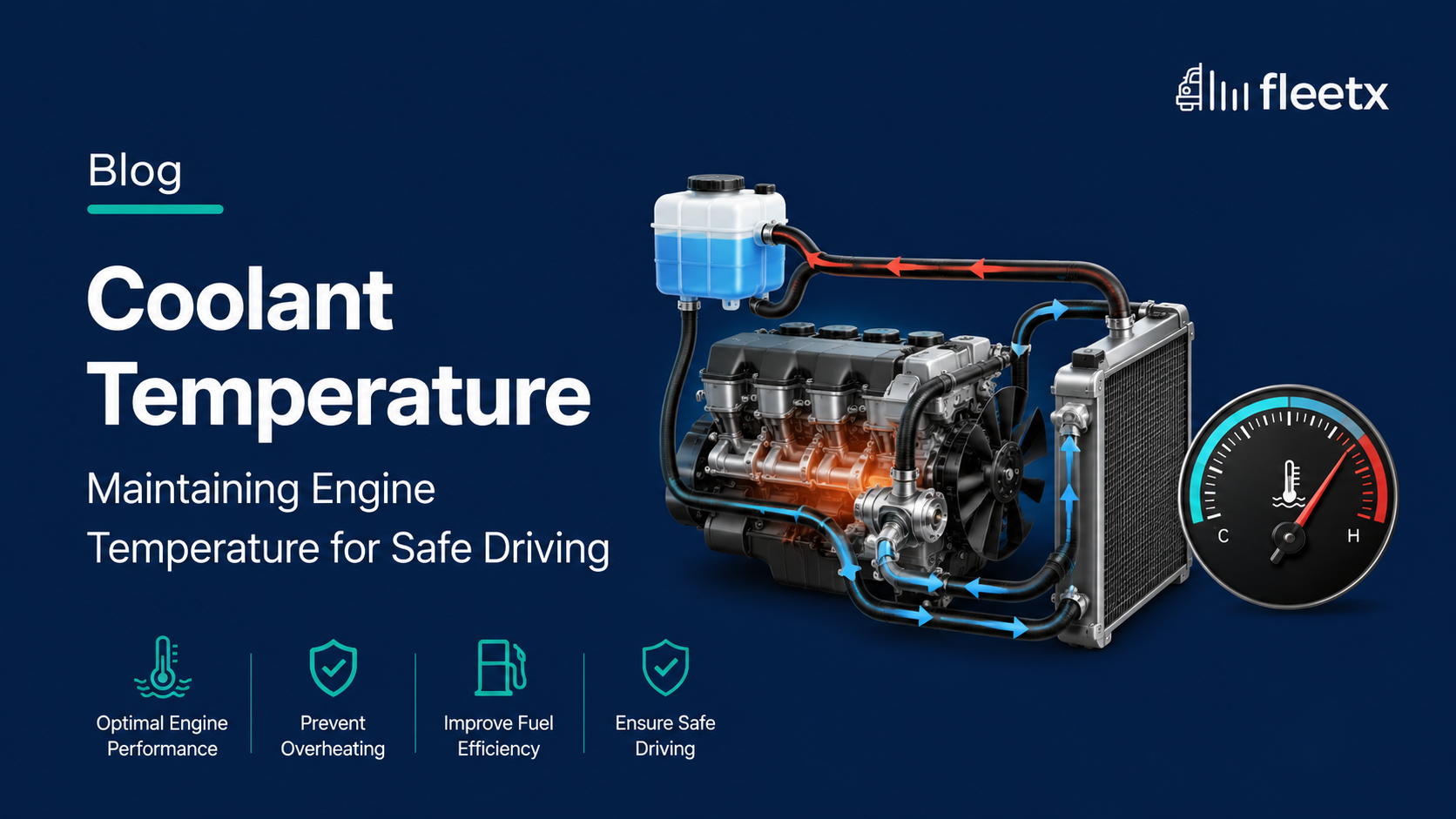
Engine coolant temperature is the measured heat level of the liquid circulating through your truck's cooling system. For safe operation, it must remain between 75°C and 105°C at all times. Temperatures outside this band — whether too low or dangerously high — directly damage engine components, reduce fuel efficiency, and, in a fleet context, cost operators thousands of rupees in avoidable repairs.
A vehicle driving down the highway at 55 miles or 90 km per hour creates over 5,000 controlled explosions inside the engine each minute. The spark plugs igniting the air and fuel mixture in all the cylinders is how a vehicle propels down the road. These explosions produce a high amount of heat and can easily destroy the vehicle's engine if not controlled. This is where the engine's cooling system comes into play — regulating these extreme temperatures and keeping your engine running efficiently for hundreds of thousands of kilometres.
Key facts about engine coolant temperature
- Normal operating range: 75°C to 105°C
- Thermostat activates coolant flow at: 80°C to 90°C
- Danger zone (overheating): above 105°C
- Fleet telematics alert threshold (Fleetx OBD): 103°C
- Coolant composition: water + antifreeze (ethylene glycol) + corrosion inhibitors + lubricants
- Recommended flush interval for Indian HCV fleets: every 40,000–60,000 km or 2 years
What is engine coolant temperature?
Modern cooling systems are much more efficient than older ones and can help your engine maintain a constant temperature, whether it is boiling hot or frigid cold outdoors. An engine cooling system uses an engine coolant, a water pump for circulation, multiple passages in the engine block and cylinder heads, a radiator for cooling, a thermostat that controls the temperature, a fan that pulls air through the radiator, a radiator cap for controlling pressure, as well as interconnecting hoses that transfer coolant.
In heavy commercial vehicles (HCVs) operating on Indian highways — particularly on high-heat routes through Rajasthan, Gujarat, and Maharashtra — the cooling system faces far greater stress than in passenger vehicles. Ambient temperatures regularly exceed 45°C in summer months, compressing the margin between ambient air temperature and the coolant's effective cooling range.
What is the purpose of coolant in a truck engine?
Engine coolant serves four distinct functions simultaneously:
Heat absorption: It absorbs combustion heat from the engine block and cylinder heads, preventing metal components from reaching destructive temperatures.
Freeze protection: The antifreeze component prevents the coolant from freezing at low temperatures, which matters on night routes through northern India during winter months (Jammu, Himachal, parts of Rajasthan).
Boiling point elevation: Coolant raises the boiling point of the liquid above 100°C — typically to around 120–130°C when pressurised — giving the system a buffer during extreme ambient heat or high-load climbs.
Corrosion and cavitation protection: Corrosion inhibitors in the coolant protect the aluminium and ferrous metals in the cooling circuit from electrochemical degradation, particularly in water pump impellers and radiator cores.
How does coolant regulate engine temperature?
The engine coolant is made with a mix of water, antifreeze, lubricants, and corrosion inhibitors, and primarily works as a convective heat transfer medium for internal combustion engines. While antifreeze and engine coolant are similar in nature, they are not the same thing. The main difference lies in the concentration: antifreeze is ethylene glycol-based and needs to be diluted with water before use in your engine. Once diluted, it is referred to as a coolant.
The cooling system circulates liquid coolant through the engine block and cylinder head passages, transferring heat from the engine components to the coolant. This hot coolant then moves via rubber hoses to the radiator, where it is cooled by airflow entering through the front grille. Once cooled, the fluid returns to the engine to absorb more heat. The water pump keeps this cycle running continuously while the engine is operating.
Normal vs dangerous coolant temperature: what the numbers mean for your truck
The average engine operating temperature lies between 75°C and 105°C. Here is what different readings indicate:
| Temperature range | What it means | Action required |
|---|---|---|
| Below 70°C | Engine still warming up | Normal — no action |
| 75°C – 105°C | Normal operating range | No action |
| 80°C – 90°C | Thermostat opens, coolant flows fully | Normal — system working |
| 105°C – 110°C | Elevated — monitor closely | Reduce load, check coolant level |
| Above 110°C | Overheating — risk of damage | Pull over safely, do not continue |
| Above 120°C | Severe overheating | Engine shutdown required immediately |
Fleet telematics systems such as Fleetx, which read ECU data directly via the OBD port without any external sensors, are configured to alert drivers and fleet managers when coolant temperature exceeds 103°C — two degrees below the danger threshold — giving operators time to act before damage occurs. Custom thresholds can also be set depending on engine type and operating conditions.
Coolant types: OAT, HOAT, and IAT — which is right for your truck?
Not all coolants are the same, and using the wrong type for your engine can accelerate corrosion and reduce protection life. There are three main technology families:
IAT (Inorganic Additive Technology): The traditional green coolant. Uses silicate and phosphate inhibitors. Effective but has a shorter service life of 2 years or 40,000 km. Widely used in older Indian truck engines and still the most commonly available coolant at highway dhabas and fuel stations.
OAT (Organic Acid Technology): Uses organic acid inhibitors (typically carboxylate-based). Longer service life — up to 5 years or 150,000 km. Does not use silicates, which makes it better for modern aluminium engine components. Popular choice for newer BS6-compliant truck engines.
HOAT (Hybrid OAT): Combines silicate for immediate protection with organic acids for long-term protection. A middle-ground solution. Used in many European and premium Indian truck OEM factory fills.
For Indian fleet operators, the practical guidance is to always use the coolant type specified by your vehicle manufacturer (Tata, Ashok Leyland, BharatBenz, Mahindra). Mixing coolant types — for example, topping up an OAT-filled system with IAT coolant — degrades both formulations and can cause sludge formation, blocking the radiator and water pump passages.
Common coolant brands used in Indian HCV fleets include Castrol Radicool, Shell Rotella ELC, and IPOL Coolant, each available in both pre-diluted and concentrated forms.
What happens when coolant temperature goes too high?
Engines today are built to be efficient, reliable, and durable, but when your vehicle's motor generates heat well above the normal operating temperature, the cooling system may begin to fail. This can cause progressive damage to engine components, eventually halting the vehicle entirely. The causes of overheating in trucks include:
- Leakage in the cooling system — causes pressure to drop and reduces the coolant's effective boiling point
- Radiator cap failure or a stuck thermostat — prevents proper pressure and flow regulation
- Water pump or drive belt failure — stops coolant circulation entirely
- Low coolant level — reduces heat absorption capacity
- Faulty head gasket — allows combustion gases into the coolant circuit, reducing cooling efficiency and causing white smoke from the exhaust
- Malfunctioning cooling fan or fan clutch — reduces airflow through the radiator, particularly dangerous in slow city traffic
- Debris or mud blocking the radiator grille — common on Indian construction site routes and unsealed roads
In Indian operating conditions, radiator blockage from dust and debris on unpaved last-mile routes is a leading field cause of overheating, particularly in tipper trucks and construction fleet vehicles.
What to do when your truck overheats on the road
If your temperature gauge climbs into the red zone or you receive a coolant alert from your fleet management system, follow these steps in order:
- Do not panic and do not switch off the engine immediately. Running the engine at idle allows the cooling system to keep circulating coolant. Switching off a severely overheated engine can cause thermal shock.
- Turn off the AC immediately. Air conditioning adds significant load to the engine.
- Turn the cabin heater to maximum. This sounds counterintuitive but the heater core acts as a secondary heat exchanger, drawing heat out of the coolant.
- Pull over safely and bring the vehicle to idle. Do not continue driving.
- Wait at least 15–20 minutes before opening the bonnet. A pressurised hot cooling system can cause severe burns if opened prematurely.
- Check the coolant reservoir level — not the radiator cap directly. If low, top up with the correct coolant type once the system has cooled.
- Check for visible leaks — look for coolant puddles under the truck, steam from the engine bay, or coolant smell.
- Call your fleet maintenance team or roadside assistance if the problem recurs or the cause is not visible.
Coolant maintenance schedule for fleet trucks in India
Coolant degradation is gradual and invisible to the naked eye, which is why it is routinely overlooked in fleet maintenance planning. The inhibitors that protect against corrosion are consumed over time — the coolant may still look clean but provide no protection.
Recommended service intervals for Indian HCV fleets:
- Coolant top-up check: Every service interval (every 10,000 km) or monthly
- Coolant condition test (pH and freeze point): Every 20,000 km
- Full coolant flush and replacement: Every 40,000–60,000 km for IAT coolant; every 80,000–1,00,000 km for OAT/HOAT coolant
- Radiator cap pressure test: Annually or at every major service
- Water pump inspection: Every 80,000 km or at timing belt/chain replacement
The cost of a coolant flush at an authorised service centre in India ranges from ₹1,500 to ₹4,500 depending on the vehicle class and coolant type. This compares favourably with the cost of engine damage from coolant failure — a head gasket replacement on an HCV costs ₹25,000 to ₹80,000, and a full engine overhaul following severe overheating can reach ₹80,000 to ₹2,50,000.
Fleet maintenance with coolant alerts
Fleet maintenance and management are a core part of logistics and transportation operations in India. With fleets running 24×7 on demanding routes, having a real-time coolant alarm is not a luxury — it is a risk management necessity. There are situations where a vehicle engine continues to run even after coolant temperature has climbed dangerously high, particularly if the driver is fatigued or distracted on a long-haul route. Fleet management software with live coolant monitoring enables fleet managers to receive coolant alerts and intervene remotely before a vehicle is damaged.
Modern fleet telematics platforms integrate directly with the engine's ECU, reading coolant temperature data in real time without requiring any external sensor hardware.
How Fleetx monitors coolant temperature for fleet operators
An engine that starts to overheat rapidly is likely to sustain damage at an equally rapid rate. Proper maintenance and monitoring of the cooling system is critical for vehicle lifespan and for ensuring uninterrupted fleet operations.
Fleetx directly measures engine metrics — including coolant temperature — by connecting to the vehicle's OBD port. This reads data directly from the Electronic Control Unit (ECU), eliminating the inaccuracies that external temperature sensors can introduce. The system is configured to alert fleet managers when coolant temperature exceeds 103°C, but custom alert thresholds can be set based on engine specifications or operating conditions.
Fleet operators using Fleetx receive instant notifications when a coolant event is detected, allowing them to:
- Contact the driver immediately to reduce speed and load
- Dispatch a service vehicle to the truck's GPS-tracked location
- Log the event in the vehicle's maintenance history for pattern analysis
- Identify repeat-offender vehicles that experience frequent thermal stress — a sign of underlying cooling system issues
By monitoring coolant temperature continuously across an entire fleet, Fleetx helps operators catch cooling system degradation before it becomes a breakdown, reducing unplanned downtime and keeping total cost of ownership under control.
What is coolant temperature in a vehicle engine?
Coolant temperature refers to the temperature of the engine coolant circulating through the engine and radiator. It helps regulate engine heat and keeps the engine operating within a safe temperature range for optimal performance and fuel efficiency.
What is the ideal engine coolant temperature?
The ideal engine operating temperature generally ranges between 75°C and 105°C. Most engines perform best around 90°C. Temperatures beyond this range can reduce fuel efficiency or lead to engine overheating and damage.
Why is maintaining coolant temperature important?
Maintaining proper coolant temperature helps:
- Prevent engine overheating
- Improve fuel efficiency
- Reduce engine wear
- Protect components like the head gasket and water pump
- Minimize vehicle breakdowns
Without proper cooling, the engine can fail faster than patience in Gurgaon traffic.
What happens if coolant temperature becomes too high?
Excessively high coolant temperature can:
- Damage the engine
- Warp cylinder heads
- Cause coolant leakage
- Reduce lubrication efficiency
- Lead to complete vehicle breakdown
If ignored, overheating can turn a maintenance issue into a full engine replacement bill.
What are the common causes of high coolant temperature?
Some major reasons include:
- Coolant leakage
- Faulty radiator cap or thermostat
- Malfunctioning water pump
- Low coolant levels
- Cooling fan failure
- Blocked radiator airflow
- Faulty head gasket
How does engine coolant help regulate temperature?
Engine coolant absorbs heat generated inside the engine and carries it to the radiator, where the heat is released. The cooled liquid then circulates back into the engine through the cooling system to repeat the process.
What is the difference between coolant and antifreeze?
Antifreeze is a concentrated liquid, usually ethylene glycol-based, that must be mixed with water before use. Once diluted, it becomes engine coolant. The coolant then helps regulate engine temperature and prevent freezing or overheating.
Can low coolant levels damage the engine?
Yes. Low coolant levels reduce the system’s ability to absorb and transfer heat, causing the engine to overheat. Prolonged driving with low coolant can severely damage engine components.
How can fleet operators monitor coolant temperature?
Fleet operators can use fleet maintenance software integrated with OBD diagnostics to monitor engine coolant temperature in real time and receive instant overheating alerts before major damage occurs.
How does Fleetx help prevent coolant-related breakdowns?
Fleetx connects directly to the vehicle’s ECU through the OBD port to monitor engine metrics and coolant temperature in real time. It sends alerts when temperatures exceed safe thresholds, helping fleet operators reduce downtime and prevent engine failures.