Every logistics operation in India reaches the same inflection point. The dashboards are live. GPS is pinging. The ERP shows shipments in motion. And yet the operations manager is on call number 47 of the day - chasing a driver near Nagpur, resolving a disputed ePOD from a Pune plant, manually reconciling a freight invoice that does not match the contracted rate.
This is the visibility paradox: organisations invest in transportation management software for visibility, achieve it, and then discover that visibility was never the bottleneck. The gap between information and action - dispatch decisions, freight audit calls, route replanning, dispute escalation - is where logistics cost and efficiency are actually determined.
Transportation management software has matured significantly since the first GPS-linked dispatch platforms of the early 2000s. The category has moved from tracking to planning, from planning to execution, and now - with the arrival of agentic AI - from execution to autonomous decision-making. For Indian enterprises managing road freight at scale, this shift is not incremental. It is structural.
This guide covers everything a logistics, supply chain, or operations leader needs to evaluate, select, and deploy the right transportation management software in 2025–26: what TMS actually does at the operational layer, how it compares to ERP, which features generate measurable ROI, and what the India-specific compliance and market context demands.
What Is Transportation Management Software?
Transportation management software - commonly abbreviated as TMS - is a logistics platform that plans, executes, and optimises the physical movement of goods. Unlike an ERP, which manages the full breadth of business operations (finance, procurement, HR, inventory), a TMS is purpose-built for the transportation layer: the decisions and workflows that govern how freight moves from origin to destination.
A modern, cloud-based TMS operates as the central nervous system for a fleet or logistics operation. It connects order data from upstream systems (ERP, WMS, e-commerce platforms), matches demand to available capacity, plans routes, dispatches vehicles, tracks movement in real time, validates delivery evidence, and settles freight invoices - all within a single unified platform.
Gartner defines a TMS as "software that supports multimodal sourcing, planning, and execution of the physical transport of goods across the supply chain." The practical translation for Indian road freight: a platform that replaces the coordination calls, the WhatsApp threads, the manual invoice comparisons, and the paper POD chases with automated, AI-driven workflows.
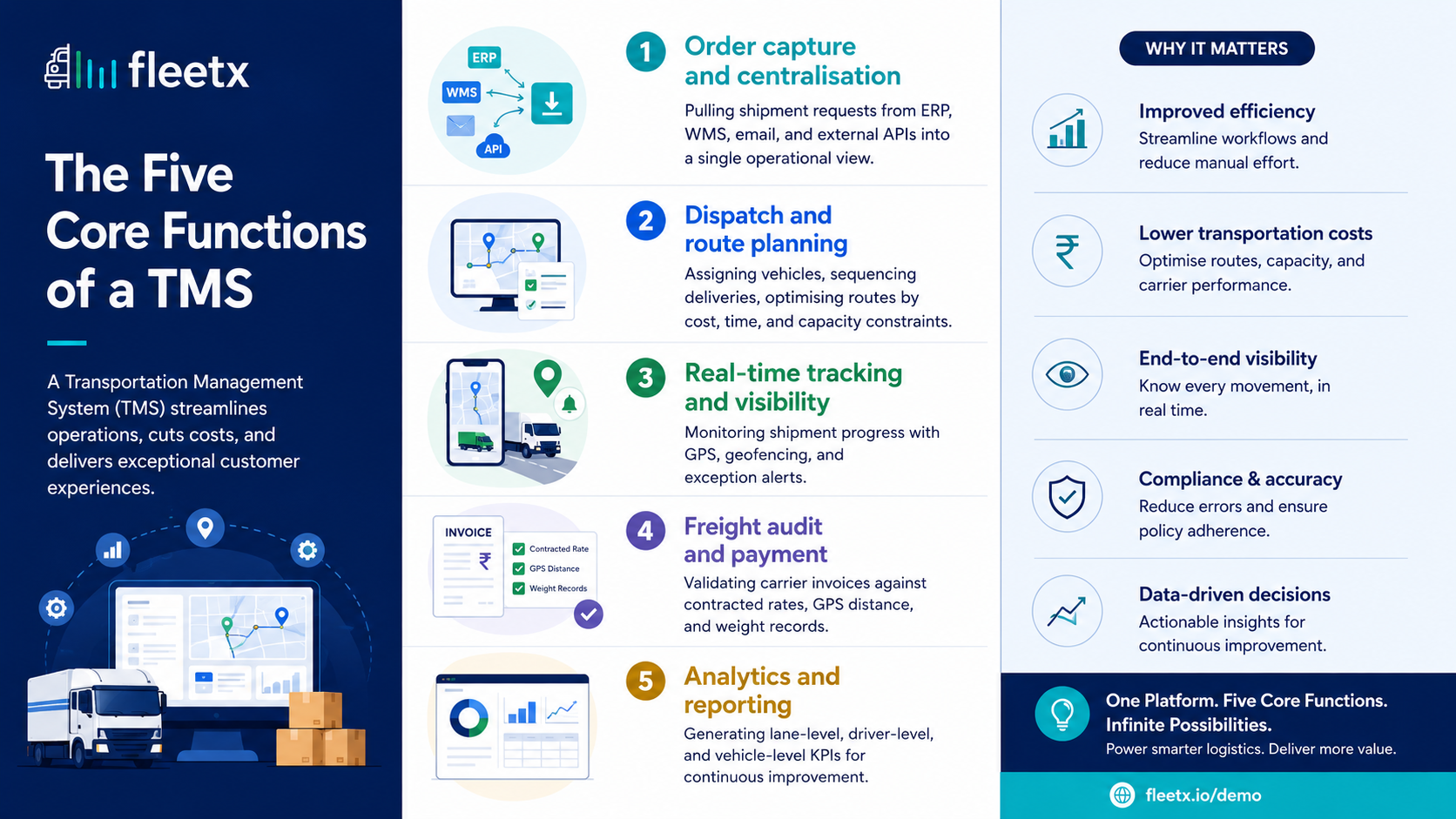
The Five Core Functions of a TMS
• Order capture and centralisation - pulling shipment requests from ERP, WMS, email, and external APIs into a single operational view
• Dispatch and route planning - assigning vehicles, sequencing deliveries, optimising routes by cost, time, and capacity constraints
• Real-time tracking and visibility - monitoring shipment progress with GPS, geofencing, and exception alerts
• Freight audit and payment - validating carrier invoices against contracted rates, GPS distance, and weight records
• Analytics and reporting - generating lane-level, driver-level, and vehicle-level KPIs for continuous improvement
The India Context: Why Standard TMS Thinking Does Not Apply
India is the most operationally complex road freight environment on earth. High vehicle density, multi-state regulatory variation, GST compliance requirements, poor last-mile infrastructure in tier-2 and tier-3 corridors, and a transporter ecosystem with deeply fragmented capacity - these are not edge cases. They are the baseline conditions under which every Indian logistics operation runs.
The AIS-140 mandate, enforced by the Ministry of Road Transport and Highways, changed the compliance floor permanently. Every commercial vehicle in India now legally requires a certified Vehicle Location and Tracking Device (VLTD) - real-time GPS, tamper detection, and integration with the VAHAN government database. Compliance is no longer a differentiator. It is the entry condition.
What this means for transportation management software selection in India is significant. A platform that is not AIS-140 compliant, does not support FASTag API integration, and cannot process GST-ready freight billing is not a TMS for India - it is a partial solution that will require manual workarounds at every regulatory touchpoint.
The second India-specific reality is scale volatility. Indian manufacturing and logistics operations - cement, steel, pharma, FMCG, auto ancillary - run extremely high trip volumes with seasonal and demand-driven variance. A cement manufacturer managing ₹4,000 Cr in logistics cost across 50,000 vehicles and 12 lakh annual trips cannot operate on a platform that requires manual intervention at every exception.
India's logistics complexity is not a problem to work around. It is the test that separates platforms with genuine operational depth from those built for simpler freight environments.
Global and India TMS Market: Key Data Points
|
Metric |
Figure |
Source /
Context |
|
Global TMS market size
(2025) |
~$28–30 Billion |
Combined fleet + TMS
platform estimates |
|
India road freight market |
~$330 Billion (2030
projected) |
Growing at ~8% CAGR |
|
Generative AI in transport
(2025) |
$1.2 Billion |
Growing to $2.83B by 2030 |
|
Fleet management market
(2025) |
$27 Billion |
Projected $122B by 2035 at
16.9% CAGR |
|
Cloud TMS adoption |
70% of fleet software now
cloud-based |
2026 market data |
|
AI fleet early adopter ROI |
200–500% annual ROI
reported |
Enterprise fleet
deployments 2025–26 |
|
India AIS-140 mandate |
All commercial vehicles —
VLTD required |
MoRTH; now compliance
floor, not differentiator |
|
Unplanned downtime
reduction (AI) |
30% fewer breakdowns |
Predictive maintenance
deployments |
Transportation Management Software vs ERP: Understanding the Difference
One of the most common points of confusion among procurement and IT teams evaluating logistics software is the relationship between a TMS and an ERP. The question - "do we need a separate TMS if we already have SAP or Oracle?" - comes up in almost every enterprise evaluation.
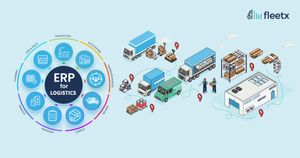
The short answer: they solve fundamentally different problems. An ERP manages the business. A TMS executes the movement. The two are not competing platforms - they are complementary layers. The most effective enterprise logistics operations use ERP for financial control and inventory management, and a dedicated TMS as the execution engine that the ERP feeds.
TMS vs ERP: Capability Comparison
|
Dimension |
Transportation
Management Software (TMS) |
ERP (SAP /
Oracle) |
|
Primary focus |
Movement of goods —
dispatch, routing, freight |
Entire business — finance,
HR, procurement, ops |
|
Core strength |
Real-time shipment
execution & carrier management |
Integrated financial
control & resource planning |
|
Route optimisation |
Native, AI-powered,
constraint-aware |
Limited or module-dependent |
|
Freight audit |
Automated — GPS + invoice +
contract validation |
Manual or partially
automated |
|
ePOD / dispute resolution |
Built-in AI evidence
analysis |
Not native; requires
integration |
|
India-specific compliance |
AIS-140, FASTag, GST-ready |
Requires localisation
customisation |
|
Implementation timeline |
4–12 weeks (cloud TMS) |
6–18+ months |
|
Best used for |
Logistics-first operations
managing 50–50,000 vehicles |
Large enterprises needing
unified business control |
|
Integration approach |
Connects to ERP via API as
execution layer |
TMS works as a module or
partner system |
The integration model matters here. A best-in-class TMS connects to SAP or Oracle via API, ingesting order data and pushing back confirmed dispatch, delivery, and invoice records. This eliminates the data re-entry problem - operations teams do not have to reconcile between systems manually. The TMS becomes the transportation execution layer within the broader enterprise architecture.
For logistics-first businesses - 3PLs, fleet operators, transporters, and logistics arms of manufacturing companies - a dedicated TMS consistently outperforms the transport module bundled inside an ERP. The feature depth, compliance coverage, and operational automation that a purpose-built platform provides cannot be replicated by a generalised ERP transport module.
Key Features of Transportation Management Software: What to Look for in 2025–26
Not all transportation management software platforms are built to the same depth. The gap between a basic GPS-plus-dispatch tool and a full agentic TMS is significant - in capability, in India compliance coverage, and in measurable operational ROI. The following feature breakdown separates the baseline from the genuinely capable.
TMS Feature Matrix: Capability vs Business Outcome
|
TMS Module |
What It
Does |
Business
Outcome |
|
Dispatch & Route
Planning |
AI-assigns trips by truck
availability, route efficiency, dealer windows |
15–25% fuel savings, fewer
empty miles |
|
3D Load Building |
Optimises space utilisation
and unloading sequence per vehicle |
Higher fill rates, lower
per-tonne freight cost |
|
Real-Time GPS Tracking |
AIS-140 compliant VLTD data
with tamper detection |
90%+ shipment visibility
across all lanes |
|
Freight Audit & Payment |
Validates invoice vs GPS
distance vs contracted rate automatically |
Eliminates overbilling;
recovers leaked freight cost |
|
ePOD & Dispute
Resolution |
AI analyses photos,
signatures, location at delivery point |
70% reduction in manual
investigation effort |
|
ERP / WMS Integration |
Connects via API to SAP,
Oracle, WMS, email, external systems |
Eliminates manual data
re-entry between systems |
|
Carrier Management |
Rate benchmarking, contract
management, performance scoring |
Better rate negotiation,
reliable carrier pool |
|
Analytics & Reporting |
KPIs per lane, driver,
vehicle type with SAP-ready output |
Data-driven decisions at
fleet scale |
1. AI-Powered Dispatch and Route Planning
Route optimisation in a modern TMS is not a static algorithm. It is a continuous, constraint-aware process that factors in vehicle availability, driver hours, dealer delivery windows, road conditions, fuel cost per lane, and load configuration - and updates in real time as conditions change.
The operational difference between rule-based dispatch and AI-powered dispatch is measurable. Rule-based systems execute predefined logic. AI-driven systems analyse multi-variable combinations simultaneously, identify the optimal assignment across the entire fleet, and flag exceptions before they become delays. For a fleet running hundreds of daily trips, this distinction directly impacts fuel spend, vehicle utilisation, and on-time delivery performance.
Advanced platforms add 3D load building to this layer - calculating how to maximise space utilisation per vehicle while sequencing loads for efficient unloading at delivery points. This alone reduces per-tonne freight cost and improves fill rates across high-volume routes.
2. Real-Time GPS Tracking and AIS-140 Compliance
For Indian fleets, real-time tracking is not optional infrastructure - it is a legal requirement. AIS-140 compliant VLTD devices provide continuous location data, tamper detection alerts, and government-integrated records via VAHAN. A TMS that sits on top of this data infrastructure can deliver 90%+ shipment tracking across all active trips.
The value beyond compliance is operational. Real-time tracking enables exception alerting (unplanned stops, route deviations, long idle times), automatic ETA updates to consignees, and the geo-stamped delivery records that make freight audit and dispute resolution possible downstream.
3. Freight Audit and Payment Automation
Freight audit is where the money is. Indian enterprises running large freight portfolios routinely deal with overbilling - carriers invoicing for distances not driven, weight not loaded, and charges not contracted. Manual audit processes catch a fraction of these discrepancies and take weeks to resolve.
An AI-powered freight audit module performs a three-way reconciliation on every invoice: contracted rate per lane vs GPS-actual distance vs loaded weight from ePOD records. Discrepancies above the defined threshold are auto-flagged, classified by fault type (carrier, customer, or system), and routed for resolution without manual intervention. The result is not just cost recovery - it is a permanent change in carrier behaviour, since systematic audit visibility removes the conditions that allow overbilling to persist.
4. ePOD and AI-Driven Dispute Resolution
Electronic Proof of Delivery has replaced paper POD as the settlement standard for enterprise logistics. But the real capability step is what happens when a delivery is disputed. A sophisticated ePOD system does not just store a photo and a signature - it analyses the evidence.
The AI ePOD agent in a platform like Fleetx detects delivery exceptions by analysing shipment photos, driver signatures, geo-stamps, and movement records simultaneously. It classifies fault, assigns accountability, and triggers automated follow-up workflows - WhatsApp to the driver at T+0, SMS to the supervisor at T+2 hours - without waiting for a human to initiate the escalation. This reduces dispute investigation effort by up to 70% and accelerates resolution from days to hours.
5. ERP and WMS Integration
A TMS that operates in isolation from the enterprise tech stack creates more coordination burden, not less. The integration architecture matters. Best-in-class platforms support live API connections to SAP, Oracle, and major WMS providers - capturing orders automatically, pushing back dispatch confirmations and ePOD records, and enabling freight invoice data to flow directly into accounts payable without manual bridging.
How Transportation Management Software Reduces Freight Costs
The ROI case for transportation management software is well-evidenced at this point, across markets and fleet sizes. But the mechanism of cost reduction matters - because the levers are different, and not every platform activates all of them.
TMS ROI: Improvement Ranges by Benefit Area
|
Benefit
Area |
Improvement
Range |
Visual
Scale |
|
Fuel cost reduction |
10–25% |
████████░░░░░░░░░░░░ |
|
Route optimization |
10–20% |
███████░░░░░░░░░░░░░ |
|
Manual admin reduction |
30–40% |
████████████░░░░░░░░ |
|
On-time delivery
improvement |
15–25% |
████████░░░░░░░░░░░░ |
|
Fleet utilization increase |
20–30% |
██████████░░░░░░░░░░ |
|
Freight audit accuracy |
95–99% |
████████████████████ |
|
Invoicing cycle (faster) |
3 weeks |
████████████░░░░░░░░ |
|
Dispute resolution |
3–5x faster |
████████████████░░░░ |
The Five Cost Levers
Fuel and routing efficiency: Route optimisation reduces total kilometres driven per trip. Fewer empty return miles, better multi-stop sequencing, and real-time rerouting around congestion add up to 10–25% fuel savings across a fleet. For an operation spending ₹500 Cr annually on fuel, that is ₹50–125 Cr in direct savings.
Freight overbilling recovery: Automated freight audit recovers cost that is currently lost silently. Every invoice paid without validation is a potential overpayment. AI audit at scale - across thousands of invoices monthly - converts a passive cost into an active recovery mechanism.
Fleet utilisation improvement: Better load planning and dispatch reduces idle vehicle time, improves fill rates, and eliminates the trips that never needed to happen. A 20–30% improvement in fleet utilisation is the equivalent of expanding capacity without adding vehicles.
Administrative overhead reduction: Manual coordination - the 60 daily calls, the WhatsApp thread chasing, the manual invoice check - is a real cost carried as headcount. Automating dispatch, tracking, and audit workflows reduces this burden by 30–40%, freeing operations staff for genuinely strategic work.
Faster invoicing and cash flow: Delayed freight invoicing is a working capital problem. ePOD-driven settlement, automated freight audit, and direct ERP integration compress the billing cycle from weeks to days - improving cash flow without changing payment terms.
Measurable Impact Across Industries: Fleetx in Production
Proof of concept has limited value at fleet scale. What matters is documented, auditable impact across real operations with real freight volumes. The following results are drawn from Fleetx TMS deployments across cement, enterprise logistics, and pharmaceutical supply chains in India.
|
Industry |
Scale |
Key Outcome |
Impact
Metric |
|
Cement |
50K vehicles · 12L trips ·
₹4,000 Cr logistics cost |
Freight cost recovered via
AI audit |
₹50 Cr+ recovered |
|
Cement |
Same fleet |
Shipments tracked
end-to-end |
90% tracking rate |
|
Cement |
Same fleet |
Order-to-dispatch cycle
time |
15% reduction |
|
Enterprise Logistics |
5,000+ vehicles · ₹700 Cr
freight invoices |
Invoicing cycle |
3 weeks faster |
|
Enterprise Logistics |
360K ePODs processed |
Dispatch efficiency |
15% improvement |
|
Enterprise Logistics |
Multi-plant operations |
Freight cost reduction |
4% savings |
|
Pharma |
Multi-validated supply
chains |
Logistics cost reduction |
12–15.7% |
|
Pharma |
Active pharma supply chains |
Operational efficiency |
20% improvement |
|
Pharma |
Continuous route monitoring |
Theft detected &
prevented |
₹77 Lakh |
Cement: Freight Audit at ₹4,000 Cr Scale
Managing 50,000 vehicles across 12 lakh annual trips with ₹4,000 Cr in total logistics cost is not a scale that tolerates manual processes. For one of India's largest cement manufacturers, the primary value of Fleetx TMS was not visibility - the fleet already had GPS. The value was in what happened to the data after it arrived.
AI freight audit, running against every invoice from every carrier on every lane, recovered ₹50 Cr in freight cost in a single year. Order-to-dispatch cycle time dropped by 15%. Shipment tracking improved to 90% across all active trips - not as a dashboard metric, but as an operational input to proactive exception management.
Enterprise Logistics: Invoicing and Dispatch at ₹700 Cr
For a large enterprise managing 5,000 vehicles and processing ₹700 Cr in annual freight invoices, the operational bottleneck was the billing cycle. Manual ePOD collection, invoice reconciliation, and approval workflows meant invoices took three weeks longer than the freight had actually moved.
Fleetx TMS, integrated with the enterprise SAP environment, automated ePOD collection across 360,000 deliveries, reconciled freight invoices against GPS and weight records automatically, and reduced the invoicing cycle by three weeks. Dispatch efficiency improved by 15%. Freight cost reduced by 4% - a direct financial return on a ₹700 Cr cost base.
Pharma: Supply Chain Integrity and Theft Prevention
Pharmaceutical logistics carries additional requirements beyond standard road freight. Temperature sensitivity, regulatory traceability, and high cargo value make supply chain integrity - not just efficiency - the primary TMS brief.
Across leading pharma companies in India, Fleetx TMS delivered 12–15.7% logistics cost reduction and 20% improvement in operational efficiency. Beyond cost, the platform's real-time monitoring and anomaly detection flagged and prevented ₹77 lakh in cargo theft - a number that does not appear in standard ROI calculations but is deeply meaningful for risk-sensitive supply chains.
Cloud-Based vs On-Premise Transportation Management Software
The on-premise vs cloud decision for TMS has largely been resolved in favour of cloud, particularly for Indian logistics operations. The operational advantages of a cloud-based TMS are material: faster deployment (4-8 weeks vs 6-18 months), automatic updates, mobile accessibility for drivers and supervisors in the field, and per-vehicle pricing models that scale with the fleet rather than requiring large upfront licence investments.
The residual case for on-premise deployment is data sovereignty - some large enterprises with sensitive freight data prefer to keep transportation records within their own infrastructure. But with cloud TMS providers offering dedicated instances and enterprise-grade data security, this concern is increasingly manageable without sacrificing the deployment speed and feature agility that cloud platforms deliver.
For most Indian logistics operations - from mid-market transporters to enterprise manufacturers - cloud-based transportation management software is the correct default. The question is not cloud vs on-premise, but which cloud TMS has the right depth of India-specific compliance, integration, and operational AI.
Transportation Management Software for Different Fleet Segments
TMS platforms are not one-size-fits-all. The right choice depends on fleet size, operational complexity, industry vertical, and whether transportation is the core business or a supporting function. The following segment breakdown helps frame the evaluation.
|
Fleet
Segment |
Primary TMS
Need |
Key
Features Required |
Typical
Scale |
|
Small business / SME fleet
(50–500 vehicles) |
Basic dispatch automation,
GPS tracking, digital invoicing |
Route planning, ePOD, GST
billing, mobile app |
Up to 500 vehicles,
regional operations |
|
Mid-market fleet operator
(500–5,000 vehicles) |
Freight cost control,
carrier management, ERP integration |
Freight audit, carrier
performance, multi-depot dispatch |
Multi-state, 500–5,000
vehicles |
|
Enterprise manufacturer
(5,000+ vehicles) |
Autonomous dispatch, AI
audit, SAP integration, multi-plant |
Agentic TMS, 3D load
building, EPOD at scale, advanced analytics |
50,000+ vehicles, national
freight |
|
3PL / logistics service
provider |
Multi-client ops,
white-label visibility, margin analytics |
Multi-tenant architecture,
customer portal, flexible billing |
Mixed fleet sizes,
client-specific SLAs |
|
Pharma / regulated freight |
Supply chain integrity,
temperature monitoring, traceability |
Anomaly detection,
chain-of-custody records, theft prevention |
Mid to large scale,
high-value cargo |
The Agentic TMS: What AI-Native Transportation Management Looks Like
The phrase AI-powered has been applied to almost every logistics software category in the past three years. It is worth being precise about what it means in the context of transportation management software - because the difference between a platform with an AI-labelled feature and a genuinely agentic TMS is the difference between assisted decision-making and autonomous operations.
A rules-based TMS automates predefined workflows. An agentic TMS makes decisions. It does not wait for a human to identify a problem, assign a task, or initiate a resolution. When a trip is marked delivered without an ePOD, the AI agent detects it, classifies the exception, assigns accountability, and triggers the follow-up sequence - without a coordinator in the loop.
The Fleetx agentic lifecycle runs through six operational phases: data centralisation (order capture, resource mapping, data standardisation), intelligent planning (route and dispatch optimisation), exception review (AI-flagged anomalies for human decision only where needed), autonomous dispatch, proof and settlement (ePOD and freight audit), and performance insight generation. Human attention is reserved for genuine exceptions - not routine coordination.
This architecture is what allows a single logistics coordinator to manage operations at a scale that previously required a team. The TMS handles the high-frequency, high-volume decisions. The human handles the genuinely complex judgement calls. The ratio shifts - and so does the headcount requirement.
The logistics coordinator role as it exists today - managing routine dispatch, chasing PODs, reconciling invoices manually - is being restructured by agentic TMS. Organisations that adopt this architecture early gain a durable cost and speed advantage.
How to Choose Transportation Management Software: An Evaluation Framework
Selecting a TMS is a multi-year operational commitment. The vendor evaluation process should go well beyond feature lists and pricing models to assess platform depth, India compliance readiness, integration architecture, and the actual operational model of the implementation team.
TMS Buyer's Checklist: Evaluation Criteria and Red Flags
|
Evaluation
Criterion |
What to
Look For |
Red Flag |
|
India compliance |
AIS-140, FASTag API,
GST-ready billing |
No mention of VAHAN / VLTD
integration |
|
AI vs rules-based
automation |
Agentic dispatch and
exception handling |
Rule-based workflows only |
|
ERP integration depth |
Live API sync with SAP /
Oracle / WMS |
CSV import/export only |
|
Freight audit accuracy |
GPS + invoice + weight
three-way reconciliation |
Manual audit or
invoice-only check |
|
ePOD capabilities |
Photo + signature +
geo-stamp at delivery |
Scanned paper POD upload |
|
Implementation speed |
Cloud TMS live in 4–8 weeks |
6+ months for basic go-live |
|
Scalability |
Handles 50 to 50,000
vehicles on same platform |
Per-vehicle pricing that
makes scaling unviable |
|
Support model |
Dedicated customer success
+ 24/7 ops support |
Ticket-only support with
48hr SLA |
The Evaluation Process
Step 1: Internal audit - Map your current operational pain - where are the calls happening, where is cost leaking, what is the manual intervention rate per 100 trips. This becomes the benchmark for ROI calculation.
Step 2: Compliance verification - For India: confirm AIS-140 certification, VAHAN integration, FASTag API support, and GST-ready billing before shortlisting any platform.
Step 3: Integration assessment - Map your existing tech stack - ERP, WMS, accounting platform. Request a live demo of the API integration, not a slide deck about it.
Step 4: Reference verification at comparable scale - Ask for customer references operating at your fleet size and in your industry vertical. A platform that works well for a 200-vehicle 3PL may not handle the exception volume of a 10,000-vehicle manufacturer.
Step 5: Pilot scope definition - Define a 6 to 8 week pilot on a single lane or depot before full rollout. The pilot should test dispatch automation, freight audit accuracy, and ERP integration under real conditions - not in a demo environment.
Transportation Management Software and the Future of Indian Logistics
The Indian logistics sector is at a structural inflection point. E-way bill mandates, GST normalisation across states, AIS-140 enforcement, and the continued formalisation of the transporter ecosystem are converging to raise the compliance and data floor for every commercial fleet operator. Simultaneously, enterprise shippers - cement, steel, pharma, auto - are under sustained pressure to reduce logistics as a percentage of total cost, after years in which it remained stubbornly high.
Agentic transportation management software is the response to both pressures. It converts compliance data (AIS-140 location feeds, FASTag toll records, VAHAN registration data) into operational intelligence. It removes the coordination overhead that adds cost without adding value. And it creates the audit trail that enterprise finance teams and regulators increasingly require.
The global freight management market is growing from $27 billion in 2025 toward $122 billion by 2035. Cloud TMS now holds 70% of the fleet software market. Generative AI in transportation is projected to reach $2.83 billion by 2030, up from $1.2 billion in 2025. The capital flowing into this category reflects a clear market verdict: autonomous logistics is not a future state. It is the current direction of competition.
For Indian enterprises, the practical implication is straightforward. Every freight rupee managed on a manual or legacy platform is a rupee that a competitor with an agentic TMS is managing at lower cost, higher accuracy, and faster settlement. The infrastructure investment required to change this is lower than it has ever been - cloud deployment, AIS-140 compliance via certified hardware, and API-first integration architectures have removed the barriers that made TMS adoption a multi-year enterprise programme.
The question is not whether transportation management software is the right investment. The question is how much operational cost and competitive ground is being absorbed by the delay in making it.
The Shift is Real: From a Tracking Layer to a Decision-Making Engine
The platforms that delivered value five years ago by showing where trucks were now deliver value by deciding where they should go, verifying that they arrived, auditing the invoice, and resolving the dispute - without human initiation at any step.
For Indian logistics operations, the compliance environment (AIS-140, GST, FASTag) creates a data-rich foundation that agentic TMS platforms are built to use. The raw material for autonomous freight management - real-time location, weigh bridge records, ePOD evidence, contracted rate data - is already being generated. The platform is what converts that data into saved cost, faster settlement, and lower coordination overhead.
The logistics operations that will define the competitive standard in Indian freight over the next five years are not the ones with the most vehicles or the largest route networks. They are the ones where the distance between data and decision has been reduced to near zero - because a transportation management system is making the call.