
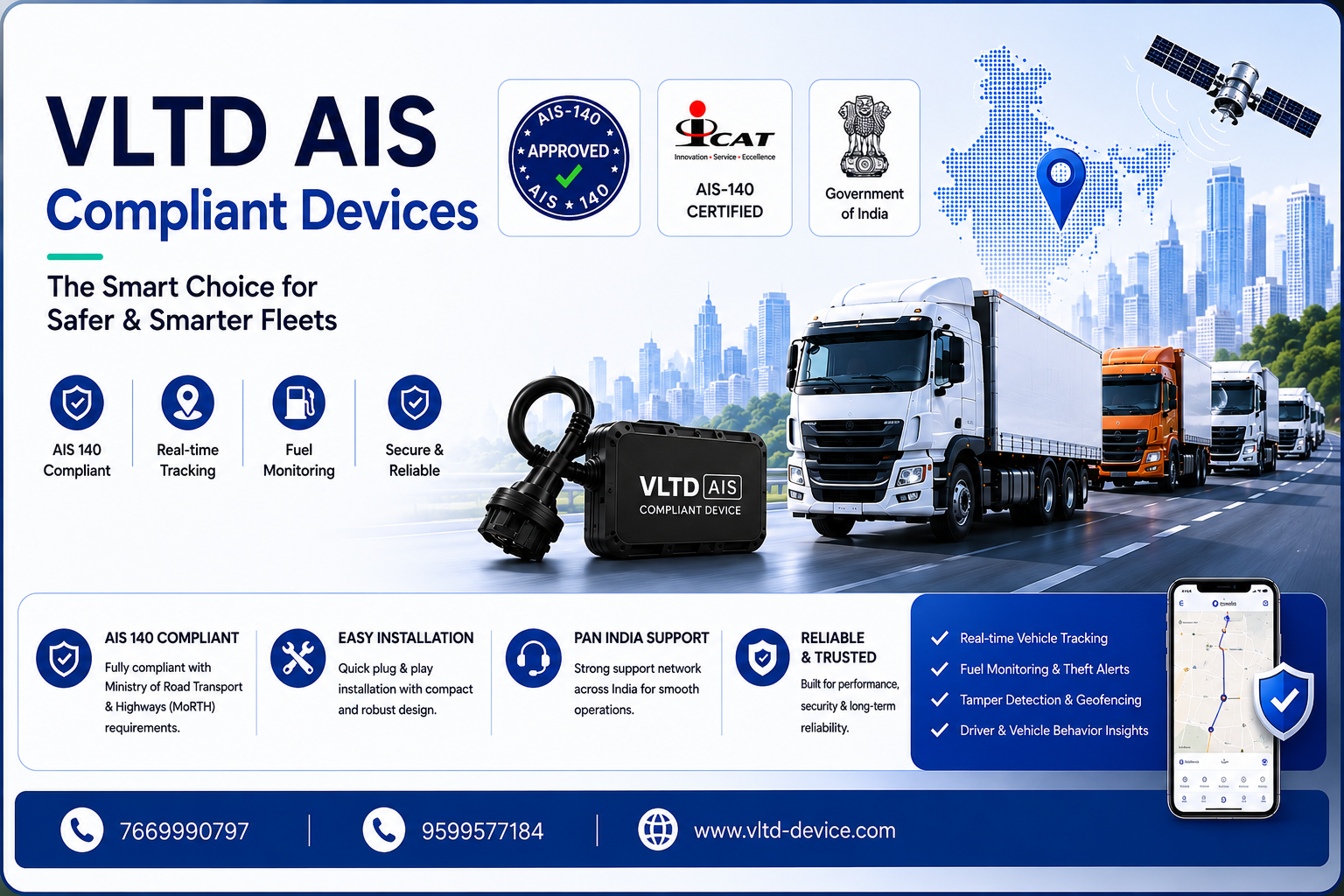
India's commercial transport sector operates at a scale that is difficult to overstate- over 300 million registered vehicles, millions of trucks moving freight across state borders every night, school buses carrying children across every city, and taxi aggregators coordinating rides for tens of millions of passengers. For decades, keeping a verified, real-time eye on all of this movement was simply not possible.
The Vehicle Location Tracking Device- VLTD- is the hardware answer to that challenge. Mandated under AIS-140, India's national GPS tracking standard notified by the Ministry of Road Transport and Highways (MoRTH), a VLTD is not just a GPS unit. It is a certified, tamper-resistant, government-integrated tracking system that every commercial vehicle in India is legally required to carry.
Whether you are searching for the VLTD full form, trying to understand what separates an AIS-140 VLTD from a standard GPS tracker, or looking for the VLTD login and portal process, this guide covers every dimension of VLTD and AIS-140 compliance that fleet operators, transport managers, and logistics businesses need to understand in 2026.
1. What Is a VLTD?
A Vehicle Location Tracking Device (VLTD) is the official Indian regulatory term for a GPS tracking unit that meets the technical specifications defined under AIS-140. The term appears in MoRTH notifications, the Vahan portal, RTO records, and state transport compliance systems. When transport officials, RTOs, or fleet management platforms refer to a 'VLTD,' they mean specifically an AIS-140 certified device- not just any GPS tracker fitted to a vehicle.
Every VLTD combines several hardware systems into a single certified unit:
- A GNSS module that receives signals from both GPS and India's NavIC satellite constellation
- A cellular modem supporting 4G LTE with fallback to 3G and 2G for data transmission
- A dedicated M2M SIM slot provisioned specifically for vehicle tracking
- A hard-wired Panic/SOS button for emergency alerts
- A tamper detection circuit that alerts authorities when the device is physically interfered with
- Non-volatile memory for local data storage during connectivity outages
- An accelerometer for harsh driving event detection
The combination of these components, all tested and certified by ARAI (Automotive Research Association of India), is what distinguishes a VLTD from an ordinary GPS device. Without this certification, a tracker installed on a commercial vehicle does not constitute legal compliance, regardless of how sophisticated its features are.
2. VLTD vs. Normal GPS Tracker: What AIS-140 Actually Demands
The most common misconception in the Indian fleet market is that any GPS tracker can serve as a VLTD. This is incorrect. The table below captures the critical differences:
The key takeaway is structural: a standard GPS tracker is a private operational tool. A VLTD is a certified component of India's national transport safety infrastructure. Fitting a standard GPS tracker and calling it an AIS-140 VLTD is a compliance failure that RTOs can now verify in real time through Vahan.
3. VLTD Full Form and Regulatory Background
The VLTD full form is Vehicle Location Tracking Device. The term was introduced through MoRTH Notification GSR 979(E) dated 28 September 2018, which notified AIS-140 as the mandatory standard for VLTDs in commercial vehicles under the Motor Vehicles Act, 1988.
AIS-140 itself — the Automotive Industry Standard 140 — was developed by the Automotive Research Association of India (ARAI) and represents the technical specification that a VLTD must meet to be legally installed in a commercial vehicle. The standard defines everything from the hardware specifications and data packet format to the backend server requirements and Vahan integration procedures.
The regulatory chain: MoRTH issues the mandate under the Motor Vehicles Act → ARAI defines the technical standard (AIS-140) → ARAI certifies devices and backends → RTOs enforce compliance through Vahan → enforcement officers verify compliance at checkposts.
AIS-140 has been amended since its original notification. AIS-140A introduced updated GNSS requirements with enhanced NavIC constellation support, revised data packet specifications, updated communication protocol requirements, additional emergency response integration requirements, and updated environmental and electromagnetic compliance testing. Fleet operators should confirm with ARAI which version is currently in force for new installations.
4. Who Needs a VLTD?
The mandate covers all vehicles classified as transport vehicles under the Motor Vehicles Act:
Private, non-commercial vehicles are exempt. AIS-140 VLTD compliance is not required for a car registered for personal, non-transport use. However, the moment a privately owned vehicle operates under a transport permit — as a taxi, cab, or delivery vehicle — the AIS-140 mandate fully applies.
Special Category: School Buses
School buses carry the most vulnerable passengers and attract the strictest compliance rules. Beyond the standard VLTD requirements, school bus operators must ensure the panic button is accessible to both the driver and the bus attendant, real-time tracking data is available to school management and parents, and data feeds into the state NVLT portal. States including Delhi, Maharashtra, Karnataka, and Tamil Nadu have additional school bus tracking mandates layered on top of the central AIS-140 requirements.
Special Category: Taxi Aggregators
Aggregators operating more than 1,000 vehicles may also be required to maintain their own AIS-140 compliant backend server and integrate it directly with the government portal. This backend obligation is separate from the VLTD hardware mandate and requires its own certification process.
5. VLTD Technical Requirements Under AIS-140
GNSS and Positioning
Every AIS-140 VLTD must support a dual-constellation GNSS module combining GPS and NavIC (India's Regional Navigation Satellite System developed by ISRO). Minimum position accuracy is 5 metres CEP (Circular Error Probable). Cold start acquisition must happen within 60 seconds; hot start within 5 seconds.
Communication and Network
Primary communication is 4G LTE with mandatory fallback to 3G and 2G. The device must support both TCP/IP and UDP protocols as defined in the AIS-140 data protocol documentation. Data is transmitted on defined ports to government-approved backend servers.
Panic Button Requirements
- Must be physical and hard-wired into the vehicle — app-based panic buttons do not qualify
- Must generate an emergency event packet transmitted immediately, outside the regular 30-second cycle
- Must be clearly labelled and accessible to both driver and passengers
- For school buses, a secondary button must be accessible to the attendant
Data Transmission Frequency
- While moving: location and telemetry data every 30 seconds
- Emergency events: immediate transmission, outside the regular schedule
- While stationary: reduced frequency, typically every 5 minutes
- During connectivity loss: data buffered in non-volatile memory and retransmitted once connectivity is restored
Data Storage and Battery Backup
Every VLTD must store a minimum of 6 hours of data locally in non-volatile memory (not RAM). A battery backup must maintain device operation and tamper alert transmission even when the vehicle's primary power supply is disconnected — a direct countermeasure against operators who attempt to defeat tracking by cutting power.
Tamper Detection
Tamper detection is mandatory. The VLTD must detect and report power supply disconnection, opening of the device casing, and SIM card removal. Each event generates an immediate tamper alert packet to the backend and state NVLT portal.
AIS-140 Data Packet Format
All VLTDs must transmit data in the standardised packet format specified by ARAI. This standardisation makes government interoperability possible: any certified backend can parse data from any ARAI-certified device, regardless of manufacturer. The packet includes:
- Packet type identifier and firmware version
- UTC timestamp and GPS fix validity flag
- Latitude and longitude (WGS-84), altitude, speed, heading
- Number of visible satellites
- Emergency/panic status flag and tamper alert flag
- Vehicle registration number and device IMEI
- Network operator details
Backend / Server Compliance
The backend server receiving VLTD data must also be certified. Requirements include India-hosted infrastructure, 99.5% or higher uptime SLA, TLS encryption for data in transit, AIS-140 packet parsing and forwarding to the national NVLT server, role-based access control, data log retention for the prescribed period, and integration with the Vahan portal.
SIM Requirements
The SIM in a VLTD must be an M2M SIM provisioned specifically for vehicle tracking by a licensed telecom operator (Airtel, Jio, BSNL, or Vi). Standard consumer SIMs are not compliant. In most states the SIM must be permanently linked to the vehicle's registration in Vahan. Removing or hot-swapping the SIM triggers a mandatory tamper alert.
6. VLTD Device Certification: The ARAI and Type Approval Process
Only devices that have completed the certification process and received Type Approval from ARAI can be legally installed as VLTDs in commercial vehicles. Here is how the process works:
Step 1: Application and Documentation
The VLTD manufacturer submits an application to ARAI in Pune along with complete technical documentation covering hardware specifications, firmware details, backend architecture, and test protocols.
Step 2: Prototype Submission
Three to five prototype units are submitted for physical testing at ARAI's certified laboratories.
Step 3: Hardware and Backend Testing
The device undergoes comprehensive testing covering GNSS accuracy, communication protocols, panic button functionality, data packet format compliance, tamper detection, environmental tests for vibration, temperature, and humidity, and electromagnetic compatibility (EMC). Simultaneously, the manufacturer's backend server is tested and certified.
Step 4: Type Approval and Listing
On successful completion, ARAI issues a Test Completion Certificate and then a formal Type Approval. The device is added to the official approved VLTD list maintained by MoRTH and ARAI. The process typically takes three to six months.
Conformity of Production (CoP)
Manufacturers must maintain Conformity of Production — an ongoing requirement ensuring every unit shipped matches the approved prototype. Periodic CoP audits are conducted by ARAI. Any design, component, or firmware change beyond defined limits requires fresh testing and re-approval.
7. VLTD Installation and Vahan Integration
Installation Requirements
- The device must be connected to the vehicle's power supply in a tamper-evident manner
- The GNSS antenna must have a clear sky view — typically mounted on the dashboard or roof
- The panic button must be installed in an accessible location on the dashboard, with a secondary button in the passenger cabin for relevant vehicle types
- The device must be permanently affixed, not clip-on or removable
- Post-installation, a functional test must verify GPS lock, data transmission, and panic button operation
Vahan Integration
After installation, the VLTD must be linked to the vehicle's record on the Vahan portal (vahan.parivahan.gov.in). This involves registering the device IMEI against the vehicle registration number, linking the M2M SIM number to the vehicle's Vahan profile, and identifying the certified backend server through which the vehicle's data is being transmitted.
Fitness certificate and permit issuance processes in Vahan now check for this VLTD linkage before approval. Transport authorities and enforcement officers can verify compliance directly from Vahan in real time using just a vehicle registration number.
8. VLTD Login, Portal Access, and the NVLT System
Vahan Portal
The primary portal for vehicle-level VLTD compliance verification is vahan.parivahan.gov.in. This is where fleet operators link VLTD IMEI numbers to vehicle registration records, RTOs verify VLTD fitment during fitness certificate and permit renewal, and enforcement officers check compliance at checkposts.
VLTD Maker Portal
The VLTD maker portal is a government interface used by VLTD manufacturers to register their certified devices and manage device-to-vehicle linkage in the national database. Fleet operators typically do not log in here directly — this is a manufacturer and authorised dealer interface.
State NVLT Portals
Each state maintains its own NVLT portal through which state transport authorities monitor real-time fleet data from all VLTDs operating within the state. Access is role-based: transport department officers, RTO officials, and school/corporate transport administrators have different access levels. Fleet management platforms must obtain API credentials from the relevant state NVLT portal to integrate AIS-140 data into their software.
9. VLTD Fitment Certificate: What It Is and How to Get It
A VLTD Fitment Certificate confirms that a compliant, ARAI-certified VLTD has been correctly installed in a vehicle by an authorised technician and that the device is functional and linked to the Vahan system. It is not a one-time document — the VLTD must remain functional and certified throughout the vehicle's active transport permit.
How to Get Your VLTD Fitment Certificate
- Purchase an ARAI-certified VLTD from an approved manufacturer (verify on arai.in)
- Have the device installed by an authorised technician who provides an installation certificate
- Ensure the M2M SIM is activated and provisioned for vehicle tracking
- Link the device IMEI and SIM number to the vehicle's record on the Vahan portal
- Verify that the backend is receiving and transmitting data to the state NVLT portal
- The RTO issues or validates the fitment record in Vahan, which serves as the official fitment verification for fitness certificate and permit processes
10. VLTD Maker: What the Term Means and Why It Matters
"VLTD maker" is one of the highest-volume search terms in this category (4,400 monthly searches). The term has two distinct meanings:
Meaning 1: VLTD Manufacturer
In the regulatory ecosystem, a 'VLTD maker' is a manufacturer that has obtained ARAI Type Approval for its Vehicle Location Tracking Device. Only VLTD makers on the official ARAI-approved list can legally supply devices for commercial vehicle compliance. The current list is maintained at www.arai.in and on the MoRTH Vahan portal.
The Indian VLTD manufacturer market includes:
- Indian automotive electronics companies with dedicated ARAI-certified product lines
- Global GPS and telematics companies offering India-specific AIS-140 certified variants
- Telecom operators offering bundled VLTD + M2M SIM + backend solutions
- Fleet technology startups with ARAI-approved devices built for the Indian market
Meaning 2: VLTD Maker Portal (Government Interface)
The VLTD Maker Portal is the government e-services interface used by approved manufacturers to manage device registrations, update the national VLTD database when devices are installed in vehicles, and link IMEIs to vehicle registration numbers in Vahan.
Vahan VLTD Maker: When this term appears, it typically refers to the process of a certified manufacturer logging into the Vahan-integrated VLTD maker portal to complete the device-to-vehicle registration linkage. Fleet operators should request confirmation from their VLTD supplier that this step has been completed — without it, the vehicle will not show as VLTD-compliant in Vahan, regardless of whether the hardware is installed.
11. AIS-140 VLTD Compliance Cost in India
For large fleets of 100 or more vehicles, volume discounts can substantially reduce per-unit costs. For small operators with one to five vehicles, a bundled solution covering hardware, SIM, and backend from a single provider simplifies procurement and compliance responsibility.
12. Penalties for AIS-140 Non-Compliance
Enforcement of AIS-140 VLTD compliance has intensified significantly through 2025 and 2026. Consequences of operating a commercial vehicle without a functional, registered VLTD include:
- Refusal of fitness certificate renewal- RTOs now check Vahan for VLTD linkage before issuing FC
- Transport permit suspension or cancellation- both new issuance and renewals are affected
- Fines ranging from ₹5,000 to ₹20,000 or more depending on the state and the nature of the violation
- On-the-spot vehicle detention at highway checkposts and enforcement drives
- Show-cause notices for taxi aggregators and potential platform-level restrictions
- School bus permit suspension and potential action against the school by education authorities
The practical risk has increased because enforcement officers no longer need to physically inspect a VLTD. Vahan now surfaces VLTD compliance status in real time, and AIS-140 data is being integrated with ANPR systems at toll booths in several states, enabling automated, continuous compliance checks.
13. VLTD in 2026: NavIC, EVs, and What Changes Next
Enhanced NavIC Integration
ISRO's expanded NavIC constellation — including the NVS-1 satellite and the upcoming NVS-2 — has led to updated NavIC integration requirements in AIS-140 specifications. As the NavIC constellation grows and its accuracy improves, its weight in VLTD certification requirements is expected to increase.
Integration with ANPR and FASTag
MoRTH is actively working toward a framework that combines AIS-140 VLTD data with FASTag transaction records and ANPR camera feeds for comprehensive commercial vehicle monitoring on national highways. A commercial vehicle's compliance, movement, and toll payment history will increasingly be cross-referenced in a single national picture.
Electric Vehicles and EV Telemetry
As electric commercial vehicles gain momentum in India, AIS-140 specifications are expected to be updated to include battery state-of-charge telemetry, charging event tracking, and EV-specific operational parameters. Next-generation VLTD manufacturers are already building EV telemetry support into their hardware architectures in anticipation of these updates.
Expansion to Two-Wheelers and Three-Wheelers
With the explosive growth of last-mile delivery operated by Swiggy, Zomato, Amazon, and Meesho, regulatory discussions are ongoing about extending AIS-140 or an equivalent VLTD standard to commercial two-wheelers and three-wheelers. A miniaturised, cost-optimised VLTD specification for smaller vehicles is expected to be a focus area for ARAI in the coming years.
AI and Intelligent Transport Systems
The national NVLT database, once fully populated with data from millions of VLTDs, will serve as the foundation for AI-driven transport analytics — predictive maintenance alerts, accident hotspot identification, route optimisation for public transport, and freight demand forecasting. AIS-140 is not just a compliance standard; it is the data infrastructure for India's intelligent transport future.
14. AIS-140 VLTD Compliance Checklist for Fleet Operators
15. Frequently Asked Questions About VLTD and AIS-140
What is the VLTD full form?
VLTD stands for Vehicle Location Tracking Device. It is the official Indian regulatory term for a GPS tracking unit that meets the technical specifications of AIS-140, the Automotive Industry Standard notified by MoRTH. All commercial vehicles in India are legally required to carry an ARAI-certified VLTD.
What is the difference between a VLTD and a normal GPS tracker?
A normal GPS tracker transmits location data to a private server with no government oversight or certification requirement. A VLTD is an ARAI-certified device that supports both GPS and NavIC, includes a mandatory physical panic button, transmits standardised data packets to the national NVLT server, links to the Vahan portal, and is required by law for all commercial vehicles in India. Installing a standard GPS tracker without AIS-140 certification does not constitute legal compliance.
What is a VLTD maker?
A VLTD maker is a manufacturer that has obtained ARAI Type Approval for its Vehicle Location Tracking Device and is listed on the official approved manufacturer list maintained at www.arai.in and MoRTH's Vahan portal. The term also refers to the government e-services portal used by certified manufacturers to register devices and link IMEIs to vehicle records in Vahan. Only devices from approved VLTD makers are legally compliant under AIS-140.
How do I access the VLTD portal or VLTD login?
Fleet operators primarily interact with VLTD compliance through the Vahan portal at vahan.parivahan.gov.in, where VLTD IMEI and SIM numbers are linked to vehicle registrations. VLTD manufacturers use a separate VLTD Maker e-services portal to manage device-to-vehicle registration. State transport authorities access VLTD tracking data through their state NVLT portals. Fleet management software providers must obtain API access credentials from state NVLT portals to integrate AIS-140 data into their platforms.
What is a VLTD fitment certificate?
A VLTD fitment certificate confirms that an ARAI-certified VLTD has been correctly installed in a commercial vehicle by an authorised technician, that the device is operational, and that it is linked to the vehicle's record in the Vahan portal. The fitment record in Vahan is what RTOs check during fitness certificate and transport permit renewal. Vehicles without a valid VLTD fitment record linked in Vahan can be denied permit renewal.
Which vehicles are required to have a VLTD?
All commercial and transport vehicles under the Motor Vehicles Act require an AIS-140 certified VLTD. This includes taxis, buses, school buses, trucks, logistics vehicles, ambulances, corporate cabs, employee transport vehicles, and taxi aggregator vehicles. Private, non-commercial vehicles are exempt. Commercial three-wheelers are subject to state-level enforcement that varies across India.
What is the AIS-140 VLTD certification process?
The certification process involves a VLTD manufacturer submitting the device and full technical documentation to ARAI in Pune, providing three to five prototype units for testing, undergoing comprehensive hardware and backend testing across all AIS-140 parameters, and receiving a Test Completion Certificate and formal Type Approval from ARAI. The backend server must be tested and certified simultaneously. The process typically takes three to six months.
What are the penalties for not having a VLTD?
Penalties for AIS-140 non-compliance include refusal of fitness certificate renewal, suspension or cancellation of transport permits, fines ranging from ₹5,000 to ₹20,000 or more depending on the state, on-the-spot vehicle detention at checkposts, show-cause notices for taxi aggregators, and suspension of school bus permits. Enforcement has intensified in 2025–2026, with VLTD compliance now verified in real time through Vahan at checkposts and toll booths.
What does a VLTD cost in India in 2026?
The total first-year cost of AIS-140 VLTD compliance per vehicle is approximately ₹4,500 to ₹14,000, covering VLTD hardware (₹3,000–₹8,000), M2M SIM and annual data plan (₹500–₹1,500), installation by an authorised technician (₹500–₹1,500), and backend software subscription (₹500–₹3,000 per year). Annual recurring costs for SIM and backend are typically ₹1,000 to ₹4,500 per vehicle.
What is the AIS-140 panic button requirement for VLTD?
AIS-140 mandates a physical, hard-wired emergency panic button in every commercial vehicle fitted with a VLTD. Software or app-based panic buttons do not qualify. The button must be accessible to both the driver and passengers, clearly labelled, and capable of generating an immediate emergency event packet transmitted to the backend and state NVLT portal. For school buses, a secondary button must be accessible to the bus attendant.
What is the VLTD data transmission frequency?
When a vehicle is moving, the VLTD must transmit location and telemetry data every 30 seconds. Emergency and tamper events must trigger immediate transmission outside the regular schedule. When stationary, the frequency drops to approximately every 5 minutes. Data that cannot be sent due to connectivity loss must be stored locally in non-volatile memory and retransmitted in sequence once connectivity is restored. Local storage of at least 6 hours of data is mandatory.
What is the difference between AIS-140 and AIS-140A?
AIS-140A is an amendment to the base AIS-140 standard that introduces enhanced NavIC constellation support, revised data packet specifications, updated communication protocol requirements, additional emergency response integration requirements, and updated environmental and EMC testing procedures. Fleet operators and manufacturers should confirm with ARAI which version is currently in force for new installations.
What are the SIM requirements for a VLTD?
The SIM installed in a VLTD must be an M2M SIM provisioned specifically for vehicle tracking by a licensed telecom operator — Airtel, Jio, BSNL, or Vi. Standard consumer voice or data SIMs are not compliant. In most states, the SIM must be permanently linked to the vehicle's registration record in Vahan. Removing or swapping the SIM must trigger a tamper alert to the backend. The SIM must not be used for voice calls or any non-tracking services.
Conclusion: VLTD Is the Compliance Foundation Every Commercial Fleet Needs
The VLTD — Vehicle Location Tracking Device — is the physical embodiment of AIS-140, and it represents a fundamental shift in how India's commercial transport sector is governed, monitored, and made safer. It is not an optional upgrade. It is the legal and operational baseline for operating any commercial vehicle in India in 2026 and beyond.
For fleet operators, the practical takeaways are clear: purchase only from ARAI-certified VLTD makers, ensure full Vahan integration with IMEI and SIM linkage, keep VLTD fitment records current, and train drivers on the panic button system. For aggregators and fleet management companies, backend certification and NVLT API integration are non-negotiable elements of the compliance picture.
India's intelligent transport system is being built on a foundation of VLTD data. The operators who treat AIS-140 compliance as a strategic investment — not just a compliance checkbox- will be better positioned for the fuel savings, insurance advantages, regulatory goodwill, and operational intelligence that a well-deployed VLTD network delivers.
This guide is updated as of June 2026. Regulations, approved vendor lists, and state-specific requirements are subject to change. Always verify current requirements with your Regional Transport Office (RTO) or the ARAI website before making compliance decisions.

)