🚚 Key Takeaways
- 📦 ERP software helps logistics companies streamline transportation, fleet, inventory, and warehouse operations from a single platform.
- ⏱️ Real-time tracking and mobile accessibility improve shipment visibility, customer communication, and faster operational decisions.
- 💰 ERP systems simplify financial management by automating invoicing, accounting, payroll, budgeting, and expense tracking.
- 🛠️ Fleet and asset management become more efficient with scheduled maintenance tracking, tyre lifecycle management, and resource monitoring.
- 🗺️ Route optimization and dispatch planning help reduce fuel costs, improve delivery timelines, and maximize fleet productivity.
- 👨✈️ Driver management features allow companies to monitor driver schedules, detention time, breaks, and compliance efficiently.
- 📊 ERP software improves data accuracy by reducing manual paperwork, minimizing human errors, and ensuring regulatory compliance.
- 🤝 Vendor and customer portals enhance transparency by providing live delivery updates, shipment status, and automated notifications.
- ⚡ Logistics companies adopting ERP gain better operational visibility, improved customer satisfaction, and stronger profitability.
- 🚀 In today’s competitive Indian logistics market, delaying ERP adoption can increase operational inefficiencies and business costs.
Highly competitive industries that contribute to India's economy are transportation and logistics. Managing logistics operations and workflow is tough work because new difficulties arise every day. From satisfying client expectations to efficiently managing vehicles, accuracy, speed, and efficiency are needed in transportation to improve operations while lowering costs.
It is essential for the transport industry to keep an eye on all their vehicles. They must arrange vehicles in addition to tracking them for permits, maintenance, payments, expenses, staff, and resources. This data is frequently manually preserved in files, which makes audits and corrections more difficult and at times inaccurate.
The logistics sector must adopt a standard unified system to get over the obstacles it faces. Regulatory hurdles, poor data management, lack of visibility, inadequate inventory and warehouse facilities, and rising transportation costs are just a few of the difficulties the logistics sector encounters. These problems affect overall operations and increase business costs.
Enterprise Resource Planning (ERP)
Enterprise Resource Planning, or ERP, is a well-known solution that enables a simple flow of supply and demand in the logistics sector. The system can undoubtedly manage challenging situations with ease and run a variety of procedures without a mishap.
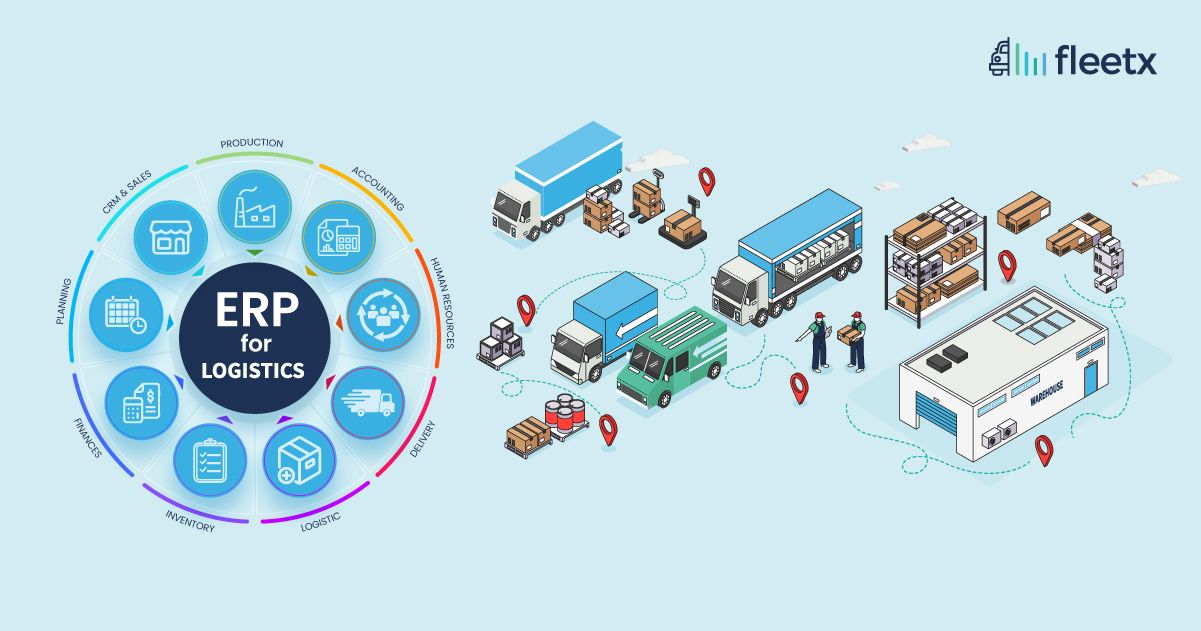
Today's ERP systems provide a variety of innovative features. ERP for the logistics and transportation sector makes it possible to complete all operational activities, and more crucially, to do so from a single platform. Overall, ERP software may assist a transport and logistics business manage crucial business operations which helps in maximizing effectiveness, customer retention, profitability, customer satisfaction, logistics management, resource management, and process optimization.
In order to increase operational efficiency and profitability, the organization can streamline and automate certain procedures using ERP solutions.
Digitize Consignment Booking & Tracking in One Place
Eliminate paperwork, auto-generate bills, manage e-way bills, track consignments live, and capture ePODs seamlessly with Fleetx Transporter ERP.
Main attributes an ERP software offers to the logistics and transportation sector
Remote accessibility: Remote access is a feature of ERP software deployed for the logistics and transportation sector. With the help of this, companies can access their account from any location with an internet connection and this also helps management and operators to communicate continuously without any hurdle.
Driver Management: ERP systems help companies in better driver management. With the help of ERP, fleet managers can monitor driver leave policies, break schedules, retention and detention timings, and working hours.
Financial Assistance: With ERP, you can manage the actual cash exchange between your business and expenses or revenues, such as freight invoicing, accounting, budget, and salaries, conveniently and effectively. This helps in accurate invoicing and helps in making fast financial decisions.
Asset management and recognition: With ERP, companies have insight into all the assets, their needs, scheduling maintenance and asset management. ERP also provides a defined budget for all the assets. For example, it provides details of all the tyres , scrap tyres, tyre values and tyre renewal dates etc.
Planning the dispatch and shipments efficiently: ERP transportation management aids in efficient dispatch planning; allows for combining the dispatch of materials from various sales orders and acquires the necessary flexibility for efficient dispatch and loading. Additionally, it aids in shipment planning and optimization while also taking expenses into account.
Portal for customers and vendors: In an effort to stay in touch and informed, ERP software includes a vendor/customer portal that makes it simple to log in and learn the status of deliveries. This allows them to notify customers by SMS or email and keep them informed.
Real-time tracking : Real-time tracking is necessary while a vehicle is in transit to keep customers informed. It helps in obtaining a comprehensive understanding of the supply chain process due to the integration of real-time tracking tools. Additionally, it is simpler and quicker with the assistance of mobile integration as it allows access anytime and gives end-to-end visibility of vehicle and cargo.
Delivery and inventory management: By having total control over the inventory, it ensures operational effectiveness. ERP allows access of all the data and information related to orders, inbound and outbound sales, delivery, and more. As a result, operations run smoothly and leads to optimizing all supply chain management processes.
Enhanced distribution: All distributors, suppliers, delivery partners, and retailers can obtain comprehensive delivery information with the use of an unified ERP system. Furthermore, they can keep an eye on the delivery , orders, stock, payments, etc. to guarantee efficient distribution management. It can also be used to optimize the routes for on-time deliveries.
Route optimization: With the use of ERP, businesses can assess order loads and choose the best mode of transportation, route, and carrier while still providing the appropriate level of customer service.
Management of data and compliance: The majority of data can be managed by logistics ERP software without any human error. Consignment notes, manufacturing costs and other crucial and accurate data can all be accessed. Additionally, the system is capable of processing and filing timely logistics regulatory compliance procedures.
Conclusion
To sum up, companies can obtain complete data visibility, a great customer experience, and a comprehensive understanding of their entire business operations with the aid of optimized planning tools and advanced features of ERP. As it focuses on and resolves the majority of operational issues, ERP has the ability to help the transportation and logistics industry. As a result of all these features, the ERP technology has the potential to reduce expenses while also substantially improving logistics performance. Being subject to the delay of technologies like ERP integration can cost businesses a lot as market competition becomes more restricted and rigid.
The best ERP software for logistics companies in India depends on fleet size, shipment volume, warehouse operations, and automation requirements. Most transporters in Delhi, Gurgaon, Mumbai, Pune, and Bangalore now prefer cloud-based logistics ERP systems because they combine fleet tracking, dispatch planning, billing, e-way bill management, inventory, trip monitoring, and driver management into a single platform. Modern ERP solutions also integrate GPS tracking, fuel monitoring, ePOD, route optimization, and transporter accounting. Pricing for logistics ERP software in India usually starts from ₹2,000–₹10,000 per vehicle annually for SMB fleets, while enterprise deployments for large transport companies can cost ₹5 lakh to ₹50 lakh depending on customization, integrations, and automation features. Companies managing interstate transportation, FMCG distribution, cold chain logistics, or ecommerce deliveries often see faster ROI through reduced fuel wastage, improved on-time deliveries, and better operational visibility.
Logistics ERP software pricing in Delhi NCR, Gurgaon, Mumbai, and other Indian logistics hubs varies based on modules, vehicle count, integrations, and deployment scale. Small logistics businesses or transport startups may spend around ₹50,000–₹2 lakh annually for basic ERP modules like trip management, invoicing, fleet tracking, and accounting. Mid-sized fleet operators generally invest between ₹3 lakh–₹15 lakh for advanced capabilities such as route optimization, fuel analytics, e-way bill automation, warehouse management, and real-time shipment tracking. Enterprise logistics companies with multi-location operations often spend ₹25 lakh or more for fully customized ERP ecosystems. Cloud-based SaaS ERP models are becoming popular because they reduce upfront infrastructure costs. In cities like Gurgaon and Mumbai, where operational costs and delivery expectations are high, ERP implementation helps reduce manual paperwork, detention delays, fuel theft, and customer complaints significantly.
Top logistics companies in Mumbai, Delhi, and Gurgaon use ERP software to centralize operations, reduce inefficiencies, and improve customer service. Large transport businesses handle thousands of shipments, multiple warehouses, vendor networks, and fleet movements daily. Without ERP automation, managing invoices, dispatch schedules, trip costs, driver records, inventory, and delivery timelines becomes chaotic. Modern logistics ERP systems provide real-time visibility across operations while reducing manual errors. Companies can monitor vehicle utilization, automate billing, manage fuel expenses, and optimize routes using AI-powered analytics. ERP systems also help transporters comply with GST, e-way bill regulations, and operational audits. In highly competitive logistics markets like Delhi NCR and Mumbai, faster delivery commitments and shipment transparency directly impact customer retention. Businesses using ERP software often improve operational efficiency by 20–30% while significantly lowering fuel misuse, idle time, and documentation delays.
Yes, ERP software plays a major role in reducing fuel and operational expenses for trucking companies across India. Fuel contributes nearly 50–60% of total transportation costs, especially for long-haul fleets operating between Delhi, Mumbai, Chennai, Kolkata, and Bangalore. ERP systems integrated with GPS and telematics can track fuel consumption, route deviations, idling time, harsh driving behavior, and unauthorized vehicle usage. Companies gain visibility into cost leakages that are otherwise difficult to detect manually. ERP software also improves trip planning, load optimization, preventive maintenance scheduling, and dispatch coordination. This reduces vehicle downtime and improves fleet utilization. Many transport companies using logistics ERP systems report fuel savings of 10–18% annually. In addition, automated invoicing, digital documentation, and ePOD workflows help reduce paperwork expenses, operational delays, and manpower dependency across logistics operations.
Transportation ERP software is widely used across industries that depend heavily on logistics, fleet movement, and supply chain visibility. FMCG, ecommerce, cement, steel, pharmaceuticals, manufacturing, retail distribution, construction, and cold chain logistics are among the top industries adopting ERP solutions in India. Businesses in Gurgaon, Noida, Mumbai, Ahmedabad, and Chennai often use ERP software to manage multi-location transportation and warehouse operations efficiently. Cold chain operators benefit from temperature tracking and route monitoring, while FMCG companies rely on faster dispatch planning and inventory synchronization. Ecommerce logistics providers use ERP systems for shipment tracking, proof of delivery, and automated customer notifications. Manufacturing companies depend on ERP tools for raw material movement and vendor coordination. As logistics networks become more digitized and customer expectations increase, ERP adoption has become almost mandatory for scalable and profitable operations.
ERP software improves warehouse and inventory management by giving logistics businesses complete visibility into stock movement, order status, and storage utilization. Companies operating warehouses in Delhi NCR, Bhiwandi, Mumbai, and Bangalore often struggle with inventory mismatches, delayed dispatches, and manual paperwork. ERP systems automate inbound and outbound inventory tracking, barcode scanning, stock reconciliation, dispatch scheduling, and warehouse allocation. Managers can track goods movement in real time while reducing stock loss and operational confusion. Integration with transportation management systems also helps synchronize warehouse operations with fleet dispatch schedules. Modern ERP platforms provide dashboards for monitoring inventory turnover, order fulfillment rates, and storage efficiency. Businesses can significantly reduce inventory carrying costs and improve delivery speed. Warehouse ERP implementation costs in India generally range from ₹2 lakh for SMB operations to ₹30 lakh or more for enterprise-grade warehouse automation systems.