🚛 Key Takeaways
- AI-powered fleet dashcams improve safety, visibility, and operational control.
- Choose dashcams based on fleet needs — front, dual-facing, rear, external, or interior cameras.
- Look for must-have features like HD recording, GPS tracking, cloud storage, and real-time alerts.
- Dashcams help reduce accidents, improve driver behavior, and lower operational costs.
- Modern fleet dashcams are shifting fleet management from reactive operations to proactive decision-making.
Every mile covered on Indian roads offers both challenges and opportunities for fleet operators and owners - not only from accidents and unforeseen events but also from increasing operational costs, regulatory requirements, and damage to business reputation. In recent years, high-quality video dashcams have replaced the low-resolution, limited vision of driving on Indian roads. AI-enabled dashcams have become the new normal - combining wider road angles, superior recording quality, and AI intelligence - to monitor multiple aspects of driving.
When Does the Need for Fleet Dashcams Arise?
Dashcams have become essential in ensuring vehicle, cargo, and personnel safety. As the fleet size expands, manual control becomes less impactful, and the need for higher supervision and improved driver training increases. The high-quality video footage from AI-powered dashcams can be used for staff training and as video evidence in the event of insurance claims.
Types of Dash Cameras and Their Purpose
Dashcams with a variety of configurations and utilities are available, and so it’s important to know which type would be the best fit for different fleets. The variations include -
Front Dashcams
Location: Front windshield
Data Point: Road in front of the vehicle
Commonly known as single-lens dashcams, these cameras capture any activity on the road ahead through a single lens. These are also apt to capture clear and detailed footage that can be later used for driver coaching or to serve as video evidence for protection against false claims. However, the activities within the cabin aren’t captured through such lenses.
Dual-Facing Dashcams
Location: Front windshield
Data Point: The road in front and the cabin interior
These cameras are more useful than the single lens due to the added feature of recording the vehicle cabin, which is particularly useful for better supervision of the vehicle driver’s activities.
External Dashcams
Location: On the outside of the vehicle, usually on either side
Data Point: Area around the vehicle
These dashcams provide a 360-degree view around the vehicles, which is particularly beneficial when the driver operates with blind spots or there’s a difficult turn to pass. Sideswiping accidents are quite common in fleets, and the recorded dashcam footage can be used as valuable evidence to protect drivers against false allegations.
Rear Dashcams
Location: At the back of the vehicle, usually around the license plate
Data Point: The back area of the vehicle
These cameras record activities behind the vehicle and are beneficial when the vehicle is being operated in reverse.
Interior Dashcams
Location: On the inside of vehicles, usually within the cargo trailer
Data: Records activities inside the vehicle
These devices can be placed anywhere within the vehicle, but transporters mostly place them for supervising and protecting the cargo or keeping the passengers safe.
Benefits of Installing AI-Powered Fleet Dashcams
Installing fleet dashcam solutions offers several advantages to fleet owners:
Unbiased Video Footage
Truck drivers are often unfairly involved in truck accidents, and their employers are dragged into the proceedings too. Installing fleet dashcams provide unbiased evidence in case of any unforeseen incident/s and help in preventing accidents, thefts, or vandalism. Fleet owners usually put in significant efforts into driver training, and a dashcam system acts as proof of their good driving behavior in case of insurance or law enforcement requirements.
Driver Training Material
Dashcams let fleet managers supervise their drivers and identify gaps for potential training improvements. Just by installing dashcams, drivers can be motivated to drive with a sense of accountability attached. Additionally, AI dashcams alert managers and drivers during events such as harsh braking, acceleration, probable collisions, etc.
Driver Motivation & Good Performance Recognition
Real-time driving feedback from dashcams highlights the areas for improvement and enables managers to train drivers better in maintaining correct driving standards and following safety protocols. Driver recognition and rewards help in fostering a positive business culture that improves the business’ bottom line significantly.
Impact Measurement KPIs
The impact of fleet dashcams can be tracked and measured by analyzing key vehicle metrics that include the frequency, nature, and costs involved with each accident. Other important KPIs include driver behavior metrics, fuel consumption levels, and fleet efficiency metrics that help in identifying the gaps and -
- Adjusting the camera placement
- Upgrading to multiple camera placements
- Implementing camera health checks
- Configuration adjustments for AI-captured events, and more
Higher Fleet Savings
Dashcam installation minimizes incidents, litigation costs, employee compensation, and repair costs. Insurance costs and early wear and tear caused by rapid acceleration and harsh braking are reduced as well.
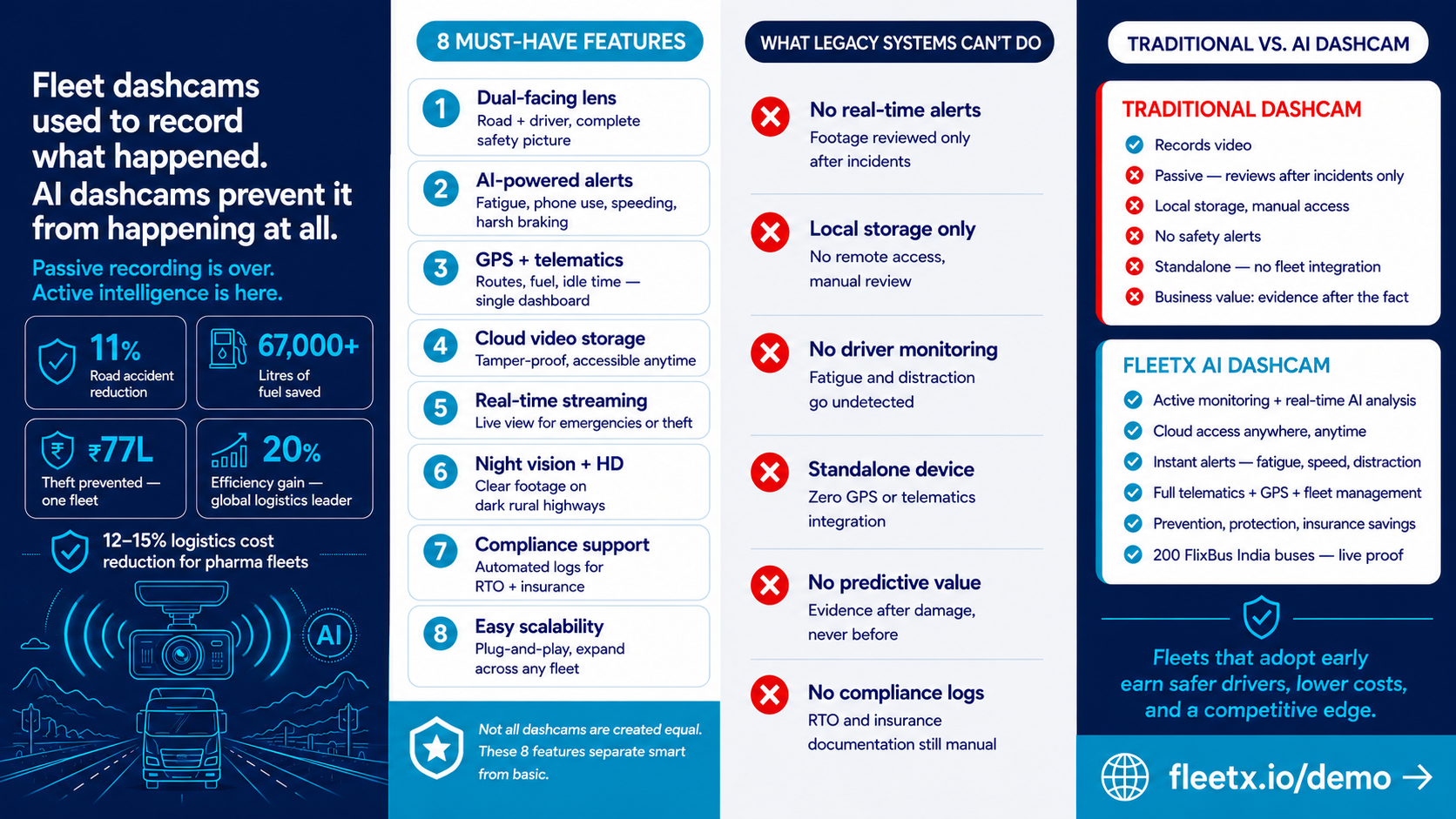
7 Must-Have Features of a Commercial Fleet Dashcam System
Certain features are essential for a high-functioning fleet dashcam system, including:
High-Definition Video Quality
When an incident occurs, the dashcam must capture the license plates or traffic signals. Dashcams record the activities of the interior and exterior of the vehicle, and this footage is a valuable asset for -
- Accident documentation to expedite insurance claims and prevent fraudulent claims
- Monitoring driver behavior and helping coach them on better safety protocols
- Incident analysis that enables post-incident reviews, aiding in identifying the cause and preventing future occurrences
Key Features -
- Minimum 1080p full HD resolution
- A wide-angle lens to capture a wider scene
- Night vision or infrared sensors for low-light conditions and clarity
Automated Recording: Zero Manual Efforts
Dashcams should start and stop capturing crucial events without relying on human capabilities to -
- Enable engine auto-start
- Detect sudden impact or motion with the G-sensor
Key Features -
- Remote access from any location, facilitating quick decisions
- Automatic cloud storage and accessibility
- Seamless integration possibilities for a comprehensive view of operations
GPS Tracking
Combining video footage with real-time GPS data transforms the dashcam into an innovative tool that -
- Logs timestamped route history
- Integrates easily with other telematics platforms
Key Features -
- Route optimization by analyzing travel routes for efficient route planning, timely deliveries, and fuel optimization
- Geofencing alerts to trigger for the vehicle’s designated area entry or exit
- Real-time location monitoring
Cloud Storage & Smart Video Management
Cloud storage ensures a secure video footage deposit with easy accessibility for -
- Loop recording that avoids overwriting crucial footage
- Event-locking critical events
- Seamless integration with fleet management platforms
Key Features -
- Anytime, anywhere access
- Automatic event uploads
- Subscription-based pricing
High-Risk Behavior Alerts
Spotting the risky driving patterns in real time lets fleet operators intervene proactively - before they turn into costly claims.
Key Features -
- Custom event-generated alerts
- Instant mobile or dashboard notifications
- Seamless integration features
Dual-Lens for Higher Accountability
A dual lens dashcam includes a driver-facing camera as well, capturing activities both on the road and in the driver’s cabin.
Key Features -
- Dual-facing lens
- Audio capabilities to monitor driver interactions
- Privacy mode for the driver’s personal space
Tamper-Proof Design
The dashcam has to be installed professionally to ensure that it captures footage effectively in critical situations.
Key Features -
- Windshield-mounted with a discreet design
- A resistant structure to prevent unauthorized removal or adjustment
- Out of the driver’s line of sight
Driving Smarter, Safer, and Stronger Fleets
AI-powered fleet dashcams are no longer optional add-ons—they’re operational essentials. In an industry where a single on-road mistake can cost lakhs in repairs, legal disputes, or reputation loss, dashcams act as a fleet’s digital witness and performance coach rolled into one. From providing visual proof in accident disputes to optimizing driver behavior and cutting insurance costs, they’re transforming fleet safety from reactive defense to proactive prevention.
For Indian fleet operators navigating unpredictable roads, adopting intelligent dashcam systems isn’t just about compliance—it’s about competitiveness. The future belongs to fleets that can see clearly, decide quickly, and act confidently. With AI-enabled dashcams, that future is already on the dashboard.