
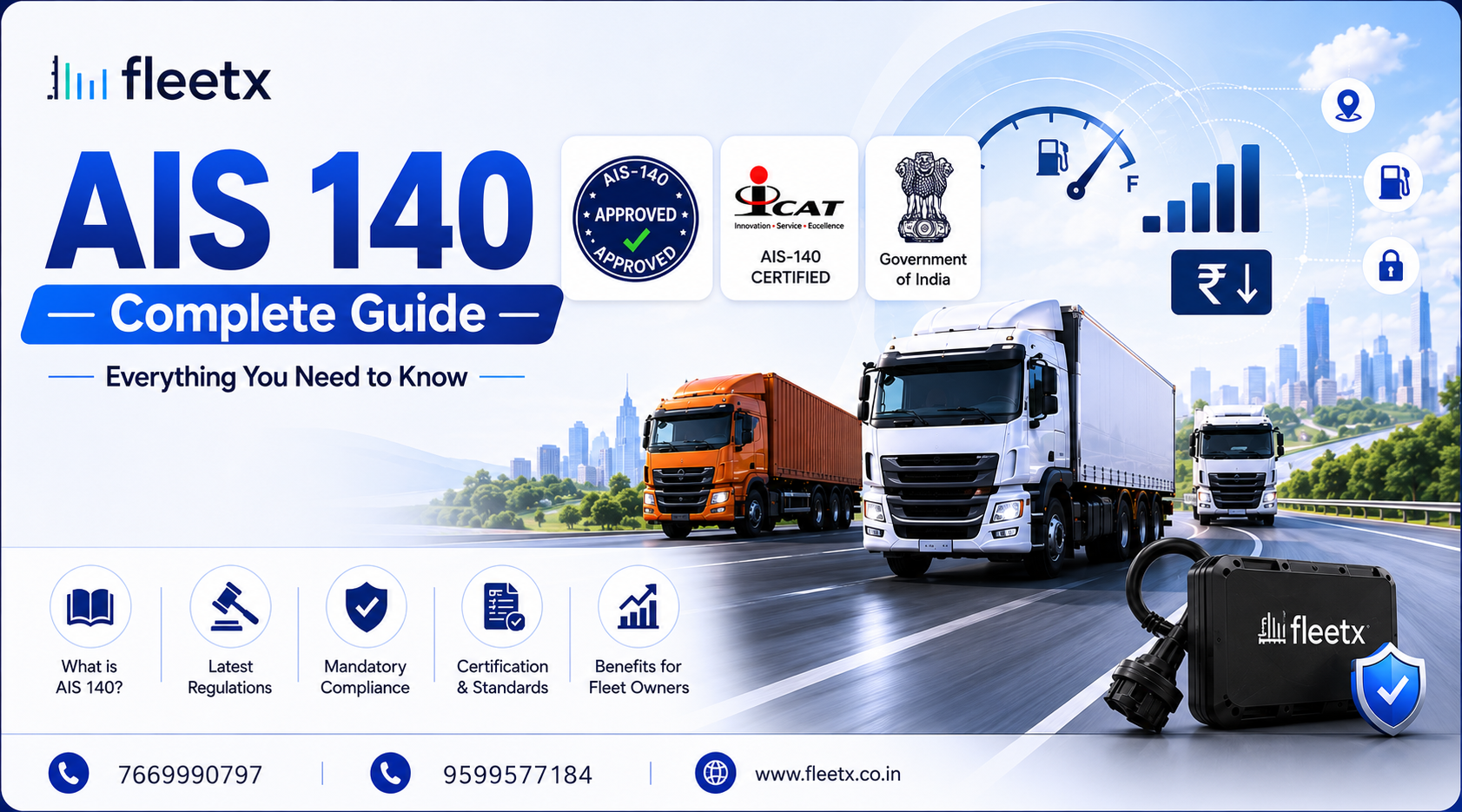
India has one of the largest and most complex road transport networks in the world, with over 5 million kilometres of roads, more than 300 million registered vehicles, and a commercial transport sector that moves the heartbeat of its economy. Yet for decades, monitoring commercial vehicles, where they go, how they behave, and whether passengers aboard are safe, remained largely an unresolved challenge.
That changed with the AIS-140.
The Automotive Industry Standard 140, commonly known as AIS-140, is a technical specification mandated by the Ministry of Road Transport and Highways (MoRTH) that defines the standards for Vehicle Location Tracking Devices (VLTDs) fitted to commercial vehicles in India. It is not merely a GPS rule. It is a comprehensive safety, emergency response, and data standardisation framework that touches every stakeholder in India's transport ecosystem, from a school bus operator in Pune to a logistics fleet manager in Delhi.
This 2026 guide covers the most-searched questions about AIS-140 compliance in India in depth, covering everything from what the standard is, to who needs it, to how to get certified, to what happens if you do not comply.
WHAT IS AIS-140?
Understanding the Standard and What It Actually Requires
AIS-140 is a technical standard developed by the Automotive Research Association of India (ARAI) and notified by MoRTH under the Motor Vehicles Act, 1988. It specifies the minimum technical and functional requirements for a Vehicle Location Tracking Device (VLTD) that must be installed in commercial vehicles plying on Indian roads.
The standard mandates that these devices track vehicle position using GPS and NavIC, India's indigenous satellite navigation system. They must transmit real-time location data at defined intervals to a certified backend server, include a physical Panic/Emergency SOS button for passenger safety, and be certified by ARAI or another approved testing agency before sale or installation. All data must integrate with MoRTH's centralised Vahan portal and the National Vehicle Location Tracking (NVLT) system.
AIS-140 is not optional for new commercial vehicles. It is a prerequisite for obtaining a fitness certificate and transport permit.
What Is a Vehicle Location Tracking Device (VLTD)?
A Vehicle Location Tracking Device (VLTD) is the term used in Indian regulatory language to describe an AIS-140 compliant GPS tracking unit. The VLTD is a hardware device installed in commercial vehicles that receives signals from GPS and NavIC satellites to determine precise location and transmits this data, along with vehicle telemetry and emergency alerts, to authorised backend servers.
A VLTD typically includes a GNSS module combining GPS and NavIC, a cellular modem supporting 2G, 3G, and 4G for data transmission, a dedicated SIM slot with specific telecom requirements, a hard-wired Panic/SOS button, tamper detection circuitry, non-volatile memory for offline data storage, and an accelerometer for shock and harsh driving event detection.
How Is an AIS-140 VLTD Different from a Normal GPS Tracker?
This is one of the most common points of confusion in the market. A normal GPS tracker or fleet management device simply records and transmits location data, usually to a private server managed by a logistics company or fleet aggregator. These are consumer or enterprise products with no regulatory certification requirements. An AIS-140 certified VLTD is fundamentally different across every dimension that matters legally.
WHO NEEDS AIS-140 COMPLIANCE?
Which Vehicles Are Covered by the AIS-140 Mandate?
As per MoRTH Notification GSR 979(E) dated 28 September 2018 and subsequent amendments, AIS-140 compliance is mandatory for all new commercial vehicles sold and registered in India. The mandate covers all vehicles that fall under the category of transport vehicles under the Motor Vehicles Act. For existing vehicles, state transport departments have been rolling out enforcement in phases, and several states have already made it mandatory for permit renewal, fitness certificate issuance, and inter-state transport permits.
Is AIS-140 Mandatory for Private Cars?
No. AIS-140 is not mandatory for private, non-transport vehicles. The standard applies specifically to transport vehicles, those used for carrying passengers or goods for hire or reward. A private car registered for personal use does not require an AIS-140 certified VLTD. However, if a privately owned car is used as a taxi or cab, or for any commercial transport purpose with a registered transport permit, the AIS-140 mandate fully applies.
AIS-140 Requirements for School Buses
School buses carry the most vulnerable passengers and as a result, AIS-140 requirements for school transport are layered with additional safety obligations under the School Bus Policy as directed by the Supreme Court and MoRTH guidelines. The panic button in a school bus must be accessible to both the driver and the bus attendant. Real-time tracking must be accessible to school management, parents, and traffic police. Live data must feed into the state transport authority's NVLT portal, and several states additionally require integration with a dedicated school tracking portal or parent-facing app.
AIS-140 for Taxis and Taxi Aggregators
Ride-hailing vehicles operating under taxi aggregators are subject to AIS-140 compliance as commercial passenger vehicles. The VLTD must be ARAI-certified and affixed on the vehicle at time of registration, the panic button must be installed and functional, and data must be transmitted to the state NVLT backend. Aggregators operating more than 1,000 vehicles on their platform may also be required to maintain their own AIS-140 compliant backend server and integrate it with the government portal. The Central Motor Vehicles Amendment Rules have been periodically updated to tighten these requirements.
AIS-140 for Ambulances and Emergency Vehicles
Ambulances are classified as public service vehicles and are expressly covered under the AIS-140 mandate. The emergency nature of ambulances makes real-time tracking even more critical, enabling dispatch centres, hospitals, and traffic management systems to monitor vehicle location, dispatch the nearest available unit, and clear traffic corridors. AIS-140 compliant devices in ambulances must also support priority alert transmission through the panic button interface.
AIS-140 for Corporate and Employee Transport
Corporate cab operators providing employee transport services, common in IT parks across Bangalore, Hyderabad, Pune, Chennai, and Noida, fall under the category of contract carriages and are required to have AIS-140 certified devices. Many large enterprises and cab aggregators serving corporate clients have already integrated AIS-140 VLTDs as part of contract requirements from their enterprise clients, which has helped drive compliance in this segment ahead of enforcement timelines.
AIS-140 Requirements for Logistics Trucks
The freight transport sector represents the bulk of India's commercial vehicle population. Long-distance trucks traversing multiple states need to be registered in the home state's NVLT, but must transmit data nationally. Hazardous goods carriers have additional tracking requirements under separate MoRTH notifications. Large fleet owners with 50 or more vehicles have generally deployed AIS-140 VLTDs ahead of schedule as part of their fleet management systems. Individual truck owners operating one to five vehicles have the lowest compliance rates and remain the primary target of ongoing enforcement drives.
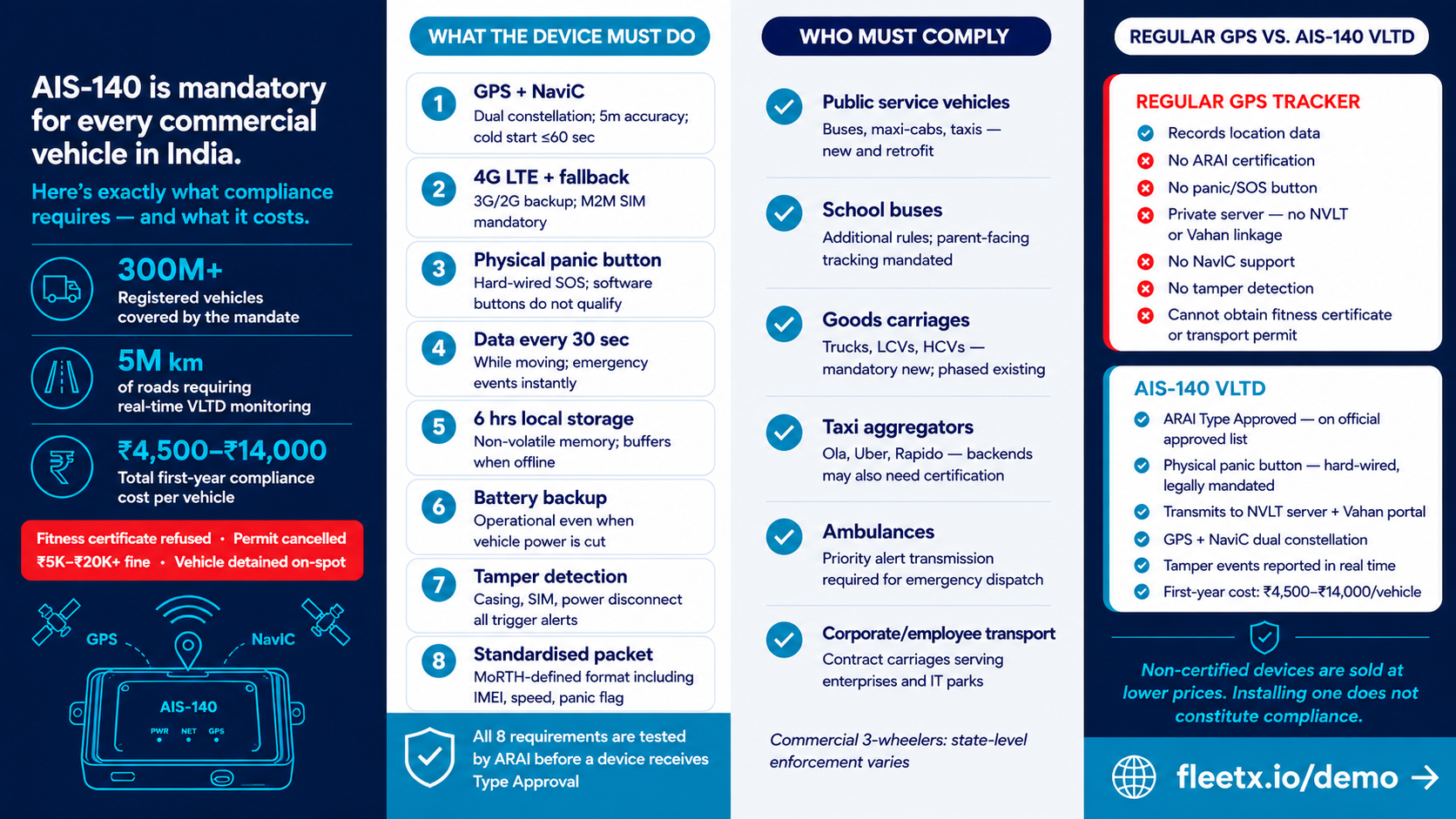
TECHNICAL REQUIREMENTS OF AIS-140
GNSS and Positioning Requirements
Every AIS-140 certified VLTD must support a dual constellation GNSS module combining GPS and NavIC, the Indian Regional Navigation Satellite System developed by ISRO. The minimum position accuracy requirement is 5 metres CEP (Circular Error Probable). Cold start acquisition must be achieved within 60 seconds, and hot start within 5 seconds. The inclusion of NavIC is a deliberate policy choice to support India's indigenous satellite infrastructure and ensure positioning reliability even during scenarios where foreign GNSS signals might be degraded.
Communication and Network Requirements
The primary communication standard for AIS-140 VLTDs is 4G LTE with mandatory fallback support to 3G and 2G. The SIM must be sourced from a Telecom Service Provider with AIS-140 specific M2M SIM provisioning. Data must be transmitted on defined ports to government-approved backend servers. The device must support both TCP/IP and UDP protocols as specified in the AIS-140 data protocol documentation.
Panic and Emergency Button Requirements
The panic button is one of the most scrutinised elements of AIS-140 compliance. The button must be physical and hard-wired into the vehicle; software or app-based panic buttons do not qualify as compliant. It must generate an emergency event packet that is transmitted immediately, without waiting for the next regular transmission cycle. The button must be clearly labelled, distinguishable from other controls, and accessible to both the driver and passengers. The exact placement varies by vehicle type but is specified in the installation guidelines issued by ARAI.
Data Transmission Frequency
AIS-140 specifies clear transmission intervals to balance data granularity with network bandwidth. When the vehicle is moving, location and telemetry data must be transmitted every 30 seconds. Emergency events such as panic button activations and tamper alerts must trigger immediate transmission regardless of the regular schedule. When the vehicle is stationary, the transmission frequency is reduced and is typically configurable, defaulting to every 5 minutes. Devices must buffer data locally when connectivity is lost and transmit the stored records in sequence once the network is restored.
Data Storage and Battery Backup
Every AIS-140 VLTD must store a minimum of 6 hours of data locally using non-volatile memory, not RAM, so that data is not lost during power cuts or connectivity failures. The device must also carry a battery backup sufficient to maintain operation and transmit tamper alerts even when the vehicle's primary power supply is disconnected. This battery backup requirement is a direct response to attempts by operators to defeat tracking by cutting device power.
Tamper Detection
Tamper detection is a mandatory function. The device must detect and report physical tampering events including power supply disconnection, opening of the device casing, and removal of the SIM card. Each of these events must generate a tamper alert packet that is transmitted to the backend immediately. State and national transport authorities can monitor for unusual patterns of tamper events in their NVLT dashboards as part of enforcement.
AIS-140 Data Packet Format
One of the most technically significant aspects of AIS-140 is the standardised data packet format. All VLTDs must transmit data in the format specified in the ARAI-issued AIS-140 document. This standardisation ensures that any government server or integrated backend can parse data from any certified device regardless of manufacturer. The AIS-140 data packet includes the packet type identifier, firmware version, packet timestamp in UTC, GPS fix validity flag, latitude and longitude in WGS-84, altitude, speed and heading, number of satellites visible, emergency and panic status flags, tamper alert flag, network operator details, vehicle registration number, and the device IMEI.
Backend and Server Compliance Requirements
AIS-140 compliance is not just about hardware. The software backend that receives and processes VLTD data must also be certified. The backend must be hosted in India in compliance with data residency requirements. It must be available 24 hours a day, 7 days a week with a minimum 99.5 percent uptime SLA. It must receive and parse AIS-140 compliant data packets and forward data to the NVLT server operated by NIC and MoRTH. The backend must implement TLS encryption for all data in transit and maintain data logs for the minimum retention period specified in the regulations. Integration with the Vahan portal for vehicle registration linkage is also mandatory.
SIM Card Requirements
The SIM card installed in an AIS-140 VLTD must be an M2M SIM provisioned specifically for vehicle tracking use, not a standard consumer voice or data SIM. It must be obtained from a licensed telecom operator such as Airtel, Jio, BSNL, or Vi under an M2M data plan with guaranteed data delivery characteristics. The SIM must not be shared with any voice or non-tracking services. In several states, the SIM must be permanently linked to the vehicle registration in the Vahan database. Hot-swapping or removing the SIM must trigger a tamper alert to the backend.
CERTIFICATION, TESTING AND COMPLIANCE PROCESS
The AIS-140 Certification Process
The AIS-140 certification process involves multiple steps. The VLTD manufacturer first submits the device for testing at an approved test agency, primarily ARAI in Pune or another MoRTH-approved laboratory. The device undergoes comprehensive technical testing covering GNSS accuracy, communication protocols, panic button functionality, data packet format compliance, tamper detection, environmental tests for vibration, temperature, and humidity, and electromagnetic compatibility (EMC).
At the same time, the manufacturer's backend server is tested and certified for compliance with AIS-140 server specifications. On successful completion, ARAI issues a Test Report and the manufacturer applies for a Type Approval certificate. Once Type Approved, the device is added to the official approved device list maintained by MoRTH and ARAI. The manufacturer must then maintain Conformity of Production to ensure every unit shipped matches the approved prototype.
Getting AIS-140 Approval from ARAI
The Automotive Research Association of India, headquartered in Pune, is the primary body for AIS-140 device certification. Manufacturers must submit a complete application with technical documentation, provide prototype samples (typically three to five units) for testing, and undergo testing at ARAI's certified labs across all required parameters. The backend compliance test runs alongside the hardware testing. Once both pass, the manufacturer receives a Test Completion Certificate followed by the formal Type Approval. The process typically takes three to six months, depending on the completeness of documentation and the number of iterations needed during testing.
Conformity of Production (CoP)
Conformity of Production is an ongoing requirement that ensures every unit of a certified AIS-140 device rolling off the production line is identical in all critical specifications to the type-approved prototype. CoP audits are conducted periodically by ARAI or authorised bodies. Manufacturers must maintain a quality management system at their production facility, allow periodic audits and batch testing, and report any changes in design, components, or firmware that may affect compliance. Changes beyond defined limits require fresh testing and re-approval before the updated device can be sold.
Certification Validity and Renewal
AIS-140 Type Approval certificates are typically valid for a period specified at the time of approval, often three to five years, subject to continued CoP compliance. Devices must be re-evaluated if there are major changes in network technology, firmware changes affecting core functionality, or at the expiry of the certification period. For vehicle operators, the VLTD must remain functional and certified throughout the life of the vehicle's transport permit. Faulty or non-functional devices must be replaced with certified units promptly to maintain compliance status.
How to Verify AIS-140 Certification
Fleet operators and transport authorities can verify AIS-140 certification through the ARAI website at arai.in, which publishes the list of type-approved VLTDs. The MoRTH and NIC portal maintains approved device records linked to Vahan. Each certified device carries a unique approval number inscribed on its physical label, and the device IMEI can be cross-checked against the NVLT database once installed in a vehicle.
INSTALLATION, INTEGRATION AND OPERATIONS
AIS-140 Device Installation Guidelines
Installation of AIS-140 VLTDs must follow specific guidelines to ensure correct function and resistance to tampering. Installation must be performed by a trained and authorised technician. The device must be connected to the vehicle's power supply in a tamper-evident manner. The GNSS antenna must be placed to ensure a clear sky view, typically on the dashboard or roof. The panic button must be installed in an accessible location, usually on the dashboard for the driver, with a secondary button inside the passenger cabin.
The device must be permanently affixed, not a clip-on or removable unit. Post-installation, the VLTD must be activated and linked to the vehicle's registration number in the Vahan portal. The installer must conduct a functional test to verify GPS lock, data transmission, and panic button operation before the vehicle is cleared for use.
AIS-140 and Vahan Integration
The Vahan portal at vahan.parivahan.gov.in is the central axis around which AIS-140 compliance revolves. The VLTD must be linked to the vehicle's Vahan record with the device IMEI registered against the registration number, the SIM number linked to the vehicle profile, and the backend server through which the vehicle's data is being transmitted, clearly identified. The fitness certificate and permit issuance processes in Vahan now check for this VLTD linkage. Transport authorities, RTOs, and enforcement officers can verify compliance directly from the Vahan portal using a vehicle's registration number.
API Integration for Platform Vendors
Fleet management software providers, taxi aggregators, and logistics platforms that want to build on top of AIS-140 data must integrate through the relevant state AIS-140 or NVLT portal. This requires obtaining API access credentials, implementing a compliant AIS-140 data protocol parser, setting up secure API calls to receive real-time vehicle data, alerts, and panic notifications, and integrating with MoRTH's centralised NVLT server for data forwarding. Companies operating as AIS-140 data service providers must also undergo backend certification. Several state governments have published API documentation for their NVLT portals.
Tracking Software Requirements
Software platforms displaying and managing AIS-140 tracking data must comply with standards around data security, access control, and interface requirements. Key requirements include role-based access for operators, enforcement officers, parents, and school administrators, real-time map display, panic and emergency alert display with push notifications to relevant authorities, geo-fence support for school bus route monitoring, historical trip playback and reporting capability, integration with state and national NVLT portals, and an audit trail for all data access and modifications.
COSTS, VENDORS AND COMPLIANCE CHECKLIST
AIS-140 Compliance Cost in India
One of the most practical questions from fleet operators concerns the cost of AIS-140 compliance. The following table provides a realistic breakdown as of 2026.
Costs vary significantly depending on the vendor, vehicle type, and whether SIM and backend services are bundled together. For large fleets of 100 or more vehicles, volume discounts can substantially reduce per-unit costs.
Finding AIS-140 Certified Device Manufacturers
As of 2026, several manufacturers have received ARAI certification for AIS-140 compliant VLTDs. The approved vendor list is maintained on the ARAI website and is periodically updated. The market includes Indian automotive electronics manufacturers with ARAI-certified product lines, global GPS and telematics companies offering India-specific AIS-140 certified variants, telecom companies offering bundled VLTD, SIM, and backend solutions, and fleet technology startups with ARAI-approved devices.
AIS-140 Compliance Checklist for Fleet Operators
Use this checklist to verify your fleet's AIS-140 compliance status across every vehicle and installation.
ENFORCEMENT, PENALTIES AND LEGAL FRAMEWORK
Penalties for AIS-140 Non-Compliance
Non-compliance with AIS-140 requirements carries significant consequences for commercial vehicle operators. At the most basic level, RTOs can refuse fitness certificate renewal for non-compliant vehicles. Transport permits can be suspended or cancelled outright. Fines under the Motor Vehicles Act vary by state but can range from Rs. 5,000 to Rs. 20,000 or more for repeated violations. Enforcement officers at check posts can now verify compliance through Vahan in real time, enabling vehicle detention on the spot.
For taxi aggregators, state transport authorities can issue show-cause notices or impose platform-level bans. For school buses, non-compliance can trigger suspension of the school bus permit and potential action by education authorities against the school itself.
AIS-140 Compliance and State Transport Permits
Transport permits, whether national, state, or district-level, now explicitly require AIS-140 VLTD compliance as a precondition for issuance and renewal. Permit renewal processes across most states query the Vahan database for device linkage. Vehicles without a linked and functional VLTD are increasingly being denied permit renewals. Operators transporting goods or passengers across state borders face a higher risk of enforcement action at inter-state check posts and highway patrol stops.
INDUSTRY-SPECIFIC CONSIDERATIONS
AIS-140 for Fleet Management Companies
Fleet management companies occupy a unique position in the AIS-140 ecosystem. They often provide both the VLTD hardware and the software platform, and may also operate as the backend service provider. Only ARAI-certified VLTDs can be provided to commercial vehicle clients. The FMC's backend platform must be AIS-140 compliant and may require its own certification depending on its role in the data chain. FMCs must ensure data forwarding to the relevant state NVLT portal. Contractual arrangements with clients must clearly define compliance responsibilities, particularly around device maintenance and SIM management.
Implementation Challenges in India
Despite the clear mandate, AIS-140 implementation has faced real-world challenges across the industry. Last-mile installation remains difficult because India has millions of commercial vehicles, many operated by small individual owner-operators with limited awareness of regulatory requirements. The market has seen non-certified or poorly manufactured devices being sold alongside legitimate products, and buyers must verify certification before purchase.
Backend fragmentation is another challenge, as different states have set up different NVLT portals with varying levels of technical maturity. Connectivity gaps in rural and remote areas lead to data blackouts for long-haul vehicles. Driver resistance exists due to limited awareness and concerns about job monitoring. Individual owner-operators of goods vehicles find the recurring SIM and backend costs challenging relative to their margins. Enforcement remains uneven across states, which creates compliance arbitrage opportunities that reduce the effectiveness of the overall system.
AIS-140 for Special Purpose and Emergency Vehicles
Beyond standard commercial categories, AIS-140 requirements extend to a broad set of special-purpose vehicles. Fire engines, disaster response vehicles, and police patrol vehicles in several states are being equipped with AIS-140 compliant VLTDs as state governments build out integrated emergency response coordination systems. The panic button functionality takes on additional importance in these applications, where officer safety and rapid dispatch coordination are critical operational requirements.
LATEST UPDATES AND THE FUTURE OF AIS-140
Key Developments in 2025 and 2026
The AIS-140 regulatory landscape has continued to evolve through 2025 and into 2026. Enhanced NavIC integration requirements have been updated following ISRO's expanded NavIC constellation with NVS-1 and upcoming NVS-2 satellites. Backend API specifications have been revised to improve data standardisation across states, addressing inconsistencies that had created integration friction for multi-state fleet operators.
Major enforcement drives have intensified in Maharashtra, Tamil Nadu, Karnataka, Rajasthan, and Uttar Pradesh. AIS-140 data is being integrated with ANPR systems at toll booths for real-time compliance checks without requiring manual inspection. MoRTH is also exploring integration with FASTAG data for a more holistic commercial vehicle monitoring framework. Stricter CoP audit requirements have been introduced for VLTD manufacturers following quality issues reported with some previously certified devices.
NavIC and the Push for Indigenous Technology
The Government of India's emphasis on NavIC as a complement to GPS in AIS-140 devices reflects a broader policy goal of reducing dependence on foreign satellite navigation systems for critical national infrastructure. As ISRO continues to expand the NavIC constellation and improve its accuracy and coverage, the weighting of NavIC in AIS-140 specifications is expected to increase. Manufacturers that invest in high-quality NavIC chip integration are better positioned for future certification cycles.
Convergence with Broader Intelligent Transport Systems
AIS-140 is not a standalone compliance exercise. It is the data foundation for India's broader intelligent transport system (ITS) vision. The national NVLT database, once fully populated with data from millions of commercial vehicles, will serve as the foundation for AI-driven insights, including predictive maintenance alerts, accident hotspot identification, route optimisation for public transport, and demand forecasting for freight logistics.
The National Highways Authority of India is actively exploring integration between AIS-140 tracking data and FASTag systems to create a comprehensive commercial vehicle monitoring ecosystem on national highways. As Vehicle-to-Everything (V2X) communication technologies mature, the VLTD framework is expected to evolve to support vehicle-to-infrastructure and vehicle-to-vehicle communication, enabling real-time traffic management and collision avoidance capabilities.
Electric Vehicles and the Next Generation of VLTDs
As electric commercial vehicles gain momentum in India, AIS-140 specifications are expected to be updated to include battery state-of-charge telemetry, charging event tracking, and EV-specific parameters alongside standard location data. Manufacturers developing next-generation VLTDs are already building in EV telemetry support in anticipation of updated standards. The commercial EV transition also opens opportunities for deeper integration between VLTD data and fleet energy management systems.
Expansion to Two-Wheelers and Three-Wheelers
The current mandate focuses on four-wheeled commercial vehicles. Regulatory discussions are ongoing about extending AIS-140 or an equivalent standard to commercial two-wheelers used for delivery and to commercial three-wheelers, driven by the explosive growth of last-mile delivery services operated by Swiggy, Zomato, Amazon, Meesho, and others. A miniaturised and cost-optimised version of the VLTD specification for smaller vehicles is likely to be a focus area for ARAI in the coming years.
AIS-140 Is a Safety Investment, Not Just a Compliance Exercise
AIS-140 compliance is not a regulatory box to tick. It is a foundational investment in passenger safety, fleet accountability, and operational efficiency. For school bus operators, it can be the difference between a missing child being found in minutes versus hours. For taxi operators, it builds verifiable trust with passengers. For logistics companies, it enables data-driven fleet management that separates competitive operations from struggling ones.
India's commercial transport sector is in the middle of a massive digital transformation, and AIS-140 is both the catalyst and the common standard that makes coordinated, accountable, safe transport possible at a national scale. Whether you are a fleet owner with a single truck or a transport aggregator managing thousands of vehicles, understanding and acting on AIS-140 compliance is essential in 2026.
Frequently Asked Questions (FAQ)
The following answers address the most commonly searched questions about AIS-140 compliance in India. This section is also structured for use as FAQ schema markup for SEO purposes.
What is AIS-140 compliance in India?
AIS-140 is a technical standard notified by MoRTH under the Motor Vehicles Act that specifies the requirements for Vehicle Location Tracking Devices (VLTDs) in commercial vehicles. It mandates GPS and NavIC based tracking, a physical panic button, certified data transmission to government servers, and integration with the Vahan portal. Compliance is mandatory for all new commercial vehicles and is being progressively enforced for existing fleets.
Who needs AIS-140 certification?
AIS-140 certification is required for all commercial and public service vehicles in India. This includes taxis, buses, school buses, trucks, logistics vehicles, ambulances, corporate cab fleets, and employee transport vehicles. It is not required for private, non-commercial vehicles. Taxi aggregators and fleet management companies also have their own backend compliance obligations.
Which vehicles require AIS-140 devices?
All transport vehicles under the Motor Vehicles Act require AIS-140 devices. This covers public service vehicles such as taxis and buses, stage and contract carriages, goods vehicles, school buses, ambulances, and employee transport vehicles. Commercial three-wheelers are subject to state-level enforcement that varies across India.
What is an AIS-140 certified GPS tracker?
An AIS-140 certified GPS tracker is a Vehicle Location Tracking Device (VLTD) that has passed testing at ARAI or another approved laboratory and received Type Approval from the regulatory authority. It supports GPS and NavIC positioning, includes a hard-wired panic button, transmits standardised data packets to government-approved backends, and integrates with the Vahan portal. Standard commercial GPS trackers without this certification are not AIS-140 compliant.
What is the difference between AIS-140 GPS and a normal GPS tracker?
A normal GPS tracker transmits location to a private server with no regulatory oversight, supports no mandatory safety features, requires no government certification, and carries no legal standing for commercial vehicle compliance. An AIS-140 VLTD must be ARAI-certified, support NavIC in addition to GPS, include a physical panic button, transmit data in a standardised government-defined format, connect to the state and national NVLT portal, and integrate with Vahan. The two are fundamentally different products serving different purposes.
What is AIS-140 compliance for school buses?
For school buses, AIS-140 compliance requires an ARAI-certified VLTD with a panic button accessible to both the driver and the bus attendant. Real-time tracking data must be available to school management, parents, and traffic authorities. Data must feed into the state NVLT portal. Several states additionally require integration with school-specific tracking portals or parent-facing mobile apps. Additional guidelines from the Supreme Court and MoRTH School Bus Policy apply on top of the base AIS-140 requirements.
What is AIS-140 compliance for taxis and cabs?
All taxis and ride-hailing vehicles operating under transport permits must be fitted with an AIS-140 certified VLTD with a functional panic button. Data must be transmitted to the state NVLT portal. Taxi aggregators operating large fleets may be required to run their own certified backend and integrate it with government servers. Compliance is verified through the Vahan portal and is a precondition for permit issuance and renewal.
What are the AIS-140 GPS tracking requirements?
AIS-140 requires dual constellation GNSS (GPS and NavIC) with a minimum accuracy of 5 metres CEP. Location data must be transmitted every 30 seconds while the vehicle is moving. Emergency events must trigger immediate transmission. Data must be stored locally for a minimum of 6 hours using non-volatile memory and transmitted to the government NVLT server in the standardised AIS-140 packet format.
What is the AIS-140 panic button requirement?
AIS-140 mandates a physical, hard-wired emergency panic button in every certified commercial vehicle. Software panic buttons do not qualify. The button must be accessible to both the driver and passengers, clearly labelled, and capable of generating an immediate emergency event transmission to the backend and state NVLT portal. For school buses, a secondary panic button must also be accessible to the bus attendant.
What is an AIS-140 certification process in India?
The certification process involves submitting the device and technical documentation to ARAI in Pune, providing prototype samples for testing, undergoing hardware and backend testing across all AIS-140 parameters, and receiving a Test Completion Certificate followed by a Type Approval. Simultaneously, the backend server must be tested and certified. The process typically takes three to six months. After approval, the manufacturer must maintain Conformity of Production to ensure all production units match the approved prototype.
How do I get AIS-140 approval from ARAI?
To get AIS-140 approval, submit your VLTD along with complete technical documentation to ARAI in Pune. Provide three to five prototype units for testing. Your device and backend will be tested against all AIS-140 specifications. On passing, you receive a Test Completion Certificate and then a formal Type Approval. Your device is then listed on the ARAI and MoRTH approved device list. Changes to the device after approval require re-submission depending on the nature of the change.
What is an AIS-140 data packet format?
The AIS-140 data packet is a standardised message format defined by ARAI that all certified VLTDs must use when transmitting data. It contains fields for packet type, firmware version, UTC timestamp, GPS fix status, latitude, longitude, altitude, speed, heading, satellite count, panic flag, tamper flag, vehicle registration number, IMEI, and network details. This standardisation allows any certified government server to parse and process data from any approved VLTD regardless of manufacturer.
What are AIS-140 server compliance requirements?
AIS-140 backend servers must be hosted in India, maintain 99.5 percent or higher uptime, parse AIS-140 format data packets, forward data to the national NVLT server, use TLS encryption for data in transit, maintain data logs for the prescribed retention period, support role-based access control, and integrate with the Vahan portal for vehicle registration linkage. Companies operating as AIS-140 backend service providers must obtain separate backend certification from the relevant authority.
What are AIS-140 compliance penalties in India?
Penalties for AIS-140 non-compliance include refusal of fitness certificate renewal, suspension or cancellation of transport permits, fines ranging from Rs. 5,000 to Rs. 20,000 or more depending on the state and nature of violation, on-the-spot vehicle detention at enforcement checkposts, show-cause notices for taxi aggregators, and suspension of school bus permits. With Vahan now surfacing VLTD compliance status to enforcement officers in real time, the practical risk of detection has increased substantially.
What is the AIS-140 compliance cost in India?
As of 2026, the total first-year cost of AIS-140 compliance per vehicle is approximately Rs. 4,500 to Rs. 14,000, covering the VLTD hardware (Rs. 3,000 to Rs. 8,000), M2M SIM and data plan (Rs. 500 to Rs. 1,500 per year), installation (Rs. 500 to Rs. 1,500), and backend software subscription (Rs. 500 to Rs. 3,000 per year). Annual recurring costs for SIM and backend typically range from Rs. 1,000 to Rs. 4,500 per vehicle. Volume pricing applies for large fleets.
What are AIS-140 SIM requirements?
The SIM card in an AIS-140 VLTD must be an M2M SIM provisioned specifically for vehicle tracking by a licensed telecom operator (Airtel, Jio, BSNL, or Vi). It must not be used for voice calls or non-tracking services. In most states it must be linked to the vehicle's registration in Vahan. Removing or swapping the SIM must trigger a tamper alert. Standard consumer SIMs are not compliant.
What is the AIS-140 tracking frequency requirement?
When moving, AIS-140 devices must transmit location and telemetry data every 30 seconds. Emergency and tamper events must trigger immediate transmission outside the regular schedule. When stationary, the transmission frequency is reduced and is typically configured to transmit every 5 minutes. Data that cannot be sent due to connectivity loss must be stored locally in non-volatile memory and retransmitted in sequence once connectivity is restored.
What is the difference between AIS-140 and AIS-140A?
AIS-140A is an amendment to the base AIS-140 standard that introduces updated GNSS requirements including enhanced NavIC constellation support, revised data packet specifications, updated communication protocol requirements, additional emergency response integration requirements, and updated environmental and electromagnetic compliance testing procedures. Devices should comply with the latest applicable version of the standard. Check with ARAI for the version currently in force.
How does AIS-140 integrate with Vahan?
AIS-140 compliance is linked to Vahan through the registration of the device IMEI and SIM number against the vehicle's registration record. The fitness certificate and transport permit issuance processes in Vahan check for this linkage before approval. Transport authorities and enforcement officers can query Vahan in real time to verify whether a vehicle has a linked, active VLTD. This integration makes compliance verification instant and removes the need for manual inspection of physical devices.
What is the future of AIS-140 and smart transportation in India?
AIS-140 is evolving from a compliance mandate into the data infrastructure for India's intelligent transport system. Key future directions include integration with ANPR and FASTag for highway monitoring, convergence with V2X communication for real-time traffic management, AI-driven analytics on national NVLT data for accident prediction and route optimisation, updated specifications to include EV battery telemetry, and possible extension to commercial two-wheelers and three-wheelers as last-mile delivery tracking becomes a regulatory priority.
This guide is updated as of May 2026. Regulations and approved vendor lists are subject to change. Always verify current requirements with your Regional Transport Office (RTO) or the ARAI website before making compliance decisions.

)