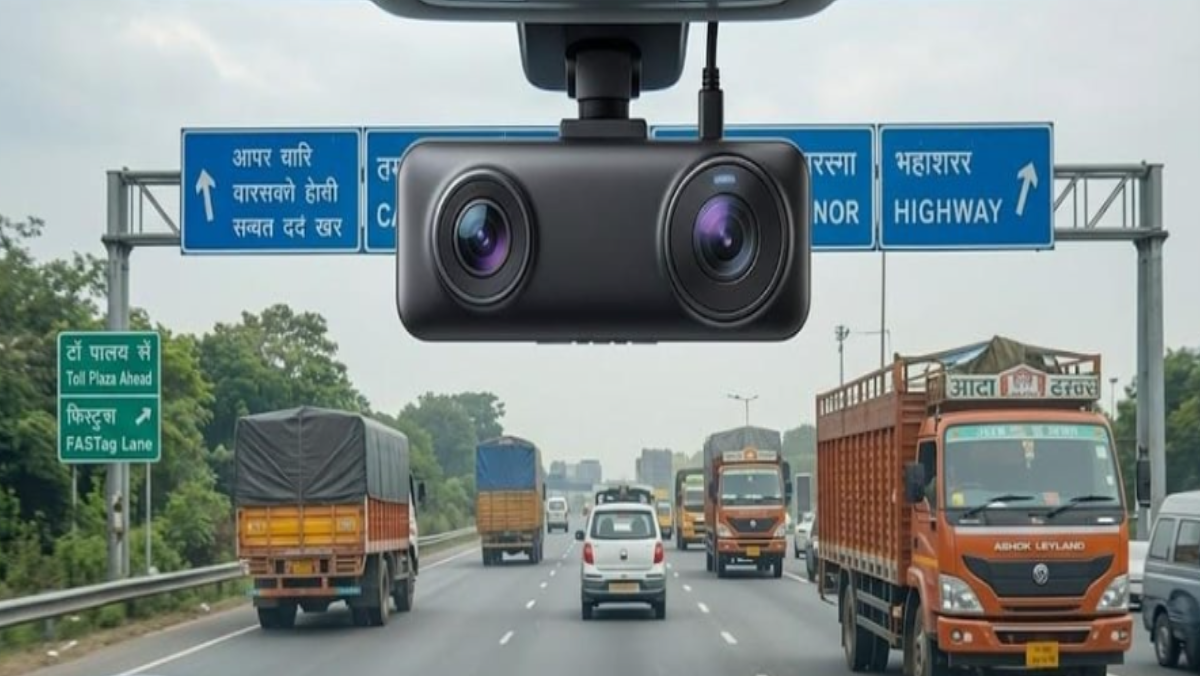
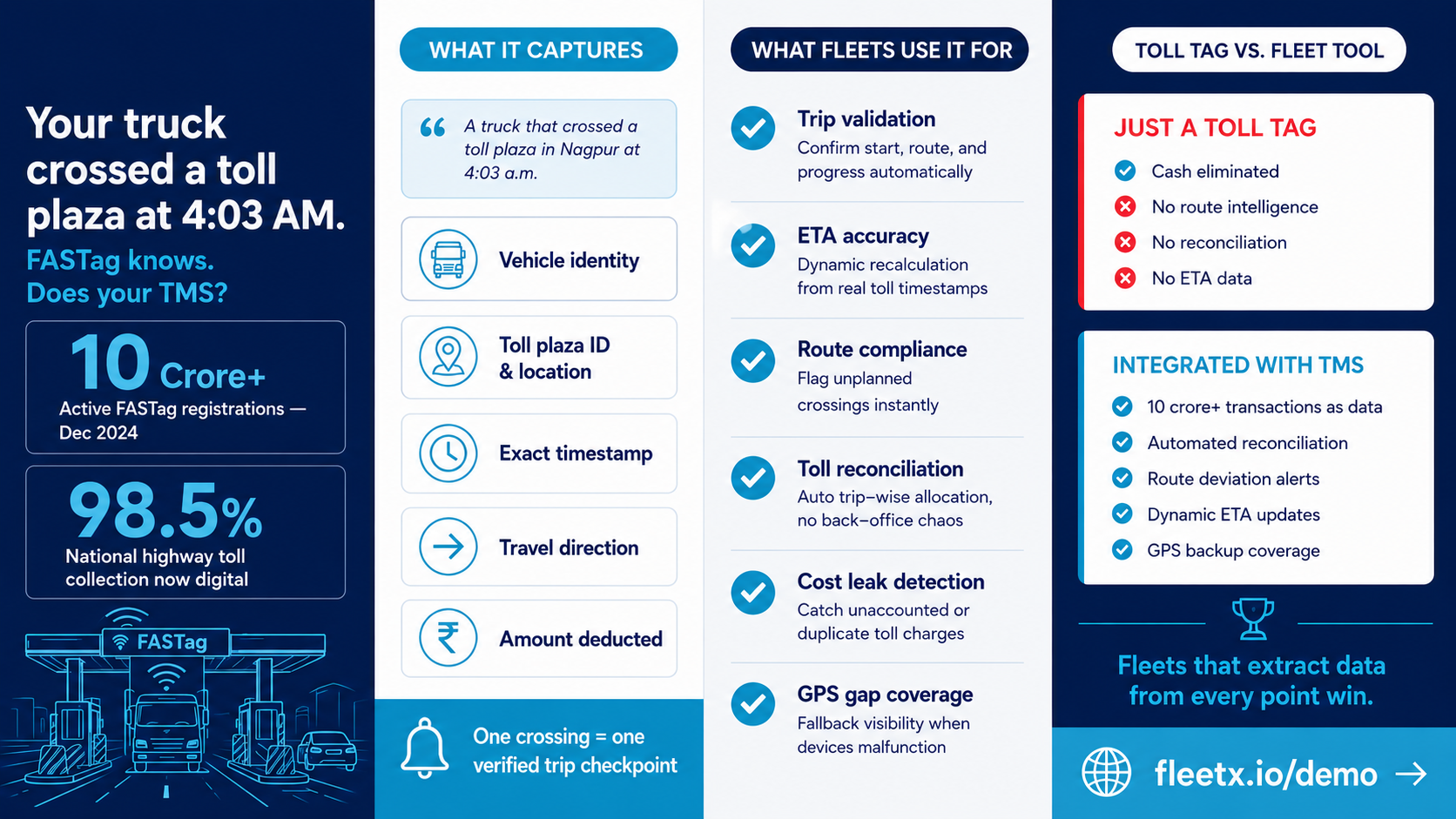
FASTag adoption is no longer in its infancy - it’s a part of any fleet’s fundamental operational infrastructure. By December 2024, over 10 crore FASTag registrations were active, and the digital toll collections are now measured in hundreds of crores per day, with a penetration rate of about 98.5% of the total fee collection. These figures are not niche telemetry statistics - these make up the national-level, high-frequency transaction flow.
The National Highways Authority of India (NHAI) collaborated with several banks and online payment platforms to offer the FASTag facility to customers, enabling a quick and easy toll
payment mechanism. But for fleets involved in the country-wide movement of FMCG, retail, agri, cement, and other industrial goods, FASTag has become more than just a toll payment system. Integrated successfully with fleet management, it works as a trip-tracking mechanism - one that provides reliable operational data to improve fleet visibility, control, and accountability for long-haul and regional goods movement.
FASTag Integration: Quick Summary
- FASTag automates toll payments for commercial fleets
- FASTag toll events help validate trips and monitor routes
- Fleet operators use FASTag data to improve ETA prediction
- FASTag supports toll reconciliation and route compliance
- FASTag complements GPS tracking during device failures
- FASTag integration reduces manual tracking and accounting work
Why is FASTag Integration Important for Commercial Fleets?
For fleet operators, FASTag transactions are not merely a financial process - but are high-frequency, timestamped, and location-specific events generated across almost every long-haul trip.
Now, consumer goods logistics is based on three primary constraints:
- Tight delivery windows
- High trip frequency
- Low margin of error in billing or fleet visibility
An effective FASTag integration directly supports all three -
- Faster route movement = Foolproof delivery schedules
Barrier-free tolling has drastically reduced truck toll queue times on major corridors, including Delhi-Mumbai, Delhi-Kolkata, Chennai-Bengaluru, Mumbai-Nagpur, and more. For commercial fleets that run long, fixed routes, FASTag operation translates into higher consistency in transit times, better route discipline, and optimal trip planning. A 10-15 minute time savings per toll plaza compounds into several operational hours saved on long-distance routes with multiple tolls - especially crucial for time-sensitive loads.
- Toll Data as Trip Checkpoints
Every FASTag transaction captures the vehicle identity, toll plaza ID, timestamp, travel details, and the toll amount. Upon integrating this data with the trip, route, or TMS, toll data becomes a significant trip marker. For operators who run fleets, at times with patchy GPS data or device malfunctions, FASTag fills the visibility gap by confirming the trip progress.
A truck that crossed a toll plaza in Nagpur at 4:03 a.m. wasn’t “somewhere on NH-48” but exactly where the system states it to be.
How Do Fleet Operators Use FASTag Data in Daily Operations?
- Automated Trip Validation
Fleet operators can utilize the benefit of automated trip validation by mapping FASTag events to:
- Confirm trip start data (first toll payment after yard exit)
- Validate route adherence
- Identify missing or unplanned toll crossings
Upon missing the mapped toll points, operators get an intimation about any route deviation, vehicle breakdowns, unplanned halts, and driver non-compliance - reducing the dependency on driver phone calls and follow-ups.
- ETA Accuracy Check
Shippers worry more about when the trucks reach customers than where the truck is at any point in time. Toll timestamps facilitate ETA calculation by -
- Dynamic ETA recalculation
- Providing realistic delivery schedules to customers
- Reducing the frantic escalation calls from customers
For high-volume shipments, this system enhances service-level consistency without adding manpower.
- Paperless Toll Reconciliation
Using manual means of toll reconciliation is a dormant cost center for many fleets still. FASTag integration enables -
- Automated trip-wise toll allocation
- Invoice-friendly toll breakups
- Duplicate or excess toll charge detection
- Faster resolution of disputes arising with issuers
Automated toll reconciliation reduces back-office chaos significantly, especially for larger fleet sizes.
- Identifying Route Deviation & Cost Leakage
Data from FASTag transactions ease the identification of -
- Unaccounted tolls paid at unassigned points
- Route diversions that result in inflated fuel and toll costs
- Misuse of the tag or vehicle-tag disparity
Toll anomaly data points, combined with GPS and fuel analytics, become early indicators of financial mismatch instead of month-end surprises.
How Does FASTag Integration Work in Fleet Management Systems?
A successful integration needs a disciplined approach, and alerts have to be designed to include the following core features -
- Transaction Inputs
- Issuer APIs or other validation files (daily or near-real-time)
- Toll Booth Mapping
- Toll ID + geofencing + route synchronization
- Trip Mapping
- Vehicle + FASTag input + trip ID
- Setting Analytics Intent
- Missed toll payments + deviation alerts + specifying cost limits
- Finance Integration
- Settlement payment vs trip vs invoice validation
What Mistakes Should Fleet Operators Avoid During FASTag Integration?
Some common mistakes that occur during FASTag integration and have to be securely avoided include:
Accounting for FASTag as a Finance-Only Tool
Several data points are captured through FASTag integration, and this data should be centrally accessible for the operations team to streamline business functions.
Neglecting the Quality of Plaza Metadata
Ineffective data mapping results in capturing insights that serve no credible business purpose.
Expectations of GPS-Grade Tracking Precision
FASTag location data is checkpoint-based and does not provide consistent fleet tracking.
Lack of SOPs for Exception Handling
Automation with no provision of exception management leads to only digital chaos. There has to be a system imbued during integration to account for unforeseen FASTag issues or glitches.
Benefits of a FASTag Integration from Fleetx
The smart fleet management platform from Fleetx has developed a premium integration approach by tapping into the nationwide FASTag network. Here’s how the system operates -
- Toll payment automation with RFID FASTags on vehicles for auto toll deduction from linked accounts, eliminating cash payments and unnecessary stops
- Fleetx integrates such transactions centrally for managers and operators to have a single view of all toll-related data
- Toll data integrated by Fleetx provides an additional option for tracking vehicles, route management, and driver monitoring
- An additional financial control measure and transparency can be utilized by fleet managers to help control fuel theft and manage budgets better
- An efficient FASTag integration assists in avoiding toll-related penalties by digitizing expense management
FASTag - A Futuristic Fleet Visibility Asset, Not Just a Toll Tag
From the Indian trucking industry perspective - especially those moving commercial goods at scale - FASTag has become a significant operational signal available today, offering additional benefits such as:
- Better trip regulation
- Robust ETA oversight
- Controls cost leakage
- Simplified accounts reconciliation
- Offers partial visibility in case of GPS failure
Indian fleet operators who’d win the competition over the next few years won’t be the ones utilizing most dashboards, but will be the ones that extract data from every point in their operations. FASTag is one such point, and ignoring its role beyond the toll payments is not an option anymore.
FAQs