“Bilty” is the one documents that transporters can’t afford to mess up in the slightest. It’s the proof that you have taken charge of the goods, the reference point in case of any dispute, and the primary consignment record that any auditor, shipper, or tax official would ask for.
India’s economic framework is heavily reliant on its road transport network, which moves over 70% of the country’s goods. As the Indian road freight transport gallops from INR 12.13 trillion in 2023 to INR 18.89 trillion by 2029, digitization and infrastructure development projects are growing to match the pace.
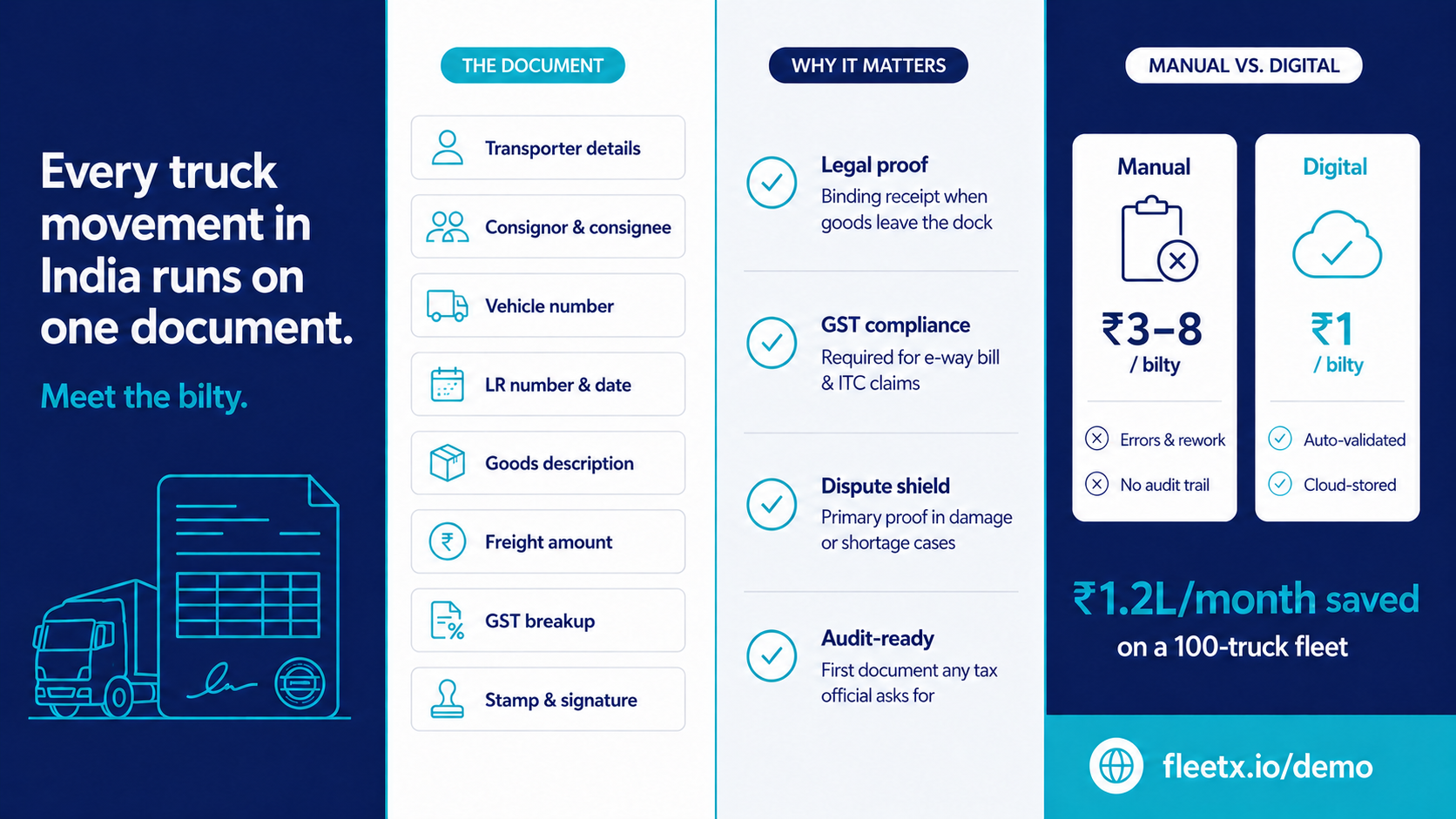
The humble truck bilty format is also quietly becoming more digital and more structured to ease the consignment operations. In most Indian transport markets, “bilty” is just a common name for the consignment note/lorry receipt (LR). A standard bilty contains the following details:
Transporter’s name, address, GSTIN,
Details of the consignor and consignee
Pickup and delivery addresses
Vehicle number
Bilty/LR number and date of issue
Description of the load (quantity, weight, packaging used, etc.)
Freight amount and terms of payment
Relevant GST details
Acknowledgement signature/stamp of the transporter
How to Generate Transport Bilty Online - Tools & Makers
Many small and medium transporters now use transport bilty maker online free instead of formatting from scratch. These serve as the optimal balance between complete manual effort and a full-fledged automated software tool.
Common features of the templates available online -
Readily usable Word, Excel, or PDF templates
Inbuilt fields such as vehicle, freight charges, GST rates, etc.
Auto-numbering function
Includes the option to save and reuse customer and lane masters
Pre-designed options to “print” and “share as PDF”
Additional Tips for Ease of Use -
A standardized master format across branches promotes a brand identity
Locked key fields, such as bilty no., GSTIN, date, etc., help in preventing overwriting by staff
Input data aligned with e-way bills helps teams during audit checks
Having the cloud/ drive backup of all generated bilties assists during audits and/ or disputes
Verified Entries - Securing Numbers & Spellings
Transport disputes mostly arise, not due to freight issues, but rather from wrong entries. Under GST, a transport bilty in India is numbered serially and maintaining this series is critical for compliance, or it leads to confusion in -
Avoiding vague descriptions like “general goods” is for the best
Run Spell Checks
Ensuring the same data in both manual and digital bilty copies is crucial
Truck Bilty - Fleetx
What are the Selection Parameters for a Bilty Generation Software?
At one point or another, especially if it’s a larger shipper, the above-mentioned bilty formats would fail to perform; that’s when companies have to look at transport bilty software or other transport management platforms.
The basis of selecting automated platforms can be broadly categorized into the following sections:
Primary Features
Bilty/LR generation with auto-numbering
Trip and vehicle assignment
Freight calculation (based on weight, lane, contract, etc.)
Clicks involved in bilty creation (is it more or less than the Excel flow?)
How fast can the old data be migrated
Status of data access in case of payment interruption
An Additional Step - A Mobile App for Smoother Bilty Operations
Transport operators and owners now prefer truck bilty app download instead of the web, and the benefits of a truck bilty app are multi-pronged:
Bilty creation at the loading point on the phone
Selecting the customer, lane, and rate from the saved masters
Click the consignment picture and attach it to the bilty online
The document can be shared instantly as PDF/WhatsApp message with the shipper/consignee
Data syncing with a centralized dashboard
Now, when it comes to evaluating the app’s performance, a few parameters weigh in significantly:
Ease of Download & Setup
Users have to ascertain whether the sign-up supports both owner and staff accounts, and also multi-lingual (English/Hindi/regional) performance.
Try a Complete Trip Flow
Running a full-length flow of the document generation, from start to end, gives a real-world estimation of the app’s performance. The staff’s familiarity with it determines the success of the adoption.
A Thorough Review-Check
Upon reading the online truck bilty reviews carefully, potential users can identify patterns in the app’s performance - whether several users have complained of system crashes, instances of data loss have been reported, if support response timeline is mentioned, and more.
Offline Performance
The app’s offline functioning also matters when evaluating its performance, for instance - if the bilty can be saved offline on the app and synced later - it is critical for highways and remote areas.
When to Use a Simple Bilty Format Vs a Detailed One
Not every movement needs the same bilty format. However, the trick lies in setting your own rules.
Simple
Detailed
Local/ short-haul with low-value goods
Cargo is high-value and long-haul
Regular routes and customers
Inter-state trip under GST scrutiny
Small shipments without special handling requirements
Temperature, stacking, sealing, etc., are required
Fixed payment terms
Multiple delivery and payment points
Lower damage risks are associated
High chance of shortage/ damage
Upgrade Your Bilty Operations & Be Future-Proof
Bilty is not just a receipt - it’s a contract that shields transporters during disputes, shortages, or damages. At the same time, it becomes a prime source of insights for lane profitability, customer data, and compliance standards.
In an industry where trillions of rupees are on the road in the form of cargo shipments, fleets that treat bilty as a strategic document and not just another formality, will be the ones to stay ahead in the race. Digitization is the only way forward in creating a robust cargo movement network and logistics automation service providers, such as Fleetx have only made the job easier by moving critical workflows into truck bilty software and apps for effective data capture at source.
Frequently Asked Questions
Bilty, lorry receipts & transport documentation in India
What is bilty in transport and why is it important for Indian logistics?
+
Bilty, also known as a lorry receipt (LR) or consignment note, is the primary legal document issued by a transporter when goods are handed over for road shipment. In Indian logistics, bilty is the single most important document because it serves as proof of receipt of goods, defines freight terms, and is required for GST compliance, e-way bill mapping, insurance claims, and dispute resolution.
Without a valid bilty, transporters, shippers, and consignees have no legally defensible record of the shipment. The Indian road freight market — which moves over 70% of the country's goods and is projected to grow from ₹12.13 trillion (2023) to ₹18.89 trillion by 2029 — relies entirely on this document to maintain accountability across millions of daily truck movements nationwide.
What details are mandatory in a standard bilty format in India?
+
A valid bilty in India must include the transporter's name, address, and GSTIN; consignor and consignee details with GSTINs; pickup and delivery addresses; vehicle registration number; a unique bilty or LR number with date; description of goods (quantity, weight, packaging); freight amount and payment terms (to-pay, paid, or to-be-billed); and the applicable GST breakup — CGST/SGST for intra-state, IGST for inter-state shipments.
For inter-state freight, the bilty must also align with the e-way bill to avoid vehicle detention at state border checkposts. Missing or mismatched fields are the leading cause of ITC rejection notices and freight payment disputes in India. Using bilty software with locked mandatory fields and GSTIN auto-validation eliminates the majority of these errors at source.
What is the typical cost of bilty processing for transporters in Delhi and Gurgaon?
+
In the Delhi-NCR and Gurgaon transport market, bilty processing costs vary by operation size. Small transporters handling 20–50 bilties per day manually (printing, data entry, filing) incur ₹3–8 per bilty in operational overhead. Mid-sized firms in Gurgaon's industrial corridors — Sector 34, IMT Manesar, NH-48 belt — using basic desktop software reduce this to ₹1–3 per bilty including licensing costs.
Larger fleet operators using an integrated transporter ERP average below ₹1 per bilty after factoring in dispute savings and reduced rework. On a 100-truck fleet processing 5 bilties per truck daily, the difference between manual and software-based processing can deliver ₹40,000–₹1.2 lakh per month in savings — making bilty software one of the fastest-payback investments in logistics operations.
What is the best bilty software or app for transporters in Mumbai and Delhi?
+
The best bilty software depends on fleet size and city. For small operators (5–20 trucks) in hubs like Bhiwandi (Mumbai) or Naraina Industrial Area (Delhi), free or low-cost bilty maker apps with WhatsApp PDF sharing are a practical starting point. For mid-sized fleets in Turbhe and Navi Mumbai or the Kundli–Manesar–Palwal (KMP) corridor, the top choice is a platform with e-way bill integration, GST invoicing, and multi-branch LR management.
For large fleets running pan-India operations across both Mumbai and Delhi, an end-to-end transporter ERP like Fleetx — covering bilty generation, trip assignment, GPS tracking, ePOD capture, and Tally export — consistently delivers the best ROI. Always prioritise offline functionality, as many highways between Delhi and Mumbai pass through areas with poor network coverage where bilty creation cannot wait for connectivity.
What are the top reasons bilty disputes arise in Indian road freight?
+
Bilty disputes in Indian road freight most commonly arise from four causes: incorrect or missing GSTIN leading to ITC rejection; mismatch between bilty goods description and e-way bill causing vehicle detention at state checkposts; unsigned or unstamped bilty copies that cannot serve as legal proof in shortage or damage claims; and duplicate or out-of-sequence LR numbers that fail GST audit verification.
In high-volume freight markets like Delhi, Mumbai, and Chennai, even a 0.5% bilty error rate can translate into crores of disputed freight annually. The best way to prevent these disputes is bilty software with master-based auto-fill for party names and GSTINs, mandatory field validation, and automatic sequential LR numbering — eliminating the most common root causes before the truck even leaves the loading dock.
What is the average freight rate per km on a truck bilty in India in 2025–2026?
+
Average truck freight rates in India for 2025–2026 vary by route type and vehicle category. For a standard 9-tonne LCV on short-haul routes (under 300 km) such as Delhi–Gurgaon or Mumbai–Pune, rates typically range from ₹18–28 per km. For a 20-tonne FTL on national highways like NH-48 (Delhi–Mumbai) or NH-44 (Delhi–Chennai), average rates are ₹55–85 per km depending on fuel surcharges and toll costs.
Part-load (LTL) shipments on high-density corridors like Gurgaon–Ahmedabad or Mumbai–Delhi are billed per kg or per CFT, averaging ₹2.5–5 per kg. These freight figures form the core financial entry on every bilty raised for the shipment and are the baseline against which freight audits, driver advances, and customer invoices are reconciled. Accurate freight entry in bilty software also feeds directly into lane-wise profitability reporting.
Is a digital or e-bilty legally valid in India under GST rules?
+
Yes — a digital or e-bilty is legally valid in India provided it contains all mandatory fields under the CGST Rules and the Carriage by Road Act, 2007. There is no statutory requirement for a bilty to be a physical paper document. A PDF bilty generated through transport software and shared via email or WhatsApp is accepted as a valid lorry receipt by consignees, banks, and insurance companies across India.
For GST audit purposes, digital bilties must be stored and retrievable for a minimum of 6 years under Section 36 of the CGST Act. Transporters in cities like Delhi, Gurgaon, and Mumbai who have shifted to e-bilty workflows report faster POD confirmation, reduced paper costs of ₹8,000–₹25,000 per month, and significantly quicker resolution of freight payment cycles — making digital bilty adoption one of the top compliance and efficiency upgrades in Indian road logistics today.
What is the best way to manage bilty operations for a fleet of 50+ trucks across Delhi, Gurgaon, and Mumbai?
+
For a fleet of 50+ trucks operating across Delhi, Gurgaon, and Mumbai, the best approach is a centralised transporter ERP with multi-branch bilty management. Must-have capabilities include: a unified dashboard for LR generation across all branches with role-based access for branch managers; automatic bilty numbering by branch prefix to prevent serial conflicts; GPS-based delivery tracking and ePOD capture linked to each bilty record; and GST-ready automated invoicing triggered on bilty completion.
Platforms like Fleetx are purpose-built for this use case, enabling fleet owners on the Delhi-NCR to Mumbai corridor — one of India's top freight lanes — to manage thousands of bilties monthly with minimal manual work. The top benefit reported by multi-city operators is real-time visibility into branch-wise bilty status, which cuts follow-up calls between hubs by 60–70% and accelerates freight billing cycles from 7–10 days to under 48 hours.