
Millions of tonnes of cargo are moved across the length and breadth of India on a daily basis. A common assumption is that such a scale of logistics operations has all the processes defined to perfection. However, in reality, the humble e-way bill raises more concerns than an unplanned RTO stop. The paperwork has gone conveniently digital, but the uncertainty around its validity, expiry, how to extend e-way bill, and the consequences of the bill’s expiration proves to be a significant hurdle to overcome.
The e-way bill is a preliminary GST compliance document, but transporters still inquire about “e-way bill meaning” and “what is e-way bill” when shipments get delayed or stuck in transit. Moreover, real-world issues such as traffic halts, breakdowns, driver-related matters, and weather setbacks add to the possibility of a compliance glitch in the issue of how to extend e-way bill validity.
Let’s have a comprehensive look at the entire e-way bill lifecycle and the associated risks to create a simplified manual for both shippers and transporters.
Rules for E-Way Bill - Time, Distance, Conditions, & Expiry
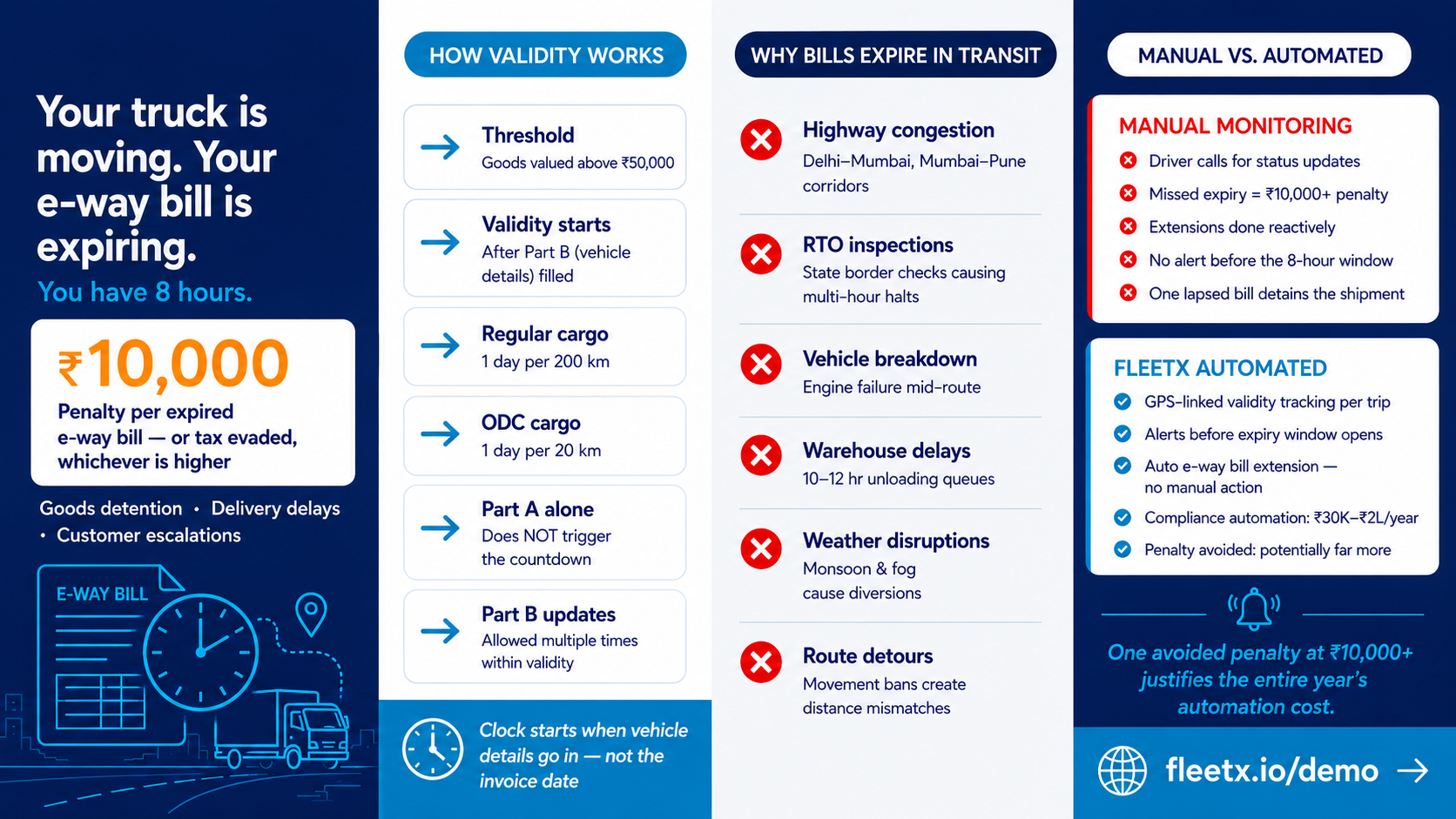
Now, fleet operators are aware of the GST e-way bill limit of INR 50,000, but they can avoid a chunk of their midnight calls if their e-way bill understanding is comprehensive. That includes the e-way bill time limit, duration, and the GST compliance norms of the bill’s validity.
Key Concepts for Bill Validity
- Distance: E-way bill validity period is based on the automated distance calculated between the origin and the destination.
- Expiry Duration: The bill's validity, without expansion, ends at the exact hour/minute of the 24-hour duration from when it was generated.
- E-Way Bill Date & Invoice Date: The two dates might vary, but the e-way bill time limit starts only after Part B is filled.
- Distance Limit: The auto-computed e-way bill distance can’t be manually overridden beyond the allowed tolerance.
- Threshold Limit: Applicable for goods that exceed the stipulated invoice value.
Additional Concepts
- Validity of Part A: Unless Part B is updated, Part A alone doesn’t initiate movement computation.
- Update Window of Part B: Within the e-way bill duration, vehicle details can be updated multiple times.
- Over Dimensional Cargo (ODC) E-Way Bill: Extended validity window due to the movement complexity of goods exceeding the standard size or weight limits, for instance, construction equipment or industrial machinery.
Validity Parameters
- The validity period of the bill depends on the trip distance.
- The countdown begins once Part B (vehicle details) is updated.
- For every 200 km covered, 1 day of validity is granted for regular cargo.
- For every 20 km covered, 1 day of validity is granted for ODC cargo.
When Can We Extend E-Way Bill Validity
Extension is not a matter of simple choice, but a compliance need when your vehicle fails to arrive on time.
Must-Have Extensions
- The shipment gets delayed, and the validity nears the end.
- Traffic, congestion, or poor route conditions extend the movement.
- Delivery gets stagnant at “still in transit” with no scope of arrival before the e-way bill expiry.
- Non-compliance is detected before dispatch completion.
Practical Hurdles
- In-Transit Expiry: The truck is moving, but with a lapsed validity.
- Breakdown Expiry: Vehicle stoppage due to engine failure.
- Movement Restrictions: Route detours due to local rules or movement bans can cause a distance mismatch.
- Unloading Delays: Delays caused by unloading issues at the warehouse.
What are Some E-Way Bill Penalties for Non-Compliance
To avoid non-compliance penalties, it’s crucial to understand the nature of such penalties first:
- If goods are being transported without a valid permit or the permit surpasses the e-way bill expiration time, 10,000 INR or the taxes evaded have to be paid as a penalty for e-way bill expiration, whichever is higher.
- If the goods mentioned in the e-way bill are missing from the shipment, it can be detained or seized as per the law.
What Happens if the E-Way Bill Expires
Non-compliance or e-way bill expired penalty can be eliminated by taking the following precautions -
- Timeline Tracking - Ensuring and double-checking the e-way bill’s validity for the entire transit and monitoring the bill closely for long-distance shipments - before it reaches the destination or while crossing state borders - is a good place to start.
- Real-Time Monitoring - Several logistics tools and apps help in tracking the bill’s validity and notify transport operators before the e-way bill’s expiry.
- Adhering to E-Way Bill Extend Time - In case of a potential delay, updating the bill before its validity expires is crucial. The auto e-way bill extension feature from Fleetx simplifies interstate or intrastate consignment movement without any fines or penalties.
E-Way Bill Extension Time Limit - The 8-Hour Window to Extend Before Expiry
One feature that half the logistics world forgets till the last moment is the range or scope of e-way bill validity extension within the last 8 hours.
Primary E-Way Bill Extension Rules
There can be one e-way bill extension reason or multiple, but the mandates are uniform -
- The extension window is the official extension period.
- The extension time limit cannot be bypassed.
- Once the portal displays - “you can’t extend this EWB”, you’re outside the permitted window.
Steps Involved in E-Way Bill (EWB) Extension
The steps to be followed for extending an e-way bill are -
Step 1: Go to the EWB panel → Select the active EWB → Choose “Extend Validity”
Step 2: State the reason for the extension or the reason for deferment (breakdown, traffic conditions, natural causes, e-way bill extension glitch, such as “server down/ site not working today”, etc.)
Step 3: Based on the auto distance computed by the e-way bill distance calculator, confirm new validity
Additional Tips to Further Simplify E-Way Bill Extension Process
- The extension window can be utilized only once.
- Only the assigned transporter or generator can undertake the extension.
- Part A cannot be modified or changed after 24 hours. However, Part B can be updated.
Handling E-Way Bill Extension - Extend After Expiry
Upon poor e-way bill maintenance and simultaneous expiry, the system assumes the end of the trip. But Indian roads can throw several curveballs, and extensions might be genuinely needed after the lapse of the bill’s validity. Wondering how to extend e-way bill after expiry? Here’s how:
- Check & Declare Reasons of Expiry
The common e-way bill queries by long-distance transporters include - “Can we extend expired e-way bill”, “what to do if expired”.
A post-expiry extension demands a reason for the same; declaring it on the system is the right way to go about it. Commonly occurring reasons include -
- Vehicle breakdown
- Weather conditions
- Regulatory restrictions
- Traffic conditions
- Unplanned mishaps
- Other operational delays
2. E-Way Bill Portal Support
On logging into the portal, users have to navigate to “E-Way Bill → Extend Validity”. However, the system only allows validity extension after expiry when the rules below are met:
3. Ensuring Time Window Admissibility
Expired e-way bills can’t be extended after a long gap. The GST rules permit extension only from the current location of the goods and usually within an 8-hour window from expiry.
4. Updating Vehicle & Location Details
The to-do list includes -
- The actual location of the goods at the time of expiry has to be entered.
- The vehicle number has to be updated if changed.
- State the reason for the delay (mandatory).
5. Additional Distance to be Covered has to be Entered
The portal recalculates the new validity based on the new distance to be covered. The standard validity is typically calculated as 1 day per 200km.
6. Extended E-Way Bill Generation
After furnishing the required details -
- The new validity period gets updated.
- The e-way bill number remains intact.
- Goods movement can be legally resumed.
7. What Must Be Avoided
- Goods movement without proper extension that invites penalties up to 10000 INR or the amount of tax evasion, whichever is higher.
- Wrong location input is not advised, as law enforcers can verify GPS trails from FASTag/GPS readings.
- Extension request long after expiry - gets blocked on the portal.
Improve Tax Compliance With Streamlined E-Way Bill Processes
Being vigilant and thorough with the e-way bill system is crucial for appropriate bill generation and timely extension. The common issues outlined above - from wrong EWB generation to facing technical glitches - have severe financial and operational impacts.
Transporters and businesses must implement robust internal systems to reduce manual efforts. Technology plays a vital role in automating these processes and minimizing human errors. Addressing the issues proactively with the power of automation ensures smooth logistics and, most importantly, avoids the heavy penalties attached with non-adherence.
The best way to track e-way bill validity for long-haul transportation in India is by combining GPS-based fleet tracking with automated e-way bill alerts. Transporters operating between Delhi, Gurgaon, Mumbai, Pune, Bengaluru, and Chennai often face unexpected delays due to toll congestion, state border checks, warehouse unloading queues, or vehicle breakdowns. Manual monitoring becomes risky when fleets scale beyond 20–30 trucks. Modern logistics software and Transport Management Systems (TMS) automatically notify fleet managers before e-way bill expiry, reducing penalty risks significantly. Most Indian transport businesses spend anywhere between ₹15,000 to ₹1 lakh monthly on fleet automation tools depending on fleet size. The top logistics companies in India now prefer AI-powered compliance monitoring because even a single expired e-way bill can trigger penalties of ₹10,000 or higher, shipment detention, and customer dissatisfaction.
If an e-way bill expires during goods movement in India, authorities can impose a penalty of ₹10,000 or the applicable tax amount, whichever is higher. This rule applies across Delhi NCR, Gurgaon, Mumbai, Ahmedabad, Hyderabad, and other Indian logistics corridors. In practical scenarios, transporters moving FMCG, industrial goods, steel, pharmaceuticals, or retail cargo are often stopped at checkpoints if validity lapses during transit. Apart from financial penalties, goods can also be detained temporarily, causing delayed deliveries and customer escalations. Businesses handling interstate transportation should especially monitor routes with heavy traffic like Delhi–Mumbai Expressway or Mumbai–Pune highways. Many mid-sized logistics companies now invest in automated compliance systems costing around ₹30,000 to ₹2 lakh annually to avoid repeated penalties and operational losses caused by expired e-way bills.
Yes, transporters can extend e-way bills after expiry in certain situations, but only within the permitted GST extension window. The extension is generally allowed within 8 hours after expiry if the goods are genuinely stuck in transit. Common reasons include traffic jams near Delhi NCR borders, vehicle breakdowns on highways near Mumbai or Jaipur, weather disruptions, strikes, unloading delays, or route diversions. The transporter must update the vehicle number, current location, remaining travel distance, and reason for delay on the GST EWB portal. However, delayed action can block extension eligibility entirely. The best practice followed by top Indian logistics operators is enabling automated extension reminders through fleet software platforms. Such systems reduce dependency on manual follow-ups and improve compliance efficiency for fleets operating across multiple Indian states.
The top e-way bill automation solutions in India are usually integrated Transport Management Systems (TMS) that combine GST compliance, GPS tracking, fleet visibility, and automated documentation workflows in one platform. Businesses operating in Gurgaon, Delhi, Mumbai, Chennai, and Bengaluru increasingly use AI-driven logistics platforms to automatically generate, monitor, and extend e-way bills without manual intervention. These systems can also trigger alerts for delays, route deviations, detention risks, and document mismatches. Pricing varies depending on fleet size and feature requirements. Small fleet operators may spend ₹20,000–₹50,000 annually, while enterprise logistics companies managing 500+ vehicles can invest several lakhs yearly. The biggest advantage is operational continuity. Automated systems reduce compliance risks, improve dispatch efficiency, and eliminate late-night manual coordination during critical shipment movements.
E-way bills commonly expire during interstate transportation because Indian road logistics rarely move exactly as planned. Transporters moving cargo between Delhi, Gurgaon, Mumbai, Kolkata, Surat, and Hyderabad often face highway congestion, RTO inspections, warehouse unloading delays, tyre bursts, weather disruptions, labour shortages, and unexpected diversions. In many cases, drivers also face waiting times exceeding 10–12 hours at industrial zones or distribution centres. Long-distance routes become even more unpredictable during festive seasons or monsoon periods. Businesses transporting perishable goods, heavy industrial cargo, pharmaceuticals, or FMCG products face higher operational pressure because delayed deliveries directly affect customer commitments. That is why the best logistics companies now combine GPS visibility, automated ETA tracking, and AI-powered compliance tools to prevent e-way bill expiry and avoid operational disruptions across Indian supply chains.
Top logistics companies in Gurgaon, Delhi NCR, Mumbai, and Bengaluru avoid e-way bill compliance issues through automation, centralized fleet monitoring, and proactive exception management. Instead of relying on drivers or dispatch teams manually checking expiry timings, they integrate e-way bill systems directly with GPS tracking and Transport Management Software. This allows automatic alerts for expiry risks, delayed routes, detention points, or missed deliveries. Many enterprise transporters also deploy control towers that monitor shipments in real time across India. Investment in such systems usually ranges from ₹50,000 for small operations to several lakhs annually for enterprise fleets. The return on investment becomes visible quickly through reduced penalties, improved delivery timelines, better customer trust, and smoother interstate transportation. Automation is increasingly becoming essential rather than optional in India’s rapidly evolving logistics sector.