There's a moment almost every logistics business hits. Revenue is climbing, the truck count has doubled, new client contracts are coming in - and somehow, the office feels more chaotic than ever. Drivers call in for trip updates because the tracking app doesn't talk to the billing sheet. Finance is still waiting on PODs from three weeks ago. The accountant is manually re-typing freight invoices into Tally every evening.
If this sounds familiar, the problem usually isn't effort - it's architecture. Most fleets start with point solutions: a GPS tracking app here, a billing spreadsheet there, maybe a basic fleet management tool bolted on later. These tools work fine at a small scale. But as the business grows, the cracks between these disconnected systems become expensive, time-consuming, and risky.
Industry data backs up what most operations heads already feel in their gut: logistics costs in India remain a disproportionately high share of GDP compared to global benchmarks, and a meaningful chunk of that inefficiency comes not from the roads or the vehicles, but from how the business itself is run behind the scenes - billing delays, paperwork bottlenecks, and a lack of real-time financial visibility. Software alone won't fix every structural issue in Indian logistics, but the right software removes an entire category of self-inflicted inefficiency.
This is exactly where the conversation around logistics ERP software becomes important. A transport ERP isn't just "fleet software with more features" - it's a fundamentally different approach to running a logistics business, one where operations, finance, compliance, and customer billing all live on a single, connected platform. In this guide, we'll break down what separates basic fleet software from a true transport ERP, why that distinction matters more as fleets scale, and what growing logistics businesses in India should actually look for when choosing their next operations platform.
The Two Worlds: Basic Fleet Software vs Transport ERP
Before comparing features line by line, it helps to understand the philosophical difference between these two categories of software.
What Basic Fleet Software Actually Does
Basic fleet management software - sometimes called fleet tracking software or a fleet management system (FMS) - is typically built around one core job: knowing where your vehicles are and how they're performing. Common capabilities include:
• Live GPS tracking of vehicles on a map
• Basic trip history and route replay
• Fuel consumption monitoring through sensors or fuel cards
• Driver behavior alerts (harsh braking, overspeeding, idling)
• Maintenance reminders based on odometer or time
• Simple reports exported as PDF or Excel
These are valuable capabilities, especially for smaller fleets or businesses just starting their digitization journey. The problem is that this is where the software's job ends. Fleet tracking software answers "where is my truck and how is it being driven?" - but it has very little to say about freight billing, vendor payments, profitability per trip, or compliance documentation.
What a Transport ERP Software Actually Does
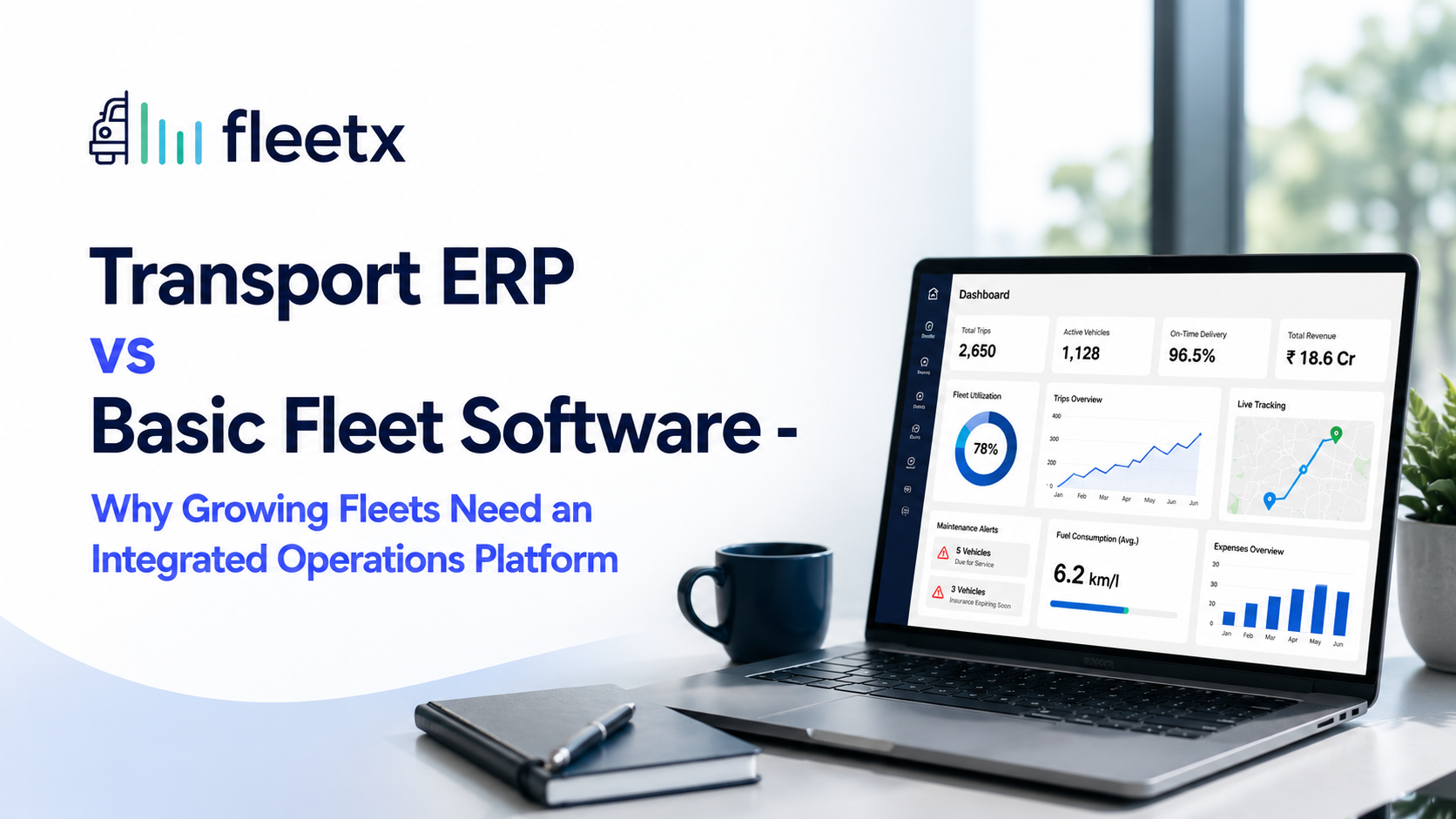
A transport ERP software - also referred to as a logistics ERP software or freight ERP - is built around a different question entirely: "How is my logistics business performing as a whole, financially and operationally, across every trip, every vehicle, and every customer?"
Instead of being a single-purpose tool, an ERP system software for logistics connects every operational function - dispatch, billing, collections, settlements, maintenance, accounting, and compliance - into one shared database. The result is that a single trip record flows seamlessly from booking to execution to invoicing to payment to ledger entry, without anyone re-typing data into a second or third system.
Think of it this way: basic fleet software gives you a dashboard for your trucks. A logistics ERP gives you a dashboard for your entire business - your trucks, your money, your compliance posture, and your customer relationships - all in one place.
Transport ERP vs Basic Fleet Software: A Side-by-Side Comparison
Here's a detailed comparison of how these two categories of software stack up across the functions that matter most to a growing fleet business.
|
Function |
Basic Fleet Software |
Transport ERP / Logistics ERP |
|
Vehicle tracking |
Live GPS location, route history, geofencing |
Same tracking, but linked directly to trip P&L and
customer billing |
|
Trip & dispatch management |
Basic trip assignment, sometimes manual |
End-to-end trip lifecycle: booking, LR generation,
dispatch, POD, billing |
|
Freight billing |
Not included — handled separately in Excel or accounting
software |
Automated freight bill generation directly from trip and
LR data |
|
Vendor & driver settlements |
Manual calculation outside the system |
Built-in settlement workflows with approval hierarchies |
|
Accounting integration |
Limited or none; manual re-entry into Tally/Zoho |
Native two-way sync with Tally, Zoho Books, SAP, and
Oracle |
|
Compliance management |
Basic document storage, often manual tracking of expiry
dates |
Automated tracking of permits, insurance, FASTag,
AIS-140/VLTD compliance, e-way bills |
|
Profitability visibility |
Not available — fleet running cost only, no P&L view |
Trip-level, route-level, and asset-level P&L in real
time |
|
Payments |
Not handled; payments done outside the platform |
Built-in payout workflows (UPI/NEFT/RTGS) with
maker-checker approval |
|
Customer collections |
Not included |
Digital invoicing, payment links, TDS handling, dispute
tracking |
|
Integrations |
Limited APIs, often closed ecosystem |
150+ pre-built integrations across ERP, payments,
telematics, ULIP |
|
Scalability |
Works well for small fleets, breaks down operationally
beyond a point |
Designed for multi-branch, multi-fleet, multi-vertical
operations |
|
Ideal for |
Owner-operators, very small fleets, single-function
tracking needs |
Growing transporters, 3PLs, fleet aggregators, enterprise
logistics teams |
The table above is a useful starting point, but the real difference shows up in day-to-day operations. A fleet running on disconnected tools doesn't just lose efficiency - it loses visibility. And in logistics, where margins are thin and fuel, tolls, and freight rates fluctuate daily, lack of visibility is one of the most expensive problems a business can have.
Why Growing Fleets Hit a Wall with Basic Fleet Software
Basic fleet software rarely fails outright - it just slowly stops being enough. Here are the most common breaking points fleet owners and operations heads describe when their business scales past a certain size.
1. Trip Data Doesn't Connect to Billing
A trip is completed, the POD is collected, and now someone has to manually create a freight invoice — often by referring back to the trip sheet, checking the agreed rate, applying detention or halting charges, and entering everything into accounting software. At 20 trips a day, this is a full-time job. At 200 trips a day, it's an entire team, and errors creep in constantly.
With a logistics ERP software, the freight bill is generated directly from the trip record - same rate card, same LR number, same POD attachment - with zero re-entry. This single change alone can cut billing cycle time dramatically.
2. No Real Profitability View
Basic fleet software can tell you how much fuel a truck consumed last month. It cannot tell you whether the trip that the truck ran was actually profitable once you factor in fuel, tolls, driver allowance, maintenance amortization, and the freight rate charged to the customer.
Growing fleets often discover - sometimes painfully - that certain routes or certain customers have been running at a loss for months, simply because no one had a consolidated view of cost versus revenue at the trip level.
3. Compliance Becomes a Scramble
As fleets grow into multi-state operations, compliance complexity grows non-linearly. Permits, fitness certificates, insurance renewals, PUC certificates, AIS-140/VLTD device compliance, and e-way bill generation all need tracking across dozens or hundreds of vehicles. Spreadsheet-based tracking - or worse, relying on memory and physical files - becomes a serious operational and legal risk.
4. Settlements and Payments Create Bottlenecks
Paying drivers, vendors, and transporters typically involves multiple steps: calculating dues, getting approvals, switching to a banking portal, making the payment, and then manually updating records to reflect the settlement. Each of these steps, done outside an integrated system, adds delay and the risk of duplicate or missed payments.
5. Disconnected Systems Mean Disconnected Teams
When operations, finance, and compliance teams each work off their own spreadsheets or tools, reconciliation becomes a monthly (or daily) headache. Finance asks operations for trip details; operations asks finance whether a customer has paid; compliance asks everyone for document copies. An integrated platform removes these internal handoffs almost entirely.
6. Growth Multiplies the Problem, It Doesn't Just Add to It
Perhaps the most underestimated issue is that these problems don't scale linearly with fleet size - they compound. A fleet of 10 vehicles might manage with a part-time person handling billing reconciliation in a couple of hours a week. A fleet of 100 vehicles doesn't need ten times that person's hours; it often needs an entire team, because the complexity of cross-referencing trips, rates, payments, and compliance documents across a larger and more varied fleet grows faster than the vehicle count itself. Adding a new branch, a new customer segment, or a new vehicle category each introduces its own set of spreadsheets, naming conventions, and manual processes - and keeping all of these consistent becomes a job in itself.
What Does "Integrated Operations Platform" Actually Mean?
The phrase "integrated platform" gets used loosely in software marketing, so it's worth being precise about what it should mean in the context of a transport ERP.
An integrated logistics ERP typically brings together the following modules under one roof, sharing a common database:
• Operations: trip booking, dispatch planning, route assignment, LR (Lorry Receipt) generation, and POD capture
• Fleet & Maintenance: vehicle health tracking, service schedules, breakdown management, and tyre/spare part inventory
• Collections: freight bill creation, digital invoicing, customer payment tracking, and dispute management
• Settlements: driver and vendor payouts, advance tracking, and reconciliation against trip costs
• Accounting: two-way sync with platforms like Tally and Zoho Books so financial records stay current automatically
• Compliance: document expiry tracking, e-way bill integration, FASTag and toll data, and regulatory device compliance such as AIS-140/VLTD
The keyword here is "shared." Many software vendors offer all of these as separate modules or even separate products that can be purchased individually - but if they don't share a common data layer, you're back to manual reconciliation between systems, just with a fancier interface.
The AI Layer: From Software to "Operating System"
A newer development in this space - and one worth understanding as you evaluate options - is the emergence of AI agents within transport ERPs. Rather than simply storing data and generating reports, some modern platforms now use AI agents to actively manage workflows: an operations agent that flags exceptions in trip execution, a collections agent that sends payment reminders and escalations automatically, and a reconciliation agent that matches payments to invoices without manual intervention.
This shift - from "software you operate" to "a system that operates parts of your business for you" - is becoming a meaningful differentiator between basic fleet tools and next-generation logistics ERP platforms.
A Closer Look: Core Modules of a Modern Transport ERP
Let's go module by module to understand what each piece actually does for a growing fleet, and why bundling them together produces compounding benefits rather than just additive ones.
Operations & Dispatch
This is the operational heart of any transport business - and the starting point for everything downstream. A strong operations module should support:
• Trip booking and order management, including multi-stop and multi-leg trips
• Vehicle and driver assignment based on availability, location, and vehicle type
• Digital LR (Lorry Receipt) generation - a critical requirement for Indian transport businesses
• Real-time trip status tracking from pickup to delivery
• Digital POD (Proof of Delivery) capture with photo and signature support
This is where transport LR software capability becomes essential. In Indian logistics, the LR isn't just a formality - it's the legal document that underpins the entire freight transaction, referenced in billing, insurance claims, and disputes. When LR generation is built into the operations module rather than handled as a separate paper or PDF process, every downstream document - the freight bill, the e-way bill reference, the POD - stays linked to that original record.
Fleet Maintenance
Vehicle downtime is one of the most direct hits to a fleet's revenue. A connected maintenance module typically includes:
• Preventive maintenance scheduling based on odometer reading, engine hours, or time intervals
• Service history logs per vehicle, useful for resale value and warranty claims
• Spare parts and tyre inventory management, often a significant hidden cost center
• Breakdown reporting and turnaround tracking
When maintenance data sits in the same system as trip and cost data, fleet managers can finally answer questions like: "Which vehicles are costing us the most in maintenance relative to the revenue they generate?" - a question that's nearly impossible to answer when maintenance logs live in a separate spreadsheet.
Collections & Customer Billing
This is often the single biggest area of improvement fleets see when moving from basic software to a logistics ERP. A modern collections module should offer:
• Automated freight bill generation directly from trip and LR data
• Digital invoice delivery via WhatsApp, email, or shareable payment links
• Native handling of TDS deductions, where customers can enter the deduction and the system auto-calculates the net payable
• Support for partial payments, where any amount received keeps the balance open for tracking
• Multi-bill settlement links, so a customer with several outstanding invoices can pay them together or selectively
• Dispute recording, so a rejected or disputed bill is logged with a reason rather than simply going unpaid
• Automatic reconciliation: when a payment lands, the bill is marked paid and the ledger updates without manual entry
For B2B logistics businesses in India, where payment cycles are long, deductions are common, and customers often pay across multiple invoices at once, this kind of flexibility in the collections process directly affects cash flow predictability.
Settlements & Payouts
On the other side of the ledger, fleets need to pay drivers, vendors, and sub-contracted transporters - often in bulk, often urgently, and always with a need for accountability. A built-in settlement and payment module typically supports:
• Direct payouts via UPI, NEFT, and RTGS, with the payment mode selectable per payee
• Bulk processing - for example, approving and disbursing 100+ vouchers in a single workflow
• Maker-checker-approver hierarchies, so payments go through role-based and threshold-based approval before execution
• Automatic audit trails, tracing every payout from voucher creation through approval to execution, with receipts generated automatically
When payments are handled inside the same platform as trip and settlement data, the days of switching between a banking portal, a spreadsheet, and the operations system - and then manually updating all three - simply disappear.
Accounting Integration
For most Indian logistics businesses, Tally remains the system of record for statutory accounting, with platforms like Zoho Books also widely used. A transport ERP that offers native two-way synchronization with these systems means that every freight bill, payment, debit note, or credit note generated in the ERP reflects in the accounting system automatically - and vice versa.
This eliminates one of the most error-prone and time-consuming tasks in a logistics back office: the end-of-day or end-of-month re-entry of operational transactions into accounting software.
Compliance Management
Indian logistics compliance has multiple layers - vehicle documents (RC, insurance, fitness, permits, PUC), driver documents (license, badge), regulatory tracking devices (AIS-140/VLTD for certain vehicle categories), FASTag for toll payments, and e-way bills for goods movement. A connected compliance module should:
• Track expiry dates for all vehicle and driver documents with automated alerts
• Maintain digital copies of documents accessible from anywhere
• Integrate with government systems like ULIP (Unified Logistics Interface Platform) and e-way bill portals
• Monitor AIS-140/VLTD device health and compliance status across the fleet
For fleets operating across state lines, where a single expired permit can mean a vehicle gets impounded mid-route, this kind of proactive compliance tracking isn't a nice-to-have - it's risk management.
Why Integration Compounds: The Network Effect of a Single Database
Each module described above delivers value on its own. But the real advantage of a logistics ERP system software comes from how these modules interact when they share one underlying database. Consider a single trip moving through the system:
- A trip is booked, and a digital LR is generated with customer, route, and rate details.
- The assigned vehicle's compliance status (permit, insurance, AIS-140 device) is automatically checked before dispatch is confirmed.
- As the trip executes, GPS and telematics data feed into the trip record - distance covered, fuel consumed, time taken.
- On delivery, the driver captures a digital POD, which attaches to the trip and LR record.
- The freight bill is auto-generated using the trip's rate card, distance, and any applicable detention charges — referencing the same LR and POD.
- The invoice is sent to the customer via WhatsApp or email with a payment link; TDS and partial payment rules apply automatically.
- Once paid, the ledger updates in both the ERP and the connected accounting software - no manual entry.
- Meanwhile, the driver's settlement (allowance, advance recovery) is calculated based on the same trip data and queued for payout approval.
- Throughout this entire flow, the trip's P&L - revenue versus all associated costs - updates in real time, visible on a dashboard.
Now compare this to a fleet running basic tracking software plus separate billing, accounting, and payment processes. The same trip would require data to be manually copied at least four or five times across systems - each copy a chance for a typo, a missed update, or a delay. At the scale of dozens of trips a day, these small frictions add up to hours of redundant work and days of delayed visibility into business performance.
This is the core argument for an integrated operations platform: it's not about having more features. It's about removing the manual handoffs between features that, in a disconnected setup, have to be bridged by people.
Does Every Fleet Need a Full Transport ERP?
Not necessarily - at least, not yet. The right software depends heavily on the size, complexity, and growth trajectory of the business. Here's a practical breakdown.
|
Fleet Profile |
Likely Best Fit |
Why |
|
Owner-operator, 1-5 vehicles |
Basic fleet tracking software |
Core need is vehicle visibility and fuel monitoring;
billing volume is low enough to manage manually |
|
Small fleet, 5-25 vehicles, single branch |
Fleet management software with basic billing add-ons |
Operational complexity is rising, but a single team can
still bridge gaps between tools |
|
Mid-size fleet, 25-100 vehicles, or multi-branch |
Transport ERP / logistics ERP software |
Billing volume, compliance complexity, and reconciliation
overhead start to require automation |
|
Large fleet, 100+ vehicles, 3PL, or fleet aggregator |
Full integrated transport ERP with AI-driven workflows |
Multi-branch operations, high transaction volume, and need
for real-time P&L across the business |
The honest answer for most growing businesses, though, is this: if you're spending more time reconciling data between systems than you are analyzing it to make decisions, you've already outgrown basic fleet software - regardless of your exact vehicle count.
ERP in Logistics and Supply Chain Management: The Bigger Picture
It's worth zooming out for a moment to look at ERP in logistics and supply chain management more broadly. Traditional ERP systems - the large, enterprise-wide platforms used across manufacturing, retail, and distribution businesses - have long included logistics as one module among many: inventory, procurement, sales, HR, finance, and transportation all under one umbrella.
For a transport or fleet business specifically, though, a horizontal ERP designed primarily for manufacturing or retail often doesn't map well to the realities of freight operations - things like LR generation, driver settlements, trip-level P&L, or AIS-140 compliance simply aren't core use cases for a generic ERP.
This is why a distinct category has emerged: purpose-built logistics ERP software, sometimes called transport ERP or freight ERP, designed specifically around the workflows of trucking and logistics businesses, while still offering the integration benefits — single database, cross-functional visibility, financial accuracy - that define ERP systems generally.
For a growing transport business, the choice often isn't "ERP or no ERP"- it's "a logistics-specific ERP, or a generic ERP awkwardly adapted to logistics." The former tends to deliver value faster because the workflows, document types (like LRs and e-way bills), and compliance requirements are already built in, rather than requiring custom development.
Logistics ERP Software Examples: What the Market Looks Like
When researching logistics ERP software examples, businesses generally encounter a few broad categories of solutions:
• Enterprise horizontal ERPs (e.g., SAP, Oracle) with transportation modules - powerful and comprehensive, but often expensive, slow to implement, and not tailored to Indian transport-specific workflows like LR generation or FASTag reconciliation
• Standalone TMS (Transport Management Systems) focused primarily on route planning, load matching, and dispatch, often without deep financial or compliance modules
• Fleet tracking platforms focused on GPS, telematics, and driver behavior, with limited or no billing and accounting capability
• Purpose-built transport ERPs designed specifically for trucking and logistics businesses, combining operations, billing, settlements, compliance, and accounting integration in one platform - built around Indian regulatory and business realities like LRs, e-way bills, TDS, and AIS-140
Within this last category, platforms differentiate themselves through depth of integration (how many systems they connect to out of the box), the breadth of financial workflows they support (not just invoicing, but collections, settlements, and payouts), and increasingly, the use of AI agents to automate routine operational and financial tasks rather than just digitizing them.
The Fleetx Approach: A Practical Example
Fleetx, a transport ERP platform built for the Indian logistics market, illustrates how these categories come together in practice. Rather than treating operations, billing, and accounting as separate products, Fleetx structures its platform around the trip lifecycle - operations, collections, settlements, maintenance, accounting, and compliance - all sharing a common data layer, with 150+ pre-built integrations spanning SAP, Oracle, payment gateways, ULIP, and OEM telematics systems.
A few specific design choices stand out as examples of what "integration" means in practice for a transport ERP:
• AI agents embedded in workflows: an Operations Agent, Collection Agent, Reconciliation Agent, and Settlement Agent work across the pre-billing, bill creation, reminders, tracking, and escalation stages - moving the platform from a passive record-keeper to an active participant in daily operations
• A native payments layer: rather than requiring users to leave the platform to pay drivers or vendors, payouts are initiated, approved, and executed within the same system, with maker-checker-approver workflows and support for UPI, NEFT, and RTGS
• A customer-facing collections experience: freight bills can be shared via WhatsApp, email, or a shareable URL, with no login required for the paying customer - and the system natively handles TDS deductions, partial payments, multi-bill settlement, and disputes
• Closed-loop reconciliation: when a customer payment lands, the corresponding bill is marked paid and the ledger updates automatically - with two-way sync to Tally and Zoho Books - removing the manual reconciliation step entirely
The point of looking at a specific platform isn't to suggest there's only one way to build a logistics ERP - it's to make the earlier, more abstract discussion of "integration" concrete. When evaluating any platform under consideration, these are the kinds of workflows worth testing directly: can you generate an LR, see it become a bill, see that bill get paid, and see the ledger update - all without leaving the system or re-entering data?
The Fleetx Advantage: Transport ERP Built for Indian Fleet Operations
Not all logistics ERP software is built the same. Most general-purpose ERP systems treat transport as an afterthought. Fleetx is different.
AI-Driven Autonomous Operations
Fleetx doesn't just automate workflows—it automates decision-making. Operations Agent optimizes dispatch. Collections Agent handles reminders and disputes. Settlement Agent processes payouts. Reconciliation Agent matches transactions automatically.
FPay: Native Fleet Payment Platform
Built specifically for fleet operations. Bulk payouts (100+ vouchers in one approval). Multiple payment modes (UPI, NEFT, RTGS). Role-based workflows by threshold. Bank-grade encryption. ₹250 Cr+ annual volume processed at scale.
FCollect: Indian B2B Payment Reality
Standard invoicing assumes one payment per bill. Indian logistics doesn't work that way. Multi-bill settlements. Native TDS handling. Partial payments. No customer login required (WhatsApp, email, URL payment). Auto-settle in Fleetx.
150+ Pre-Built Integrations
Accounting systems (Tally, Zoho Books, QuickBooks). Enterprise systems (SAP, Oracle). Payment gateways. Logistics infrastructure (ULIP). Government portals (Vahan, e-way bill). One central nervous system for your entire fleet.
Real P&L That's Actually Real
Fleetx's core promise: "One Platform That Tracks Every Rupee Spent." Every trip has real-time P&L attached. Every route's profitability is visible and adjustable. Every customer segment's margin is measurable. Every driver's economics are transparent. Your consolidated fleet P&L updates in real-time, not weekly.
Why Growing Indian Fleets Choose Fleetx
Annual On-Platform Payments Processed
Pre-Built System Integrations
Fleet Operators Running Operations
Ready to Run Your Fleet Like a True Operating System?
See how Fleetx transforms dispatch, billing, settlements, compliance, and accounting into a seamless, end-to-end workflow.
Top 10 Logistics Software Capabilities Worth Evaluating
Whether you're comparing named products or simply trying to understand what "good" looks like in this category, here are the ten capabilities that consistently separate strong logistics ERP software platforms from basic tools - useful as a checklist when researching any top 10 logistics software list or vendor comparison.
|
# |
Capability |
What to Look For |
|
1 |
Digital LR & trip lifecycle |
End-to-end trip management from booking to POD, with
digital LR generation built in |
|
2 |
Automated freight billing |
Invoices generated directly from trip data, with rate
cards and detention charges applied automatically |
|
3 |
Trip-level P&L visibility |
Real-time profitability by trip, route, vehicle, and
customer |
|
4 |
Driver & vendor settlements |
Built-in payout workflows with approval hierarchies and
audit trails |
|
5 |
Native payment processing |
UPI/NEFT/RTGS payments initiated and tracked within the
platform, not via a separate portal |
|
6 |
Collections & dispute handling |
Digital invoicing, TDS handling, partial payments, and
dispute logging |
|
7 |
Accounting sync |
Two-way integration with Tally, Zoho Books, or other
accounting systems used by the business |
|
8 |
Compliance automation |
Document expiry tracking, e-way bill and ULIP integration,
AIS-140/VLTD monitoring |
|
9 |
Fleet maintenance tracking |
Preventive maintenance schedules, service history, and
parts/tyre inventory linked to cost data |
|
10 |
Integration ecosystem |
Pre-built connectors to ERPs, telematics, payment
gateways, and government platforms — reducing custom dev work |
If a platform you're evaluating struggles to demonstrate more than four or five of these capabilities working together natively - rather than through bolt-on integrations or third-party tools - it's likely closer to basic fleet software than a true logistics ERP, regardless of how it's marketed.
Questions Worth Asking During a Demo
Vendor demos can make almost any product look impressive in isolation. The more useful test is to ask demo teams to walk through connected workflows, not isolated features. Some questions that tend to separate a true logistics ERP from a basic tool with an ERP label:
• If I edit a trip's rate card after dispatch, does the generated freight bill update automatically, or does someone need to manually adjust it?
• When a customer makes a partial payment, what happens to the remaining balance - does it stay visible and trackable, or does the system treat the invoice as closed?
• Can I see a profitability figure for an individual trip, including fuel, tolls, and driver costs, without exporting data to Excel first?
• If a vehicle's insurance is about to expire, does the system prevent or flag that vehicle from being dispatched, or is the alert purely informational?
• When a payment is received from a customer, does the accounting ledger update automatically, or is there a manual sync step?
• Can drivers or field staff update trip status and capture POD from a mobile device, or does this require a desktop workflow?
The answers to these questions reveal whether a platform's modules are genuinely integrated at the data layer, or whether they're separate products presented under one brand - a distinction that matters far more after six months of daily use than it does during a 30-minute demo.
Build, Customize, or Buy? Thinking Through the Options
Larger logistics businesses sometimes consider building a custom system in-house, or heavily customizing a generic ERP, rather than adopting a purpose-built transport ERP. It's worth weighing these paths honestly, because each comes with trade-offs that aren't always obvious upfront.
Building In-House
A custom-built system can, in theory, be tailored exactly to a business's workflows. In practice, though, building and maintaining software that covers operations, billing, compliance, payments, and accounting integration is a substantial and ongoing engineering commitment - one that most logistics businesses, whose core competency is moving freight rather than building software, end up under-resourcing over time. Compliance requirements change, accounting standards get updated, and integration partners (banks, telematics providers, government portals) evolve their APIs - all of which require continuous engineering investment just to keep a custom system functional, let alone improve it.
Customizing a Generic ERP
Adapting a large horizontal ERP (built primarily for manufacturing, retail, or distribution) to handle transport-specific workflows like LR generation, driver settlements, or AIS-140 compliance is possible, but often requires significant custom development on top of the base product. This can result in a system that's powerful in areas like general accounting, but clunky and expensive to maintain in the transport-specific areas that matter most day to day.
Adopting a Purpose-Built Transport ERP
A logistics-specific ERP starts from the opposite direction: transport workflows - LRs, trip-level P&L, driver settlements, compliance tracking - are core to the product from day one, while accounting integration (via Tally, Zoho Books, SAP, or Oracle sync) handles the connection to whatever financial system the business already uses. For most growing fleets, this combination - transport-native operations with flexible accounting connectivity - offers the fastest path to the kind of integration discussed throughout this guide, without requiring the business to become a software development organization along the way.
Why This Matters Even More for Transport Businesses in India
The case for an integrated platform isn't unique to India, but several factors make transport ERP software in India and logistics ERP software India particularly important categories to get right.
Documentation-Heavy Workflows
Indian B2B logistics runs on documents - LRs, e-way bills, GST invoices, debit/credit notes, and proof-of-delivery records. Each of these has both a regulatory function and a financial one. A transport software in India that doesn't natively generate and link these documents forces businesses into parallel paper or PDF-based processes, which inevitably fall out of sync with the digital records.
Complex Payment Cycles
TDS deductions, partial payments, multi-invoice settlements, and long payment cycles are standard in Indian B2B freight. Generic billing tools - and most basic fleet software - simply aren't built to handle these nuances, leaving finance teams to manage exceptions manually, invoice by invoice.
Multi-State Compliance Complexity
A fleet operating across even two or three states has to manage permits, e-way bills, and AIS-140/VLTD compliance across different jurisdictions and timelines. The cost of a compliance miss - a vehicle held at a checkpoint, a penalty for an expired document - is immediate and operational, not just administrative.
Fragmented Vendor Ecosystems
Many Indian transport businesses work with a mix of owned fleet, attached vehicles, and market vehicles sourced from brokers - each with different settlement terms. An ERP system software that can handle these varied relationships within a single settlement framework removes a significant administrative burden that would otherwise require separate tracking systems for each vehicle category.
Taken together, these factors mean that for transport businesses in India, the gap between basic fleet software and a true logistics ERP tends to be wider - and the cost of staying on basic tools tends to be felt sooner - than in markets with simpler documentation and payment norms.
Signs Your Business Has Outgrown Basic Fleet Software
If you're unsure whether your current setup is holding you back, these are some of the clearest signals that it's time to evaluate a transport ERP:
• Your team spends significant time each week re-entering trip data into billing or accounting software
• You can't quickly answer "which routes or customers are most profitable right now" without manual analysis
• Freight bills regularly go out late because they depend on someone manually compiling trip details
• Compliance document expiries are tracked in a spreadsheet, and renewals are sometimes missed
• Driver and vendor payments require switching between a banking app, a spreadsheet, and your operations tool
• Reconciling customer payments against invoices takes hours or days each month
• Adding a new branch, vehicle category, or business line means building yet another spreadsheet or workaround
• Your finance team's month-end close depends heavily on data that operations has to manually hand over
Any one of these on its own might be manageable. But when several of them show up together - which is common as fleets cross the 25-50 vehicle mark, or expand to multiple branches - they tend to compound into a real drag on growth, not just an operational inconvenience.
Making the Transition: What to Expect When Moving to a Transport ERP
Switching from a patchwork of tools to an integrated platform is a meaningful operational change, and it's worth setting realistic expectations about the process.
Start with the Highest-Friction Workflow
Most fleets don't migrate everything overnight. A common approach is to start with the workflow causing the most pain - often billing or settlements - and expand from there as teams get comfortable with the new system. Because a logistics ERP shares a common database, even a partial rollout (say, operations and billing first) starts delivering the connected-data benefits, with accounting and compliance modules layered in afterward.
Data Migration and Master Data Setup
Vehicle master data, driver records, customer rate cards, and vendor details all need to be set up correctly in the new system. This is often the most time-consuming part of onboarding, but it's also where a lot of long-term value gets locked in - accurate rate cards, for instance, are what make automated billing actually reliable.
Integration with Existing Accounting Systems
For most businesses, the accounting system (Tally, Zoho Books, or similar) isn't going anywhere - and it shouldn't have to. The goal of ERP adoption isn't to replace the accounting system, but to ensure the ERP and the accounting platform stay in sync automatically, removing the manual bridge between operational and financial records.
Team Adoption
Operations staff, drivers, finance teams, and compliance officers all interact with different parts of an integrated platform. Rollout typically works best when each team is onboarded to the specific workflows relevant to their role, rather than expecting everyone to learn the entire system at once. Mobile access for drivers (for POD capture, for instance) and simplified dashboards for finance teams both matter here.
The Hidden Cost of "We'll Just Manage With What We Have"
One reason fleets delay moving to an integrated platform is that the costs of staying on basic fleet software are largely invisible - they don't show up as a single line item on a P&L statement. Instead, they're distributed across dozens of small inefficiencies that, individually, seem too minor to fix. Added together, though, they represent a meaningful drag on both margins and growth capacity.
The Cost of Manual Re-Entry
Consider a fleet running 50 trips a day. If each trip requires roughly 10-15 minutes of manual work to convert trip data into a freight bill - checking the rate card, applying detention charges, formatting the invoice, and entering it into accounting software - that's somewhere between 8 and 12 hours of work every single day, just for billing. At a growing fleet's scale, this isn't a part-time task; it's often two or three full-time roles whose entire job is bridging gaps between systems that don't talk to each other.
The Cost of Delayed Billing
In B2B logistics, freight bills that go out late don't just delay revenue recognition - they delay the entire payment cycle. If a customer's payment terms are 45 days from invoice date, and the invoice itself is delayed by a week because someone was waiting on trip paperwork, that's an extra week of working capital tied up, multiplied across every invoice in the cycle. For fleets running on thin margins and significant fuel and toll outlays, working capital delays of this kind can be the difference between healthy cash flow and a constant scramble to cover diesel and driver payments.
The Cost of Profitability Blind Spots
Perhaps the most expensive hidden cost is the one that's hardest to quantify: routes, customers, or vehicle categories that are quietly unprofitable because no one has the trip-level data to see it. A route that looks busy and "productive" on a tracking dashboard can still be losing money once fuel, tolls, driver costs, and maintenance are properly allocated against the freight revenue it generates. Without a P&L view at the trip level, these losses simply get absorbed into the overall business performance - diluting margins on profitable routes without anyone realizing where the dilution is coming from.
The Cost of Compliance Risk
A missed permit renewal or an expired insurance document isn't just an administrative oversight - in many states, it can mean a vehicle gets detained at a checkpoint, with the truck, driver, and cargo all sitting idle until the issue is resolved. Beyond the direct penalty, there's the cost of the delayed delivery, the customer relationship impact, and the driver's lost working time. These are the kinds of costs that basic spreadsheet-based compliance tracking simply isn't built to prevent at scale.
The Bottom Line
Basic fleet software answers a narrow but useful question: where are my vehicles, and how are they performing? For small fleets, that's often enough. But as a logistics business grows - more vehicles, more routes, more customers, more compliance obligations, more money moving in and out - that narrow view stops being sufficient, and the cost of disconnected systems starts showing up in slower billing cycles, unclear profitability, compliance risk, and teams spending more time reconciling data than using it.
A logistics ERP software platform addresses this by connecting operations, billing, settlements, accounting, and compliance into a single system built around the trip lifecycle - so that one record, created once, flows through to every downstream process automatically. For growing fleets in India specifically, where documentation, payment cycles, and compliance requirements add real complexity, this kind of integration isn't a convenience - it's increasingly a baseline requirement for running an efficient, financially transparent transport business.
The question worth asking isn't whether your business will eventually need this kind of platform; for most growing fleets, it's a matter of when, not if. The more useful question is whether your current tools are still buying you time, or whether the manual workarounds have already started costing more than the upgrade would.