🚛 Key Takeaways
- Traditional freight paperwork like lorry receipts (LR), bilty, challans, and physical PODs continue to slow down Indian transport operations through delays, disputes, and document losses.
- More than ₹19,000 crore remains blocked across the Indian freight industry due to delayed physical POD collection and slow invoice processing.
- Digital documentation systems such as ePOD, digital bilty, and e-invoicing help transporters accelerate billing cycles, reduce reconciliation errors, and improve cash flow.
- Transporters in logistics-heavy regions like Delhi NCR, Gurgaon, Mumbai, Pune, and Ahmedabad are rapidly shifting toward paperless workflows to meet rising customer and compliance expectations.
- Digitization improves every stage of trucking operations — from dispatch and transit tracking to delivery confirmation, settlement, and audit compliance.
- ePOD systems using OTP verification, digital signatures, timestamps, geotagging, and photo proof provide faster and more reliable delivery confirmation.
- Integrated transporter ERP platforms eliminate disconnected spreadsheets and manual processes by centralizing documentation, invoicing, tracking, and settlement workflows.
- As GST digitization and enterprise logistics visibility demands increase, paper-based transport operations are becoming operationally and financially unsustainable.
In India’s freight sector, paper documentation - lorry receipt (LR), bilty, challan, signatures, handwritten notes - is still widespread. However, it drags operations down, resulting in delays, misplaced documents, disputes, and slow payments. Going digital isn’t just modern gloss; it's survival. With tightening regulations, rising customer expectations, and rising costs, the transport industry must transition from paper to e-documents like ePOD, digital bilty, e-invoices, etc.
This post examines what’s broken with traditional paperwork, why digital documentation is urgent, the benefits at each stage of operations, and how logistics automation platforms are enabling this, backed by data.
What are the Challenges Associated With Traditional Methods of Trucking Documentation
Here are some specifics of how traditional paper-based docs cause loss or inefficiency:
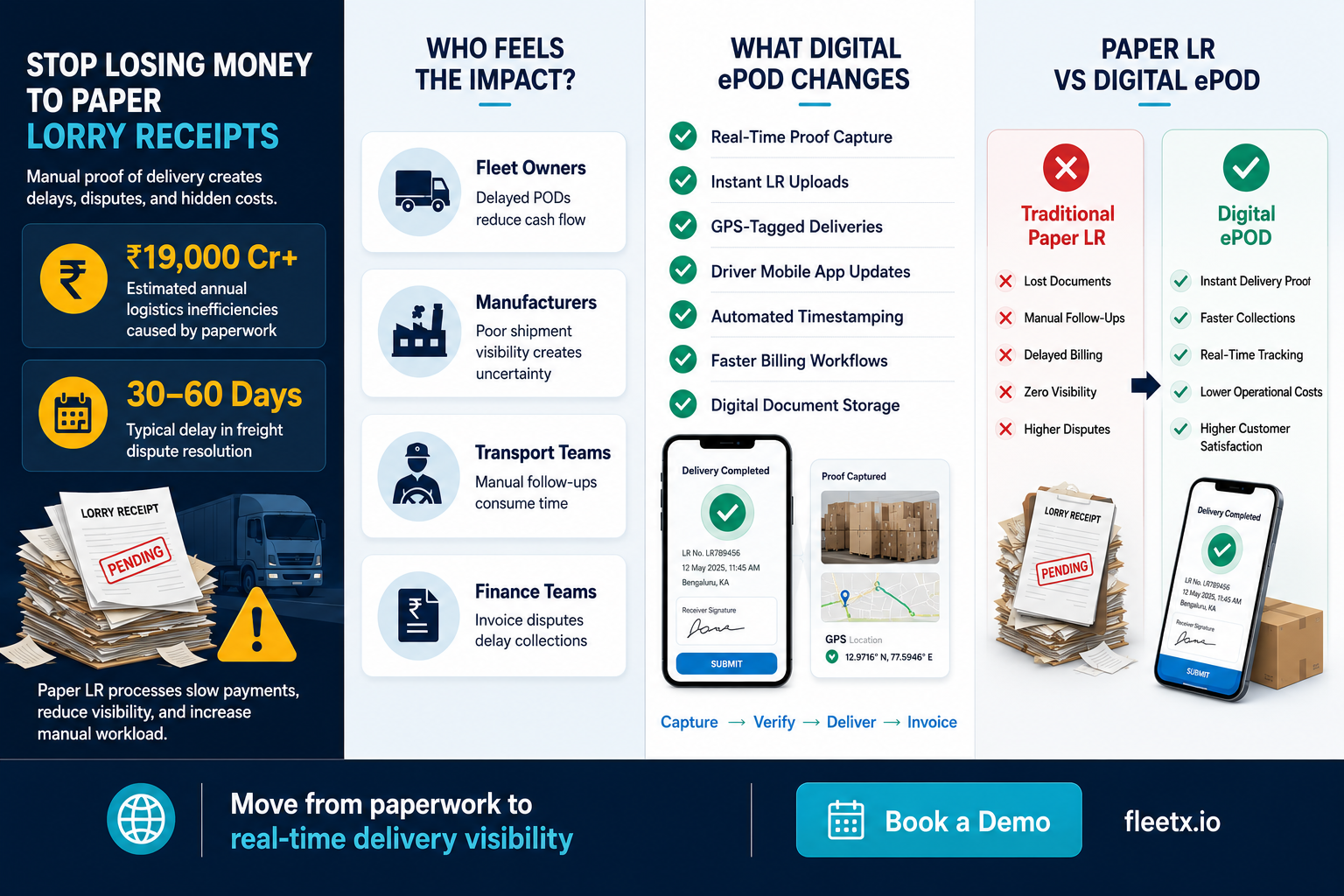
- Cash flow blocked by proof of delivery (POD) delays: Transporters in India have more than US$30 billion (~ ₹19,000 crore) locked up due to delays in obtaining physical proof of delivery (POD), which then delays invoicing/payment.
- Payment delays: After generating the physical POD, invoice processes often are delayed further by 30-60 days, adding to working capital problems.
- Inefficiency from manual workflows: Handwritten/physical documents are slow to process, error-prone, often lost/damaged, or misfiled.
E-Documentation: Why is it the Need of the Hour in the Indian Transportation Sector?
The drivers of urgent digitization include:
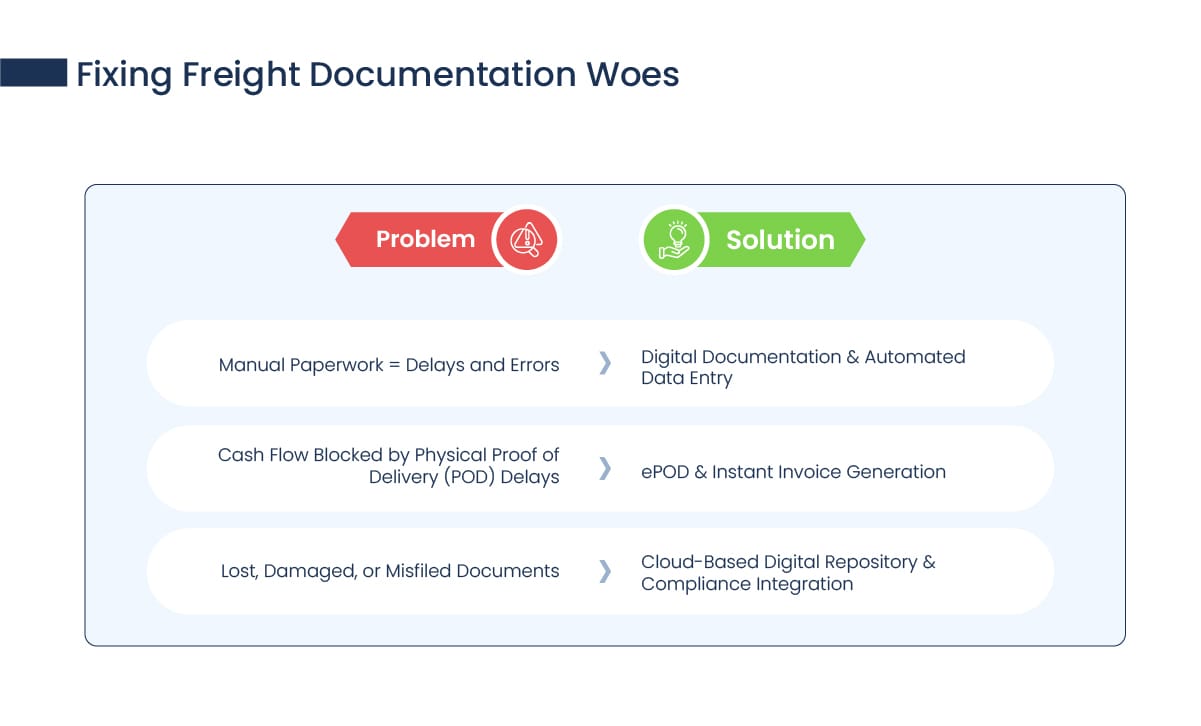
- Scale of blocked funds: As above, nearly ₹19,000 crore is locked up due to delays in physical POD.
- Regulatory push: GST & e-way bills already mandate digitization; further pressure is expected to accept electronic PODs, etc.
- Customer expectations: Faster settlement with more transparency is demanded, and digital documentation is core to delivering that.
- Technology readiness: High mobile penetration, improving connectivity even in far-flung regions, plus platforms that support ePOD, digital LR/bilty, etc.
How is Digitized Documentation Benefitting Trucking Functions
Below is a breakdown by stage: what documents are involved, what digitization looks like, and key advantages -
Some quantified benefits:
- With ePOD/digital proof adoption, transporters can significantly reduce payment delay from weeks (often 2-3 weeks for POD return plus 30-60 day payment windows) to a much shorter cycle. Even if it cuts 50% off payment cycles, it has big working capital benefits.
- Cost saved from reducing paperwork, errors, and lost/damaged documents is harder to quantify, but global studies show digitalizing bills of lading/documentation can uncover billions of dollars in savings.
What are the Document Digitization Features of the Fleetx Platform?
Here’s a summary table of what Fleetx’s Transporter ERP offers in digitization/e-document workflows:
Unblocking Cash, Speeding Deliveries: Digitization Is Now Non-Negotiable
Numbers don’t lie: ₹19,000 crore locked in due to physical POD delays. Weeks of payment cycle spent in waiting for documents, disputes, losses, and inefficiencies eating into margins - if you’re in transportation, fleet operations, or 3PL, paper costs you more than you think - every day.
Digitization via ePOD, digital bilty, LRs, automated invoicing, and secure archives isn’t “nice to have.” It’s what separates survivors from strugglers. Platforms like Fleetx are already enabling this change.
If you’re still dragging along stacks of paper, find where your biggest delays/cash-blockers are. Start with ePOD adoption, push for digital acceptance of bilty/LR, automate dispatch & invoice matching, and continue the digitization process. Because the longer the wait, the more money you leave on the table.
Frequently Asked Questions About ePOD, Digital Bilty & Lorry Receipt Systems in India
The best ePOD software in India is typically one that combines proof of delivery capture, GPS tracking, automated invoicing, document digitization, and transporter ERP features in a single platform. Large transporters in Delhi NCR, Gurgaon, Mumbai, Ahmedabad, and Pune increasingly prefer integrated logistics automation platforms over standalone POD tools because disconnected systems create reconciliation problems later. A modern ePOD solution should support photo capture, OTP verification, digital signatures, geotagging, timestamping, and instant document uploads from a driver mobile app. Pricing in India usually ranges from ₹2,000 to ₹15,000 per month depending on fleet size, number of users, and integrations required. Top logistics companies also evaluate scalability, GST compliance, analytics, multilingual driver interfaces, and customer support responsiveness before selecting a digital POD system. For high-volume operations, cloud-based document workflows reduce delays, improve cash flow cycles, and eliminate dependency on physical POD movement.
The cost of digital bilty and lorry receipt software in India depends on fleet size, operational complexity, and whether the platform includes transporter ERP, invoicing, GPS tracking, and compliance management features. Small fleet operators handling local deliveries in cities like Gurgaon or Delhi may spend around ₹2,000 to ₹5,000 monthly for basic digital documentation features. Mid-sized logistics companies operating interstate routes between Mumbai, Delhi, Jaipur, Nagpur, or Surat often invest ₹10,000 to ₹50,000 monthly for advanced automation capabilities. Enterprise-grade transportation management systems with API integrations, analytics dashboards, automated settlement workflows, and ePOD modules may cost significantly more. However, most transporters recover the investment quickly through faster payment cycles, fewer document disputes, lower administrative overhead, and reduced losses from misplaced paperwork. In India’s highly competitive trucking sector, manual documentation is now becoming more expensive than digitization itself.
Transporters in Delhi NCR and Gurgaon are rapidly adopting digital POD systems because freight movement in the region is extremely time-sensitive and operationally dense. Manual paperwork delays directly impact billing cycles, truck turnaround time, and customer satisfaction. Logistics companies serving industrial hubs like Manesar, Faridabad, Bhiwadi, Noida, and Kundli face heavy shipment volumes daily, making physical POD collection increasingly inefficient. Digital proof of delivery systems allow transport teams to instantly upload delivery confirmation using mobile devices, reducing document turnaround from weeks to minutes. Many Gurgaon-based logistics operators are also under pressure from enterprise clients demanding real-time visibility, faster settlements, and better compliance tracking. Additionally, GST digitization and e-invoice adoption have accelerated the shift toward paperless workflows. Transporters that still rely heavily on physical bilty copies and manual signatures are struggling with slower operations, reconciliation errors, and rising administrative costs.
Mumbai’s logistics ecosystem handles high-volume freight across industries such as pharmaceuticals, FMCG, retail distribution, chemicals, automotive, construction materials, and export-import operations. These sectors benefit heavily from ePOD and digital documentation because shipment delays, misplaced paperwork, and compliance gaps directly affect customer commitments and working capital. Pharmaceutical transporters especially require digitally traceable proof of delivery and timestamp validation to maintain regulatory accountability. FMCG and retail distributors operating across Mumbai, Navi Mumbai, Bhiwandi, and Thane rely on faster delivery confirmation to accelerate invoicing and distributor settlements. Digital bilty and LR systems also reduce operational friction at warehouses and transport hubs where document verification traditionally slows dispatches. Companies moving high shipment volumes daily prefer integrated transporter ERP platforms because they centralize tracking, invoicing, POD management, and freight settlement into one workflow instead of juggling disconnected spreadsheets, WhatsApp photos, and physical paperwork folders.
In India’s trucking and freight industry, the terms bilty and lorry receipt (LR) are often used interchangeably, although operationally they may differ slightly depending on the transporter or region. A bilty is generally a transport document issued by the transporter acknowledging receipt of goods for shipment. A lorry receipt serves as a formal proof that the transporter has accepted goods for transportation from the consignor to the consignee. Both documents contain shipment details such as consignee name, vehicle details, freight charges, material description, origin, destination, and dispatch information. Traditionally these documents were paper-based, but modern logistics operations are shifting toward digital bilty and eLR systems. Digital versions reduce manual entry errors, improve shipment visibility, and simplify compliance management. Transport companies operating large interstate fleets now prefer automated documentation systems integrated with transporter ERP and ePOD workflows.
Yes, ePOD or electronic proof of delivery is increasingly accepted across India’s logistics and transportation sector as a valid operational document when supported by digital timestamps, GPS data, customer signatures, OTP verification, or photo evidence. Many enterprise shippers, 3PL providers, and transporter companies now use ePOD systems to accelerate invoicing and reduce dependency on physical POD collection. While specific legal acceptance may vary depending on contractual agreements and customer requirements, digital documentation aligns strongly with India’s broader GST, e-invoicing, and digitization initiatives. Courts and compliance processes increasingly recognize digitally traceable records when audit trails and authentication layers are properly maintained. For transporters operating across Delhi, Mumbai, Bangalore, Chennai, and Hyderabad, ePOD adoption has become more of a competitive necessity than an experimental technology. Physical POD-only workflows are simply too slow for modern supply chain expectations.
Freight payment delays in India often happen because physical proof of delivery documents take days or weeks to return from the delivery location to the transporter’s accounts team. Without POD confirmation, invoicing is delayed, which directly affects transporter cash flow. Digital documentation systems solve this problem by instantly capturing and uploading delivery confirmation through mobile applications. Once the consignee signs digitally or verifies delivery through OTP, the ePOD is automatically stored in the system and linked to invoicing workflows. This significantly reduces turnaround time for billing and payment processing. Transporters handling routes between Delhi, Mumbai, Kolkata, Chennai, and industrial clusters like Gurgaon or Sanand benefit heavily from this automation because large shipment volumes make manual paperwork unmanageable. Faster document flow also improves customer trust, reduces disputes, and enables better financial planning for logistics operators and fleet owners.
Top transporter ERP systems in India help logistics companies centralize operations such as fleet tracking, digital documentation, trip management, freight billing, POD collection, driver management, and compliance monitoring into a single platform. Instead of operating through spreadsheets, physical files, WhatsApp updates, and manual reconciliations, transporters gain real-time operational visibility across dispatch, transit, and delivery stages. Logistics companies in Delhi NCR, Mumbai, Pune, Hyderabad, and Ahmedabad are increasingly investing in transporter ERP platforms because rising fuel costs, operational leakages, and customer expectations require tighter control over logistics workflows. Digital systems also improve scalability by reducing dependency on manual paperwork and repetitive data entry. Most importantly, integrated documentation workflows help reduce payment delays and disputes. In India’s highly fragmented trucking ecosystem, transporter ERP adoption is gradually becoming a business survival strategy rather than just a technology upgrade.