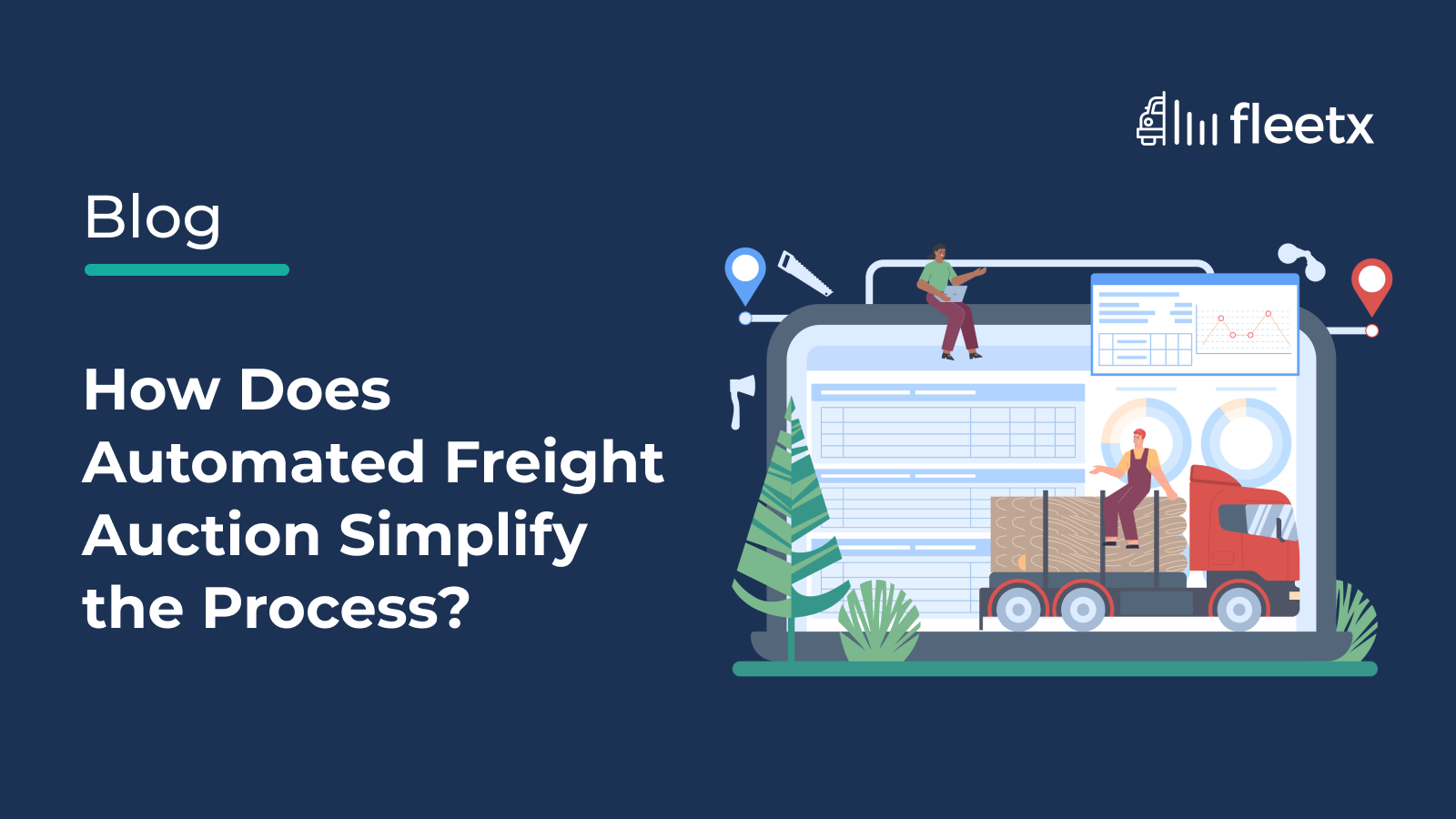
How Does Automated Freight Auction Simplify the Process?

Jump ahead

🚚 Key Takeaways

  • Automated freight auctions reduce manual negotiation and speed up transporter selection.
  • AI-powered freight bidding platforms improve pricing transparency and real-time decision-making.
  • Digital freight marketplaces help shippers match instantly with suitable carriers across India.
  • Dynamic auction pricing and reverse bidding optimize freight procurement costs.
  • Fleetx enables WhatsApp-based spot bidding, real-time bid updates, and automated freight management.

Logistics operations involve an extensive spread of functions - sourcing raw materials, manufacturing goods, and finally delivering them to the buyer - often becoming a complex process involving several stakeholders. However, freight movement can become effortless by employing several streamlined processes. Managing freight bids online is one such approach.  

What was the Traditional Approach to Freight Bidding

The bid for freight process traditionally involves yearly contracts with estimates of the total freight volume and the mutually settled rate. Breach of contract invites consequences for both parties. Mostly, business owners cannot avail of better deals as they are obligated to the existing contractors. Moreover, the additional risk of carriers backing out in times of increased demand is a bother.

Under such circumstances, mini-bids cover the routes denied by contractors. To enable the process, shippers use a request for proposal (RFP) to multiple carriers from a specified group to address the demand surge. Many shippers take on the challenge of transport bidding themselves, making it an economical solution but it’s a time-consuming task. Alternatively, 3PL companies act as negotiators between the shippers and carriers.

Freight brokers act as a bridge between these two parties, actively searching for the most favorable deals to secure sufficient spots for the shipper and the most favorable freight rates for the carrier. Each successful logistics bidding leads to a commission, based on the total value of the shipment.

How has Technology Impacted Freight Auction

With the evolving bidding process, RFPs are conducted half-yearly or quarterly. Technology has enabled carriers and brokers to manage bid responses optimally, throughout the year. Cloud-based SaaS logistics bidding platforms simplify the entire process and an overview of the benefits includes:

  • Real-time visibility into the carrier capacity, costs, and other relevant details
  • Accessibility to data intelligence, both real-time and historical, facilitates faster decisions
  • Improved communication channels to find mutually beneficial solutions swiftly

📈 Industry Snapshot: A Gurgaon-based FMCG shipper reduced spot procurement delays by 38% using automated freight auctions, enabling faster transporter allocation, improved bidding visibility, and quicker freight decision-making across high-volume delivery routes.

Transforming the Digital Freight Marketplace with Cloud-Based Freight Bidding Software

The modern digital freight marketplace offers a dual-sided dynamic mechanism that maintains equilibrium and fairness for all stakeholders.

Freight to Carrier Smart Matching

Transport bidding sites in India eliminate the need for manual intervention, enabling shippers to automatically connect to a suitable match based on their specific requirements. The swift mechanism saves time, otherwise wasted on manual RFP processing. Carriers get the opportunity to sell their empty miles at the last minute, and the shippers can access competitive offers in the market.

Dynamic Auction Pricing

Spot auctions take up most of the time in the entire bidding cycle due to the absence of a predefined contract. However, this is a favored solution in case of priority shipments and the availability of surplus shipment space along the shippers’ preferred route, or when the annual shipment volume is low altogether. An algorithm-based approach evaluates such variable factors rapidly and accepts or rejects accordingly.

Contract Management

AI can handle the contracts, too. Shippers mostly prefer to secure their spots assuredly by optimally merging contracts with spot auctions. In frequently used routes, contracting lanes are more beneficial than searching for spots.

Strategic Freight Sourcing and Reverse Bidding

Machine learning (ML) streamlines the work of the freight-sourcing teams by assembling all carrier-based information at ready disposal for swift decisions. Automated pricing lets carriers optimize their reverse bidding strategies as well, with the prices going down in a process reversal.

Logistics Optimization & Market Monitoring

The modern digital marketplace arms freight forwarders and stakeholders with tools to deal with the dynamically changing rates, ensuring fairness in pricing. An automated system updates itself with real-time market rates and other variables so that buyers and sellers do not have to monitor the market conditions themselves.

Why Should You Manage Freight Bidding with Fleetx?

With a thorough understanding of the logistics landscape in India and solving the various issues associated, the spot auction platform from Fleetx drives cost efficiency and provides convenience through features that provide:

WhatsApp-Based, On-the-Go Spot Bidding

Leverage the convenience of WhatsApp for spot bidding. Submit and monitor bids through the app and participate in auctions anytime-anywhere.

Real-Time Updates

Stay informed with instant notifications on transporter bids, allowing quick, informed decisions for seamless auction management.

Benefits of the Fleetx Freight Procurement Tool

If you are still unsure about stepping into the automated bidding landscape, the following benefits might ease your decisions:

Lower Labor Costs

Automation saves staff time and resources by eliminating the manual need for sending out public tenders, managing multiple carrier calls and emails, organizing paperwork, or rate negotiations. The WhatsApp-based quick update feature has gained significant popularity amongst users. 

Insightful Decision-Making

Data-driven quote options let shippers compare bid details analytically to identify the best freight option. Visibility into real-time pricing facilitates strategic bid choices.

Flexibility & Command

Each business can tailor the solution as per their freight requirement, providing flexible automation settings and operational norms. The Fleetx solution tracks and manages vendor-wise and route-wise profitability through the market/hired vehicle module, automates the billing process, sends auction and bid updates through WhatsApp, and more.

Ensure Hassle-Free Freight Bidding, Every Time

Based on an organization’s specific strategies, correlating the industry segment, carrier preference, and purchasing strategies, automated freight bidding can be a complex configuration. Selecting an experienced software provider is key to success.

🚛 Frequently Asked Questions About Automated Freight Auction

The best automated freight auction platforms in India are designed to reduce manual freight negotiations, improve transporter allocation speed, and optimize freight procurement costs. Businesses operating in logistics-heavy hubs like Delhi NCR, Gurgaon, Mumbai, Pune, and Ahmedabad increasingly rely on AI-powered freight bidding platforms for real-time transporter matching and spot auctions. A top freight auction platform usually includes reverse bidding, automated RFQ management, live transporter participation, WhatsApp bidding, lane-wise rate comparison, and freight analytics dashboards. Large enterprises in FMCG, cement, steel, retail, and manufacturing sectors use these tools to improve freight visibility and reduce procurement leakages. Pricing for freight bidding software in India generally starts from ₹25,000 to ₹1.5 lakh per month depending on shipment volume, integrations, automation depth, and enterprise requirements. Many SaaS-based logistics bidding platforms also offer scalable pricing for mid-sized businesses. Companies in Gurgaon and Mumbai especially prefer cloud-based freight auction systems because they help reduce empty miles, improve truck utilization, and eliminate delays caused by manual tendering processes.
The cost of automated freight bidding software in India depends on the number of transporters, shipment frequency, integration requirements, and operational complexity. For small and medium-sized businesses in Delhi, Gurgaon, Noida, and Mumbai, pricing can begin around ₹25,000–₹50,000 per month for basic spot auction and transporter management features. Enterprise-grade transportation procurement platforms with AI-based rate prediction, reverse auction workflows, ERP integration, GPS visibility, freight audit modules, and analytics can range between ₹1 lakh and ₹5 lakh monthly. Some providers also charge based on shipment volume or annual contracts. Businesses managing large-scale freight procurement often recover costs quickly through freight savings, lower detention costs, reduced empty return trips, and faster transporter allocation. Logistics-intensive sectors such as manufacturing, automotive, retail distribution, steel, and eCommerce particularly benefit from automated freight sourcing systems. Companies in Gurgaon and Mumbai are increasingly adopting these tools to improve operational agility and reduce dependency on manual rate negotiations done over calls and spreadsheets.
Transport companies in Gurgaon, Mumbai, and other major logistics corridors are rapidly shifting toward digital freight marketplaces because traditional freight allocation methods are slow, opaque, and heavily dependent on manual coordination. AI-powered freight marketplaces simplify transporter onboarding, automate bidding, and improve load matching efficiency. In high-volume freight regions like Delhi NCR and Mumbai, companies often manage hundreds of transporters simultaneously. Manual phone-based bidding creates pricing inconsistencies, operational delays, and low visibility into market rates. Digital freight platforms solve this by enabling real-time spot auctions, automated lane allocation, and instant bid comparisons. Another major advantage is visibility. Fleet operators and shippers can track transporter performance, route profitability, freight trends, and bid participation in one centralized dashboard. Modern logistics marketplaces also help carriers monetize empty miles and improve truck utilization. This is especially valuable in metro regions where fuel costs, tolls, and turnaround times directly affect freight margins. The result is faster procurement, better pricing control, and improved transporter relationships.
AI significantly improves freight auctions by automating pricing decisions, transporter matching, and bid evaluation processes. In traditional freight procurement, logistics managers spend hours negotiating rates manually with transporters across multiple routes. AI-based freight auction systems reduce this workload by instantly analyzing route demand, market rates, truck availability, and historical transporter performance. Reverse bidding becomes smarter because AI algorithms can identify optimal freight rates in real time. Instead of relying purely on lowest-cost bids, advanced systems evaluate delivery timelines, transporter reliability, fleet availability, and historical turnaround performance before selecting a carrier. In logistics hubs like Delhi, Gurgaon, Mumbai, Chennai, and Bengaluru, AI-driven freight sourcing helps enterprises react quickly during seasonal demand spikes. The system continuously monitors market fluctuations and recommends better freight procurement strategies automatically. Businesses using AI-enabled freight procurement platforms often report lower freight costs, faster transporter allocation, improved shipment visibility, and reduced operational dependency on manual intervention. It transforms freight procurement from reactive negotiation into a data-driven logistics strategy.
Automated freight auction software is especially beneficial for industries with high shipment volumes, dynamic transportation requirements, and large transporter networks. In India, sectors such as FMCG, cement, steel, automotive, construction materials, retail, eCommerce, chemicals, and manufacturing are among the biggest adopters of digital freight bidding platforms. Companies operating across Delhi NCR, Mumbai, Pune, Chennai, and Ahmedabad often manage multiple transporters and thousands of shipments monthly. Manual freight procurement creates delays, inconsistent pricing, and limited visibility into transporter performance. Freight auction platforms simplify this by automating transporter selection and enabling real-time bidding. Steel and cement industries particularly benefit because freight represents a significant percentage of total operational costs. Retail and FMCG companies use automated freight sourcing to manage seasonal demand surges efficiently. The best logistics auction platforms also help enterprises optimize lane allocation, reduce empty truck movement, automate billing workflows, and improve vendor accountability. Businesses adopting AI-based freight procurement systems gain stronger cost control and significantly faster freight decision-making across operations.
You've successfully subscribed to Fleetx
Great! Next, complete checkout to get full access to all premium content.
Error! Could not sign up. invalid link.
Welcome back! You've successfully signed in.
Error! Could not sign in. Please try again.
Success! Your account is fully activated, you now have access to all content.
Error! Stripe checkout failed.
Success! Your billing info is updated.
Error! Billing info update failed.