
A fleet operator in Rajasthan runs 40 trucks on long-haul routes. His fuel bill has been climbing for three years. Mileage per litre is down. Maintenance costs are up. He blames rising diesel prices, bad roads, and ageing vehicles. His operations manager blames the drivers. His drivers blame the trucks.
Nobody is looking at the fuel tank.
Three months after installing fuel level sensors across his fleet, he discovers that 11 of his 40 trucks are consistently losing between 20 and 40 litres of diesel on overnight routes, at locations where the trucks are supposed to be in transit. The loss is not from consumption. The tanks are being physically drained while the trucks sit at unauthorised stops on dark highway stretches.
He has been losing an estimated 18 to 22 lakh rupees per year to fuel theft alone. For three years.
This is not an exceptional story. It is a representative one. Fuel theft is one of the most widespread and underreported problems in Indian commercial fleet operations, and it persists primarily because most fleets lack the right monitoring technology to see it clearly.
Let's explore how fuel theft happens in Indian truck fleets, why traditional monitoring methods consistently fail to catch it, and how real-time fuel level sensors integrated with fleet management platforms are giving operators the visibility they need to stop the bleeding.
How serious is fuel theft in Indian truck fleets?
Fuel typically accounts for 35 to 45 percent of total fleet operating costs in India. For a mid-sized fleet running 50 trucks on long-haul routes, that translates to several crores of rupees per year flowing through fuel alone. The sheer volume of diesel moving through an Indian fleet makes it a high-value target, and the opacity of traditional fuel management makes it an accessible one.
Industry estimates suggest that Indian fleet operators lose between 10 and 20 percent of their total fuel expenditure to theft and pilferage annually. On a fleet spending 2 crore rupees per year on diesel, that is 20 to 40 lakh rupees walking out of the business every single year through the fuel tank.
The range in estimates is wide because underreporting is endemic. Fleet operators who discover theft frequently choose internal resolution over formal complaints, either to avoid reputational exposure or because the evidentiary standard required for a police complaint is too difficult to meet with paper records alone. A receipt that says 150 litres were filled and a driver who says the truck ran slow because of road conditions are not evidence of anything.
The practical result is that fuel theft is both widespread and largely invisible in the absence of real-time monitoring technology. And invisibility is exactly what allows it to continue for years.
How fuel theft actually happens: 5 methods used in Indian fleets
Understanding how fuel is stolen is the first step toward understanding why a sensor catches it so effectively. Fuel theft in Indian truck fleets is not a single behaviour. It is a spectrum of methods ranging from opportunistic petty pilferage to organised, systematic extraction. Here are the five most common approaches.
1. Siphoning at Unauthorised Stoppages
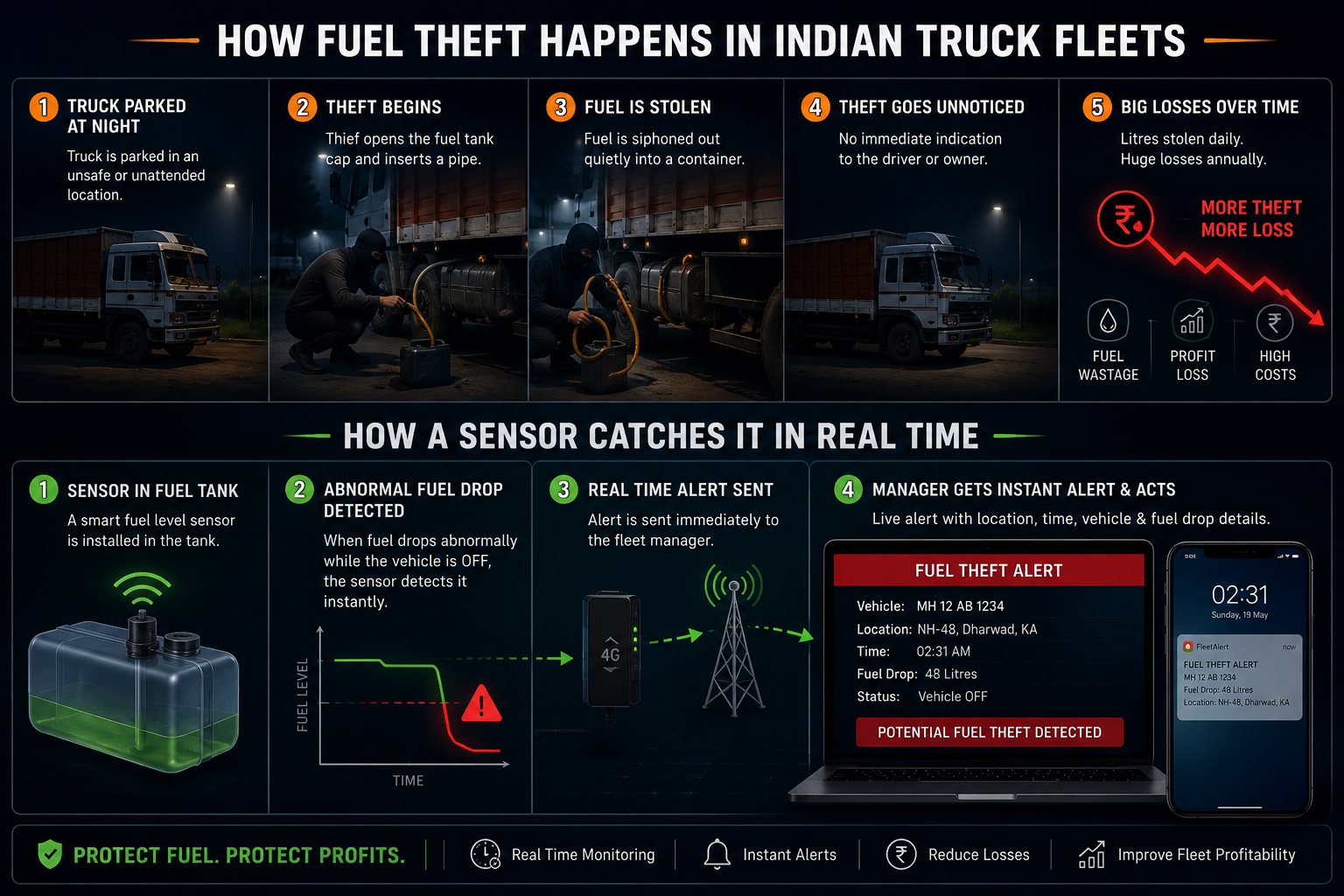
The most common method. A truck stops at a pre-arranged location on a quiet highway stretch, typically at night or in the early hours of the morning. A second party arrives with a transfer pump or manual siphon. Diesel is extracted directly from the tank, transferred to containers or another vehicle, and the truck continues its journey. The whole operation takes 15 to 30 minutes.
From the fleet manager's perspective, the truck's GPS shows a brief stop at a location on the route. If there is no fuel sensor, there is no record of what happened to the fuel during that stop. The driver explains the stoppage as a meal break or a roadside rest. The fuel shortage is attributed to mileage variation or road conditions. The incident is never formally identified as theft.
This method is particularly common on National Highway corridors where trucks run overnight with minimal checkpoints and the driver has considerable independence regarding when and where to stop.
2. Short-Fuelling at the Pump
A subtler and frequently overlooked form of fuel theft that happens at the point of refuelling rather than in transit. The driver visits a fuel station, receives a receipt for say 150 litres, but only 120 litres actually enters the tank. The difference is either pocketed as a cash kickback from a colluding fuel station attendant, or the driver submits a fraudulent receipt for a higher quantity than was dispensed.
This method is particularly difficult to detect through traditional expense management because the paper trail appears clean. The receipt matches the claimed quantity. Only a fuel sensor that records the actual volume entering the tank can catch the discrepancy between what was reported and what was received.
Collusion between drivers and specific fuel stations is often long-standing. The same station is visited on every run through a particular corridor, the same attendant handles the transaction, and a reliable under-the-table arrangement has been operating for months or years before anyone notices.
3. Carrying and Selling Excess Fuel
Some drivers fill the tank to capacity and then use supplementary jerry cans carried in the cab or strapped to the chassis to carry additional diesel. The extra fuel is sold directly to other drivers, small vehicle operators, or local buyers at roadside stops. This method works best on routes where the driver has freedom over fuelling decisions and the fleet manager has no visibility into tank levels between fill-ups.
On fleets that reimburse fuel at a fixed per-kilometre rate or on a route-based budget, a driver who sources cheaper diesel (or sells fleet diesel to pocket the margin) can create a significant illicit income stream with very little risk of detection through manual monitoring.
4. Adulterating or Diluting Fuel
Less common but damaging in a fundamentally different way. Diesel is mixed with kerosene or another lower-grade fuel, with the difference pocketed or sold. The truck runs on adulterated fuel, which the driver reports as genuine diesel consumption. Engine wear accelerates. Mileage drops. The fleet manager sees a maintenance cost problem that is actually a fuel fraud problem.
This method is particularly insidious because the damage it causes extends far beyond the immediate theft value. A single tank of adulterated diesel can cause injector damage and filter blockages that cost many times the value of the stolen fuel to repair. And because the symptoms look like ordinary wear, the connection to fuel adulteration is rarely made without sensor data as evidence.
5. Fuel Card and Bill Manipulation
In fleets using fuel cards or pre-approved fuel accounts at network stations, collusion between drivers and fuel station staff can result in inflated fill records. Multiple swipes for partial fills recorded as single full fills. Fuel card use at locations the vehicle was never near. Receipts for premium diesel when standard diesel was dispensed.
As fleet operators have moved toward digital payment systems for fuel in an effort to improve accountability, a new layer of manipulation has emerged alongside it. Without sensor-side verification, a fuel card transaction record is only as reliable as the honesty of the people generating it.
Why do traditional fuel monitoring methods fail?
Most Indian fleet operators have some form of fuel management in place. They track fuel receipts. They calculate mileage per litre averages. They set per-trip fuel budgets. They compare actual spend against benchmarks. And yet theft continues, because all of these methods share a fundamental weakness: they are based on reported data, not independently measured data.
A driver who submits a fraudulent fuel receipt is feeding corrupted information into a system that has no way to verify it. A mileage per litre calculation that runs slightly low can always be explained by road conditions, load weight, tyre pressure, or wind. These explanations are frequently legitimate, which makes them excellent cover for the times when they are not.
Manual monitoring by operations staff compounds the problem. On a fleet of 30 or 40 vehicles running concurrent trips, no operations manager has the bandwidth to scrutinise every fuel receipt, cross-check every stoppage, and flag every mileage anomaly. The review becomes selective. The selective review is what the theft operates in the gaps of.
The only reliable solution is a monitoring system that operates independently of the driver and reports directly to the fleet management platform. That system is a real-time fuel level sensor.
How does a fuel level sensor work in trucks?
A fuel level sensor is a hardware device installed directly inside the vehicle's fuel tank. It continuously measures the actual volume of diesel in the tank using one of two primary technologies.
Capacitive sensors measure the dielectric properties of the fuel column to determine volume. They are accurate, have no moving parts, and are well-suited to the vibration-heavy environment of a long-haul truck.
Ultrasonic sensors use sound waves to gauge the distance between the sensor head and the fuel surface. They perform reliably across a range of fuel types and tank geometries.
Both types transmit readings at configurable intervals, typically every 30 to 60 seconds, to the vehicle's GPS tracker, which relays the data to the fleet management platform. The result is a continuous, timestamped, GPS-correlated record of fuel level for every vehicle in the fleet.
On the platform, this data appears as a tank level graph for each vehicle, plotted against time and GPS location. The graph tells a story that no receipt or driver report can alter.
A normal refuelling event looks like a sharp upward spike in the tank level graph, at a GPS location that matches a known fuel station, at a time consistent with the driver's reported fill. Clean, expected, and verifiable.
A siphoning event looks very different. A sudden downward drop in tank level at a GPS location that is not a fuel station, at a time when the truck is supposed to be in transit and covers no meaningful distance in the window of the drop. The platform flags this as an anomaly, generates an alert, and timestamps the event with precise location data.
That is the moment the theft is caught, in real time, while the event is still happening or within minutes of it.
What alerts does the fleet manager see in real time?
The transformative power of sensor-based fuel monitoring is not only in historical analysis after the fact. It is in real-time detection that enables intervention while the incident is occurring or immediately thereafter.
Fleetx's fuel sensor integration generates automated alerts for the following events, each with full contextual data attached.
Sudden fuel drop alert - When the tank level falls by more than a configured threshold within a short time window without a corresponding increase in distance travelled, the system fires an alert immediately. The fleet manager sees the vehicle's location, the current tank level, the rate of loss, and a map view of where the event is occurring. This catches active siphoning events in real time.
Fuelling location mismatch - When a fuel level increase occurs at a GPS location that does not correspond to an authorised or known fuel station, the system flags the fill for review. This catches instances where drivers are fuelling from unauthorised sources, which may indicate either fuel fraud or vehicle misuse.
Consumption deviation alert - When a vehicle's fuel consumption on a particular route segment is significantly higher than the historical baseline for that route under similar load conditions, the system raises a flag. This catches gradual theft, dilution, or mechanical consumption anomalies that a single-event alert might miss over a series of trips.
Receipt versus sensor reconciliation - When a driver submits a fuel receipt, the platform compares the claimed fill quantity against the sensor-recorded volume increase at the corresponding time and location. Discrepancies above a defined tolerance are flagged automatically, without requiring manual cross-referencing by the operations team.
End-of-trip fuel reconciliation report - At the conclusion of every trip, the platform generates an automatic fuel summary: fuel at departure, fuel added (verified by sensor, not by receipt alone), fuel at arrival, distance covered, and calculated consumption versus the expected baseline for that route. Discrepancies above tolerance are flagged for review before the next trip is assigned.
This suite of alerts means that a fuel theft event on an overnight route is not discovered three months later during a quarterly cost review. It is visible within minutes of occurring, while there is still an opportunity to act.
What else can fuel sensors reveal beyond fuel theft?
Fuel sensors do more than catch theft. The continuous data stream they generate illuminates fleet economics in ways that spreadsheet-based fuel management is structurally incapable of.
Driver behaviour and fuel efficiency patterns - Aggressive acceleration, excessive idling at fuel-intensive RPM levels, and over-revving all show up as elevated fuel consumption in the sensor data, correlated with specific drivers and routes. This enables targeted driver coaching that can meaningfully improve fleet-wide fuel economy, often by 5 to 8 percent, which on a large fleet represents substantial annual savings entirely separate from the theft recovery.
Fuelling quality control at the pump level - Consistent discrepancies between fuel receipts and sensor-recorded fill volumes, even small ones, point to either pump calibration issues at specific stations or systematic short-fuelling. Fleets with sensor data can identify and stop routing through fuel stations that are consistently underfilling, and have the data to demand correction from fuel network operators.
Early maintenance indicators - A sudden unexplained increase in fuel consumption on a vehicle with otherwise stable sensor data often indicates a mechanical issue: a fuel injector problem, a filter blockage, a turbocharger issue, or an air intake restriction. Catching these patterns early reduces both fuel waste and the cost of deferred maintenance. On a well-monitored fleet, sensor data frequently identifies vehicles for workshop inspection before they break down on route.
Route-level fuel benchmarking - Comparing sensor-verified fuel consumption data across different route options for the same origin-destination pair, under comparable load conditions, provides empirical data for route planning decisions. The result over time is a set of fuel consumption baselines, per route and per vehicle class, that becomes an increasingly valuable operational asset.
How does Fleetx turn fuel sensor data into fleet intelligence?
A fuel sensor in isolation generates data. A fuel sensor integrated with a fleet management platform generates intelligence that the entire operation can act on.
Fleetx's fuel monitoring module connects real-time sensor data with GPS tracking, trip records, driver profiles, and financial reporting in a unified operational view. Every fuel event is tied to a specific vehicle, driver, trip, and GPS location. Anomalies surface automatically through the alerting system rather than waiting for someone to go looking for them.
For fleet operators managing fuel card programs, Fleetx reconciles card transaction records against sensor-verified fill volumes automatically, flagging mismatches without requiring manual cross-referencing. This closes the loop on bill manipulation and short-fuelling at the pump, the methods that paper receipt management and even digital payment records alone cannot detect.
The financial reporting module converts fuel anomalies into rupee values. It is not enough to know that a vehicle showed an anomalous drop at a particular location. The platform quantifies how much was lost, attributes it to the vehicle and driver, aggregates the pattern across trips, and presents the total financial impact in a report that management can act on with confidence.
For large fleets, Fleetx's dashboard provides fleet-wide fuel performance at a glance, with drill-down capability to individual vehicles, drivers, routes, and time periods. The operations team knows, at any moment, which vehicles are performing within expected fuel parameters and which are flagged for investigation.
Implementation: What do fleet operators need to know before deploying fuel sensors?
Fuel sensor installation requires a trained technician and typically involves two to three hours of vehicle downtime per unit. The sensor is installed directly inside the fuel tank, with the signal wire routed to the vehicle's GPS tracker. On fleets where hardwired GPS trackers are already installed, adding a fuel sensor is a relatively straightforward process.
Calibration is non-negotiable - Every tank has a different geometry, and the relationship between sensor reading and actual volume must be calibrated individually for each vehicle. A proper calibration process, completed at installation with the tank at known fill levels, ensures that the platform receives accurate volume data. Shortcuts on calibration produce imprecise readings that undermine the value of the entire system. Any installation provider or platform that does not emphasise calibration quality should be treated with caution.
Phased deployment by risk profile works well - For fleets evaluating sensor deployment across a large vehicle pool, starting with the highest-mileage vehicles on the longest overnight routes delivers the fastest return on investment. Overnight long-haul vehicles have the highest theft exposure, the most fuel throughput, and the greatest distance from direct oversight. Early deployment on this segment builds organisational confidence in the technology before broader rollout.
Driver communication matters - Drivers who understand that sensors are being installed to protect fleet assets, and who are told clearly that anomalies will be investigated fairly with the data as evidence, are significantly more cooperative than those who feel the system is being introduced covertly. Transparent communication also reinforces that the sensor data will exonerate drivers from false accusations of theft, which is a meaningful protection for the majority who are operating honestly.
Why does sensor deployment change driver behaviour?
There is a dimension of fuel sensor deployment that does not show up in the raw data but is consistently reported by fleet operators across India who have implemented it: the behavioural shift.
When drivers know that a sensor is continuously recording tank levels and that the fleet management platform will immediately flag anomalies in real time, the opportunity for undetected theft effectively disappears. The rational calculation changes. Drivers who were previously extracting value from an unmonitored system find that monitoring removes both the opportunity and the ambiguity that had made it possible.
In most fleets, the large majority of drivers are not involved in active fuel theft. They are professionals doing their job honestly in a difficult environment. The accountability effect benefits them directly, because it removes the easy narrative of blaming collective driver behaviour for cost anomalies that are actually caused by a small minority. Clean, granular data makes individual accountability possible in a way that aggregate fuel cost tracking never could.
The commercial implication is significant. Fleet operators who have deployed fuel sensors consistently report that fuel cost per kilometre stabilises or improves within the first billing cycle after deployment, often before a single formal disciplinary action has been taken. The visibility itself changes the operating environment.
Conclusion: The tank has been talking. It is time to listen.
Fuel theft in Indian fleets is not a new problem. It has been tolerated, absorbed into cost structures, and explained away for decades, because until recently, there was no reliable, scalable way to see it clearly enough to address it systematically.
Fuel level sensors change that fundamental equation. They convert the fuel tank from a black box into a real-time data source, reporting every fill, every drop, every anomaly to a platform that can flag it, quantify it, and act on it.
The investment is modest relative to the losses being recovered. The payback period for a fleet absorbing even moderate fuel theft is measured in months, not years. And beyond the direct financial recovery, the operational clarity that comes from knowing exactly what your fuel is doing across your entire fleet is a foundation for every other efficiency improvement you want to build on top of it.
Fuel is your single largest variable cost. It is also your most monitored asset that is somehow the least measured. That gap is what fuel theft lives in. Close the gap, and the theft has nowhere to hide.
The tank has been talking for years. A fuel sensor is simply the tool that finally lets you hear what it has been saying.
How accurate are fuel level sensors?
A properly calibrated capacitive or ultrasonic fuel sensor is accurate to within 1 to 2 percent of actual tank volume. At this precision level, a theft of even 10 to 15 litres is clearly visible in the sensor data.
Can the sensor be bypassed or tampered with?
Tamper attempts generate alerts on the Fleetx platform. Physical disconnection of the sensor from the GPS unit shows up as a data gap, which is itself a flag for investigation. Sophisticated bypass attempts are technically possible but rare and leave evidence in the data trail.
Does installation void the vehicle warranty?
Reputable fuel sensor installations by certified technicians do not void vehicle warranties. The sensor is installed inside the tank without modifying the tank structure, and the signal wire is routed to existing tracking hardware.
How long does it take to see ROI?
For fleets with active fuel theft, return on investment is typically measured in weeks to a few months, depending on the scale of losses being recovered. For fleets where theft is not the primary driver, the efficiency gains from consumption benchmarking and driver behaviour improvement typically deliver ROI within the first year.
Is the sensor suitable for all vehicle types?
Fuel level sensors are compatible with the fuel tank configurations of most Indian commercial vehicles, including trucks, buses, tankers, and LCVs. Tank geometry varies across vehicle models, and calibration accounts for this variation.