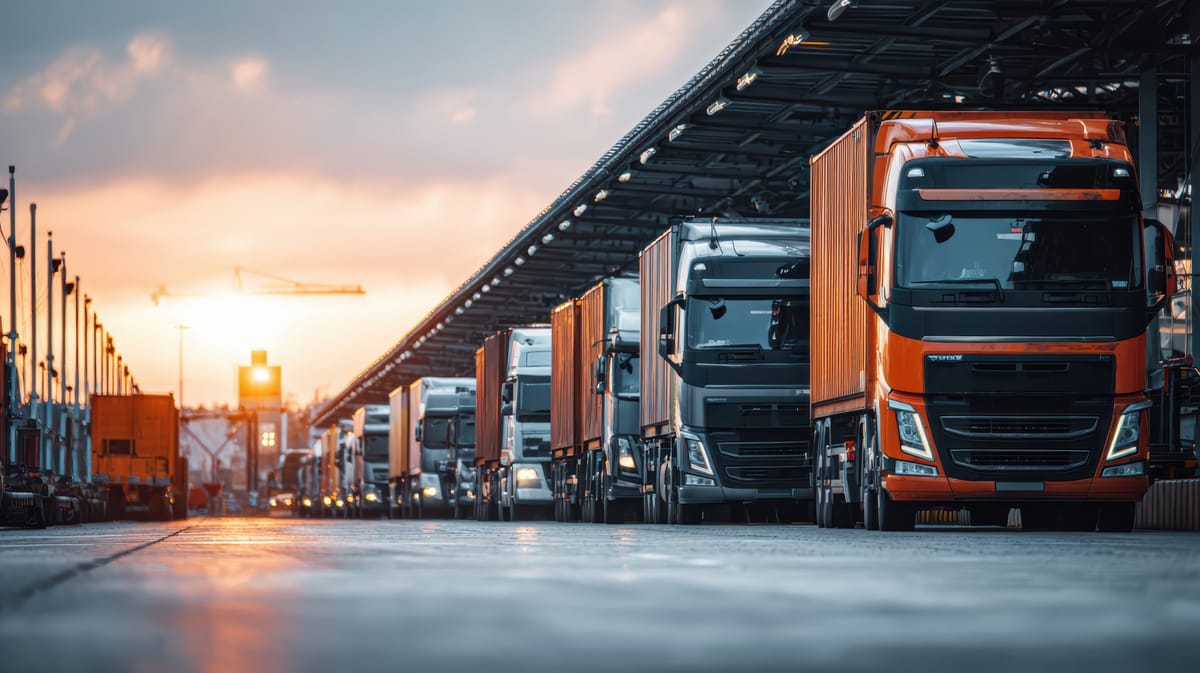
Telematics systems are primarily used by companies or service providers in the automotive or fleet management industry to offer vehicle tracking and communication services. Vehicle Telematics is what makes real-time monitoring of vehicles possible. A feature credited for revolutionizing the transportation industry by making the operations more transparent and technology-driven.
What is telematics?
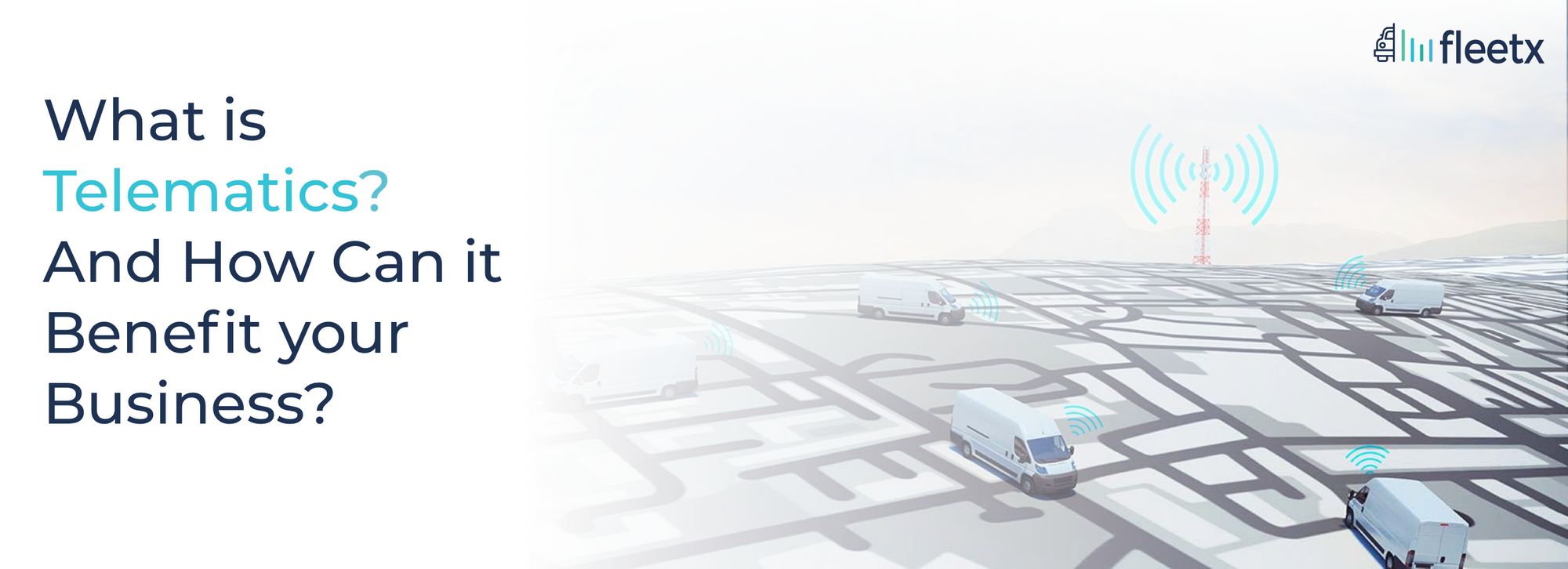
Telematics definition can be understood as a nexus between telecommunication, i.e., how communication occurs over long distances, and informatics, making data and information communicable between computers and humans. In simple terms, if one is looking for an appropriate telematics definition, a telematics system makes it possible for vehicular data to be collected and communicated to the end-user through a monitoring software of sorts.
An excellent example for us to understand how the telematics system works is through ride-sharing or e-taxi applications like Uber, Ola, etc. They use an advanced vehicle telematics system to track and communicate real-time location, speed, estimated time, and other information to both the customers and their team for all the vehicles in their fleet. Since telematics meaning is a bit clear now, we will understand how the system works in the next paragraph.
How does telematics work?
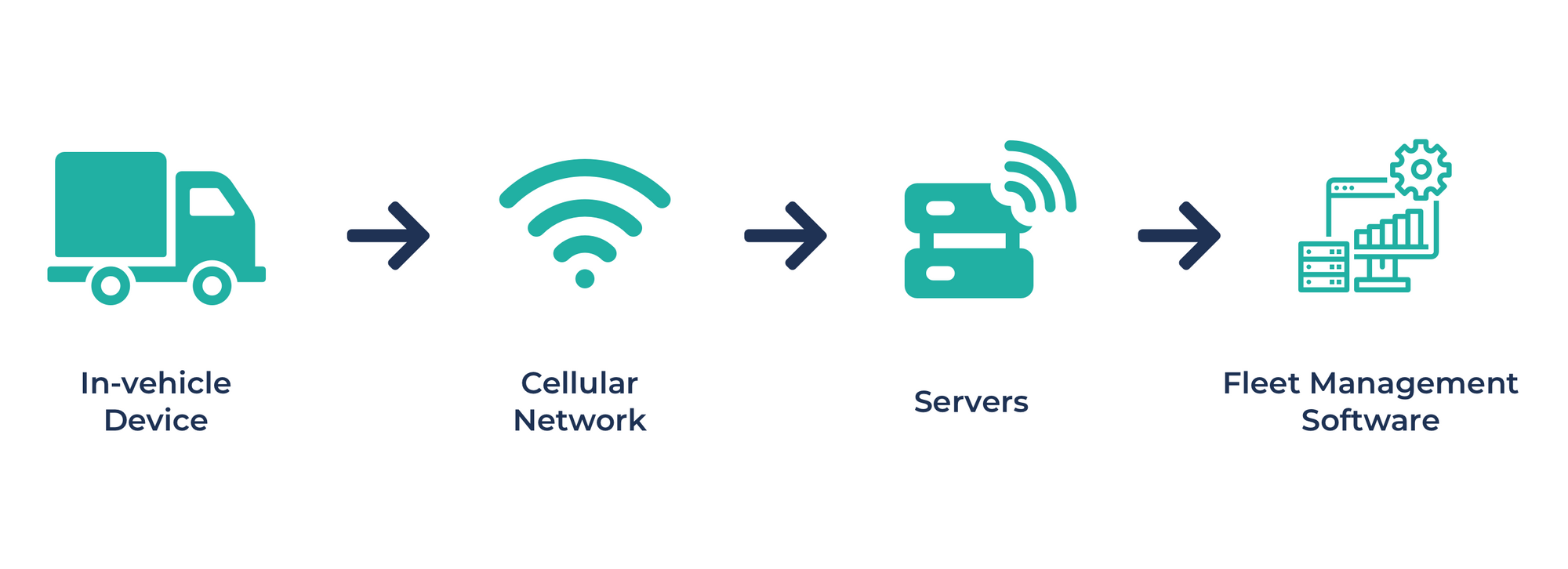
Contrary to popular belief, telematics is more than just GPS or navigation. It is an entire system for communicating every practical detail regarding the vehicle in the most efficient way. To understand how it works, we need to break it down into a list of its components.
Basics of telematics systems
The foundation of telematics is the commercialization of the Global Positioning System (GPS) and the internet, making satellite data more accessible for both private and commercial use. The advancement in GPS technology allowed for more accurate location and vehicle-related data to be collected. At the same time, the internet and machine-to-machine communication technology made it possible for that data to be communicated into helpful insight and shared across to the end-user.
What are the components of telematics systems
The most crucial component of a telematics system is a telematics device, popularly called a Black Box. A black box is fitted in the vehicle and can collect and transfer essential information regarding the car and driver to the telematics system, some of which include,
- GPS location
- Speed
- Mileage
- Trip recordings
- Drive times
- Time on location
- Fuel usage
- Driving related behavior (in case of harsh driving)
- Other data related to vehicle utility
- Driver-related details
More data is collected based on the kind of black box installed. In case of accidents, the black box is very crucial for insurance claims. Opening up another avenue for telematics called insurance telematics. Additional information like,
- engine load
- engine temperature
- errors
- seatbelt use
- cruise control
- status of the door (open or close)
And others can also be gathered, providing additional analysis related to driver maintenance, sustainability, etc.
How telematics systems work
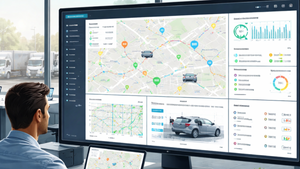
The black box can connect to various ports, including CAN-bus, OBD-port, or native sensors like ignition, fuel gauge, door sensors, etc., to gather data. The internal algorithm makes sense of this data and creates pre-formatted information. This data is transmitted to an external platform or software in real-time through the standard cellular network using the internal SIM card. From there, the end-user can access and analyze all these metrics from a single dashboard.
Why do we need telematics technology?
Telematics has carved out an essential role for its use in various industries and businesses. Whether it is ride-sharing apps or public transport, or, to a particular extent, logistics & fleet management services, some companies wouldn't exist without an efficient telematics system. But to understand the importance of telematics, we need first to understand what questions the existence of telematics answers. The answer to that varies depending on the industry and service.
AI Telematics vs Traditional Telematics: What’s the Difference?
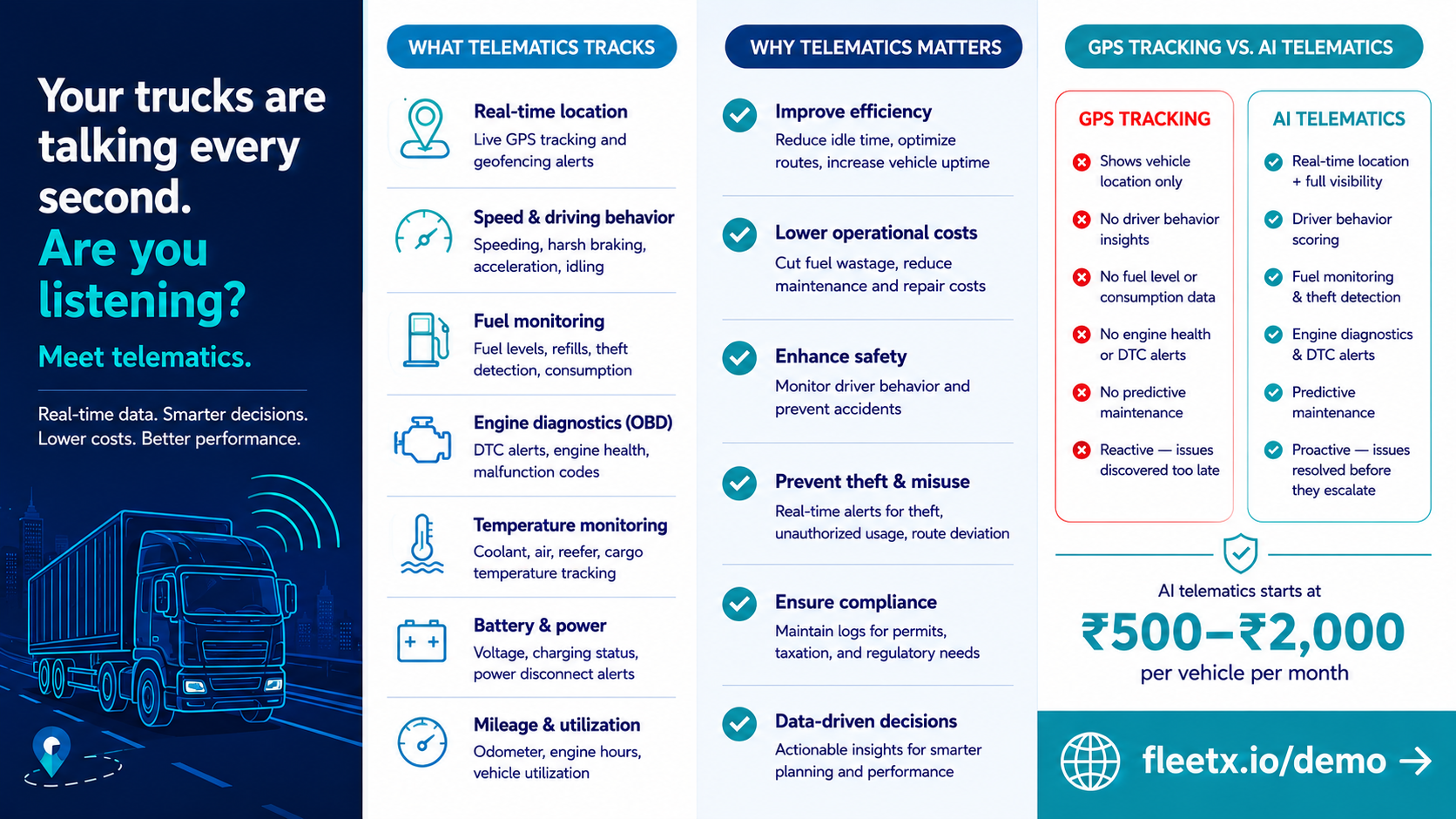
While traditional telematics systems primarily focus on GPS tracking and basic vehicle monitoring, modern AI-powered telematics platforms go far beyond location visibility. AI telematics uses machine learning, predictive analytics, automation, and real-time data intelligence to help logistics companies reduce operational costs, improve fleet safety, optimize routes, and make faster business decisions.
| Feature | Traditional Telematics | AI-Powered Telematics |
|---|---|---|
| Primary Function | Basic GPS tracking and vehicle monitoring | Predictive fleet intelligence and operational optimization |
| Data Analysis | Manual analysis with limited reporting | AI-driven real-time analytics and automated insights |
| Route Optimization | Static route planning | Dynamic route optimization using live traffic and historical trip data |
| Fuel Monitoring | Basic fuel usage visibility | AI-based fuel theft detection and fuel efficiency recommendations |
| Driver Safety | Limited driver behavior tracking | AI driver scoring, fatigue detection, harsh braking alerts, and video telematics |
| Vehicle Maintenance | Reactive maintenance after breakdowns | Predictive maintenance alerts before failures occur |
| Operational Visibility | Limited operational insights | Complete end-to-end fleet visibility with centralized dashboards |
| Alerts & Notifications | Basic location alerts | Smart anomaly detection and automated real-time alerts |
| Scalability | Difficult to scale for large fleets | Designed for enterprise-scale logistics operations across India |
| Best For | Basic fleet tracking requirements | Logistics companies seeking automation, AI insights, and cost optimization |
For logistics companies operating in Delhi NCR, Mumbai, Bangalore, Chennai, and other high-volume freight corridors, AI-powered telematics systems are rapidly replacing traditional telematics platforms. Businesses now require more than just GPS tracking — they need predictive visibility, intelligent automation, fuel intelligence, driver safety analytics, and real-time operational control to stay competitive in India’s evolving transportation industry.
Vehicle telematics in private & public transportation
For private and public transportation, a telematics system helps the business or the user by providing real-time information regarding the vehicle's location. It does so by using GPS technology to offer navigation, routing, and fleet monitoring, which has become an integral part of the way we use public and private transport today. Today, if we can,
- Navigate our cars to the required destination without asking for directions from bystanders,
- Track and enquire about the location of the bus or train in real-time,
- Monitor the status of our food delivery through our phone screens,
- Get an estimated time for us to reach our destination in a ride-sharing taxi,
And so much more, we have a highly efficient and technological driven vehicle telematics to thanks!
How is vehicle telematics in industry and fleet management making a difference?
Automotive telematics has revolutionized the logistics industry in more than one way. Tracking logistics operations with thousands of vehicles in their fleet was impossible until a couple of years ago. The entire process of logistics & transportation of goods was riddled with inefficiencies due to the lack of transparency in the fleet movement. Fleet managers were dependent on drivers for updates through phones. In remote areas, poor signal strength meant a complete lack of communication.
The lack of foresight resulted in inefficiencies like theft of goods, high operational costs resulting from poor route planning & navigation, delayed shipments, loss of revenue, and countless others, which incurred heavy financial and operational burdens on businesses. Today, with the introduction of automotive telematics, companies and fleet managers can,
- Monitor and track the location of each vehicle in their fleet through a centralized system,
- Plan and navigate through the most efficient route for each trip,
- Save cost by employing telematic-based fuel management systems to monitor fuel usage,
- Manage and schedule fleet maintenance and breakdowns,
And so much more. Telematics has brought in much-needed transparency to logistics operations required for optimal performance.
Truck telematics for construction vehicles
A use case for construction vehicles would be mixing transport trucks which uses a revolving drum attached to the vehicle for mixing materials such as cement. A Telematics system for such vehicles involves a drum rotation sensor that detects rotations at a location. Integrating such sensors with a telematics system could help companies accurately monitor drum rotations by measuring rotating speed, total drum operation time, number of starts, temperature, among others. These metrics can be transmitted to the server and made available to the user via their fleet management software on their phone or computer. By accurately measuring such metrics, companies can improve their operational efficiency and improve the life of the vehicle as well.
Another use case for truck telematics for construction vehicles could be preventing cargo theft and unwanted cargo drop-offs, which are quite common with construction vehicles like dumpers while loading and unloading. Dumper vehicles fitted with sensors like tilt sensor, load dump proximity sensor integrated with telematics system offer complete transparency in loading-unloading operation, avoid blind spots, and monitor the tilt angle while loading and unloading which helps the operator keep track of the load, avoid breakdowns, and mishaps.
What are the top 5 benefits of using telematics for commercial operations?
As discussed above, it is a no-brainer that a wide array of users uses telematics technology. They can range from taxi-aggregators like Ola, Uber, and large-scale fleet service providers or logistics companies. However, telematics offers benefits that every user can realize regardless of their use case or industry, despite the various use cases and drives. Let's look at some of the key benefits companies get by employing telematics technology in their operations.
1. Telematics systems offer complete transparency in operations to business owners.
Equipping vehicles with telematics systems offer the amount of transparency and visibility that was never possible before. Vehicle telematics allows companies and fleet managers to track each vehicle in their fleet at all times through a single dashboard. By offering a robust Vehicle Tracking System, telematics enables companies to reduce their transportation system inefficiencies and avoid malpractices and unwanted stops by drivers. It improves the quality of service offered as well as reduces operational costs.
2.Telematics systems improve accountability and safety
With much deeper and accurate insights and information related to drivers and vehicles, companies often see an exponential improvement in overall productivity in their operation. Services like Driver Behaviour Analytics & Safety allow for better evaluation of driver performance considering factors like fatigue driving, over-speeding, sharp turns, SLA violations, and various other metrics. It enables companies to hold rash drivers accountable and reward more productive employees, thus, improving their service quality and raising safety standards.
3. Telematics systems improve productivity and overall operational efficiency.
When coupled with another telematics-related tech, the black box can track fuel consumption and engine performance. Such features enable companies to track and minimize instances of engine idling which is the leading cause of unnecessary fuel consumption. In addition to that, companies can follow up with timely vehicle maintenance, which improves vehicle longevity and prevent expensive maintenance cost by tracking performance in real-time. Such vehicle telematics features cut operational costs by cutting unwanted expenses and enhancing the productivity of vehicles and overall operation.
4.Telematics systems enhance route planning and fleet optimization for better performance.
Telematics technology is capable of gathering and processing vehicle data in real-time for each trip. This data can prove a gold mine when optimizing routes. The telematics system uses historical data to predict and assess vehicle performance and provide accurate predictions and analyses concerning each trip. Metrics like estimate-time to delivery, fuel consumption, driver behavior, and performance, among others, enables companies to provide a better and more punctual service while maximizing their efficiency. Scheduling and Route Planning features allow fleet managers to choose the most efficient route for each trip using historical data and real-time traffic monitoring and navigation. High traffic, congestion, closed roads, and other circumstances can be avoided allowing for a better delivery experience.
5.Telematics systems offer better compliance and seamless integration.
Commercial logistics and transport have a very stringent set of regulations and demand extensive compliance. Tracking and complying with requirements like hours of service, electronic logging, Vehicle documents, E-way bill, among others, for all drivers and vehicles while operating large fleets can often be challenging and borderline impossible. Advance telematics system offers seamless integration with other services that cater to such compliance. Additionally, features like Electronic POD management making invoicing, challans, and other business-related documentation more accessible.
Should your business use a telematics system for better fleet management?
The logistics industry is rapidly evolving to becoming more technology-centric; however, there is still a need for widespread acceptance in day-to-day operations. The industry is still struggling with questions, and some of the most common ones are mentioned below.
- How do I cut down operational costs for my fleet?
- How to reduce fuel consumption and engine idling?
- How to check if my driver is speeding or rash driving?
- How do I prevent theft of goods in on-route vehicles?
- How to keep track of all the cars in my fleet?
- How can I avoid challans for expired e-way bills?
On a closer analysis of these questions, one can conclude that most of the problems mentioned above can be resolved by equipping the fleet with an advanced telematics system. Whether the fleet is small or large, operation intra-city or pan-country, companies, in general, have greatly benefitted from employing telematics systems in their operations.
Fleet Management companies like fleetx offer the most advanced and integrated telematics for every industry and use case. Driven by data & AI, telematics is the next leap in tech for logistics and transportation, which is on the rise.
Frequently Asked Questions About Telematics
The best telematics system for Indian fleet businesses depends on fleet size, operational complexity, and business goals. Companies operating in Delhi NCR, Gurgaon, Mumbai, Pune, and Bangalore usually prefer AI-powered telematics platforms that offer GPS tracking, fuel monitoring, route optimization, driver behavior analytics, video telematics, and predictive maintenance in one dashboard. Modern telematics solutions also integrate with FASTag, E-way bills, TMS software, and ePOD systems for end-to-end visibility. Pricing in India usually starts from ₹700 to ₹2,500 per vehicle per month depending on hardware, sensors, and software modules. For large logistics enterprises, customized pricing models are common. Businesses choosing the top telematics systems generally achieve lower fuel costs, improved fleet utilization, reduced theft risks, and better on-time delivery performance.
Telematics system pricing in India varies based on the type of vehicles, fleet size, and features required. In cities like Delhi, Gurgaon, Noida, and Mumbai, basic GPS tracking solutions typically cost between ₹5,000 and ₹12,000 per vehicle for hardware installation, while software subscription charges range from ₹700 to ₹3,000 monthly per vehicle. Advanced AI telematics solutions with dashcams, fuel sensors, temperature monitoring, and predictive analytics can cost significantly higher. Enterprise logistics companies operating long-haul fleets often invest in integrated telematics and transportation management systems to improve operational efficiency. Although initial investment may appear high, most businesses recover costs through fuel savings, lower maintenance expenses, better driver accountability, and improved delivery performance within the first year.
Logistics companies in Gurgaon and Delhi NCR are adopting telematics systems because traditional fleet management methods no longer support modern supply chain demands. Traffic congestion, fuel theft, delayed deliveries, driver shortages, and rising transportation costs have forced businesses to adopt data-driven operations. Telematics platforms provide real-time visibility into vehicle movement, route efficiency, fuel consumption, idle time, and driver behavior. For logistics hubs like Gurgaon, Manesar, Faridabad, and Delhi, this visibility is critical for maintaining SLAs and improving customer satisfaction. Businesses also use telematics to reduce detention time, improve vehicle utilization, and automate compliance tracking. AI-powered fleet intelligence has become a competitive advantage rather than a luxury for transporters operating in high-volume freight corridors across India.
Telematics offers multiple operational and financial benefits for trucking companies across India. The biggest advantage is real-time fleet visibility, allowing businesses to track every vehicle from a centralized dashboard. Telematics also helps reduce fuel wastage through route optimization and idle time monitoring. Indian transporters operating between Delhi, Mumbai, Chennai, Ahmedabad, and Kolkata use telematics to improve trip planning and reduce delays caused by traffic or route deviations. Driver behavior monitoring improves road safety and reduces accident-related expenses. Predictive maintenance alerts help avoid unexpected breakdowns on highways. Advanced telematics systems also support electronic proof of delivery, compliance management, and automated reporting. Many Indian logistics companies report improved turnaround time, lower operating costs, and better customer trust after implementing telematics technology.
Yes, telematics systems are increasingly being used across India to reduce fuel theft and cargo pilferage. Fleet operators in Delhi, Haryana, Rajasthan, Maharashtra, and Gujarat often face challenges related to unauthorized fuel draining, route deviations, and unplanned stops. Advanced telematics solutions integrate with fuel sensors and AI-based analytics to detect unusual fuel drops, excessive idling, and suspicious vehicle behavior in real time. Alerts are instantly sent to fleet managers, allowing quick action before losses increase. GPS-based tracking also improves route accountability and reduces unauthorized stoppages. For long-haul trucking operations, even a small reduction in fuel theft can generate substantial annual savings. This is why fuel monitoring has become one of the most demanded telematics features in India’s logistics and transportation industry.
Several industries in India heavily rely on telematics systems to improve operational visibility and efficiency. Logistics and transportation companies are the largest adopters, especially those handling FMCG distribution, eCommerce deliveries, cold chain transportation, cement logistics, mining operations, and pharmaceutical supply chains. Businesses operating in Mumbai, Delhi NCR, Hyderabad, Chennai, and Bangalore use telematics to monitor fleet movement, improve turnaround times, and reduce operational leakages. Construction companies use telematics for dumpers and heavy equipment monitoring, while cold chain operators depend on temperature tracking sensors for cargo safety. Passenger transportation businesses, including employee transport and bus operators, also use telematics for route monitoring and passenger safety. As AI adoption grows, telematics is becoming central to digital transformation across India’s mobility ecosystem.
AI has transformed telematics from a simple tracking system into an intelligent logistics optimization platform. Modern AI-powered telematics systems can analyze large volumes of fleet data to identify inefficiencies, predict delays, optimize routes, and improve driver performance. Logistics businesses in Delhi, Gurgaon, Mumbai, and Bangalore increasingly use AI telematics to reduce operational costs and improve customer service levels. Predictive maintenance algorithms help prevent vehicle breakdowns before they occur, while AI-based driver scoring improves safety compliance. Smart routing engines analyze live traffic conditions and historical trip data to recommend faster and more fuel-efficient routes. AI also enhances video telematics by detecting unsafe driving events like mobile phone usage, harsh braking, and fatigue. This makes logistics operations more proactive, scalable, and data-driven.
Many businesses confuse GPS tracking with telematics, but the two are very different. GPS tracking primarily provides vehicle location data, while telematics is a much broader technology ecosystem. Advanced telematics systems combine GPS data with fuel analytics, engine diagnostics, driver behavior monitoring, predictive maintenance, route optimization, compliance tracking, and AI-powered reporting. In logistics-heavy cities like Delhi, Mumbai, and Gurgaon, businesses increasingly prefer full telematics platforms over standalone GPS tracking because operational visibility is now critical for profitability. GPS tracking tells businesses where a vehicle is, but telematics explains how efficiently that vehicle is operating. This deeper operational intelligence helps logistics companies reduce costs, improve delivery performance, increase asset utilization, and build more reliable transportation networks across India.