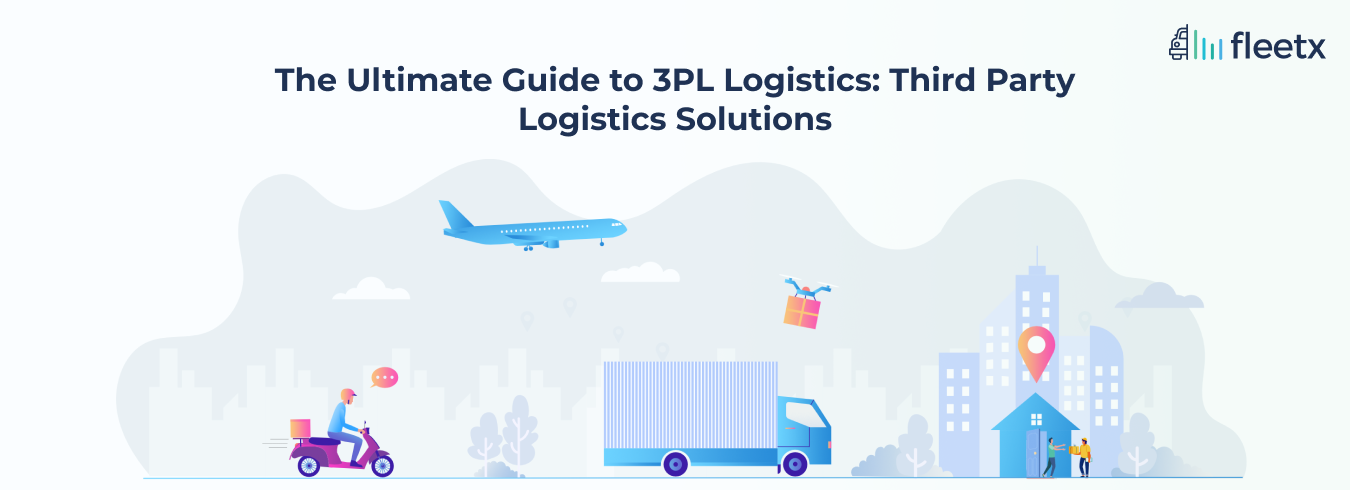
According to reports, the global logistics market is estimated to be at 1v2% of the global GDP in 2018. This comes as no surprise as an efficient logistics system is essential to run any successful business or organization which deals with products. Key factors like business type, scale, feasibility, efficiency among others are considered whether an organization chooses to manage the logistics for their entire operation internally or outsource it to companies that specialize in logistical and supply-chain operations.
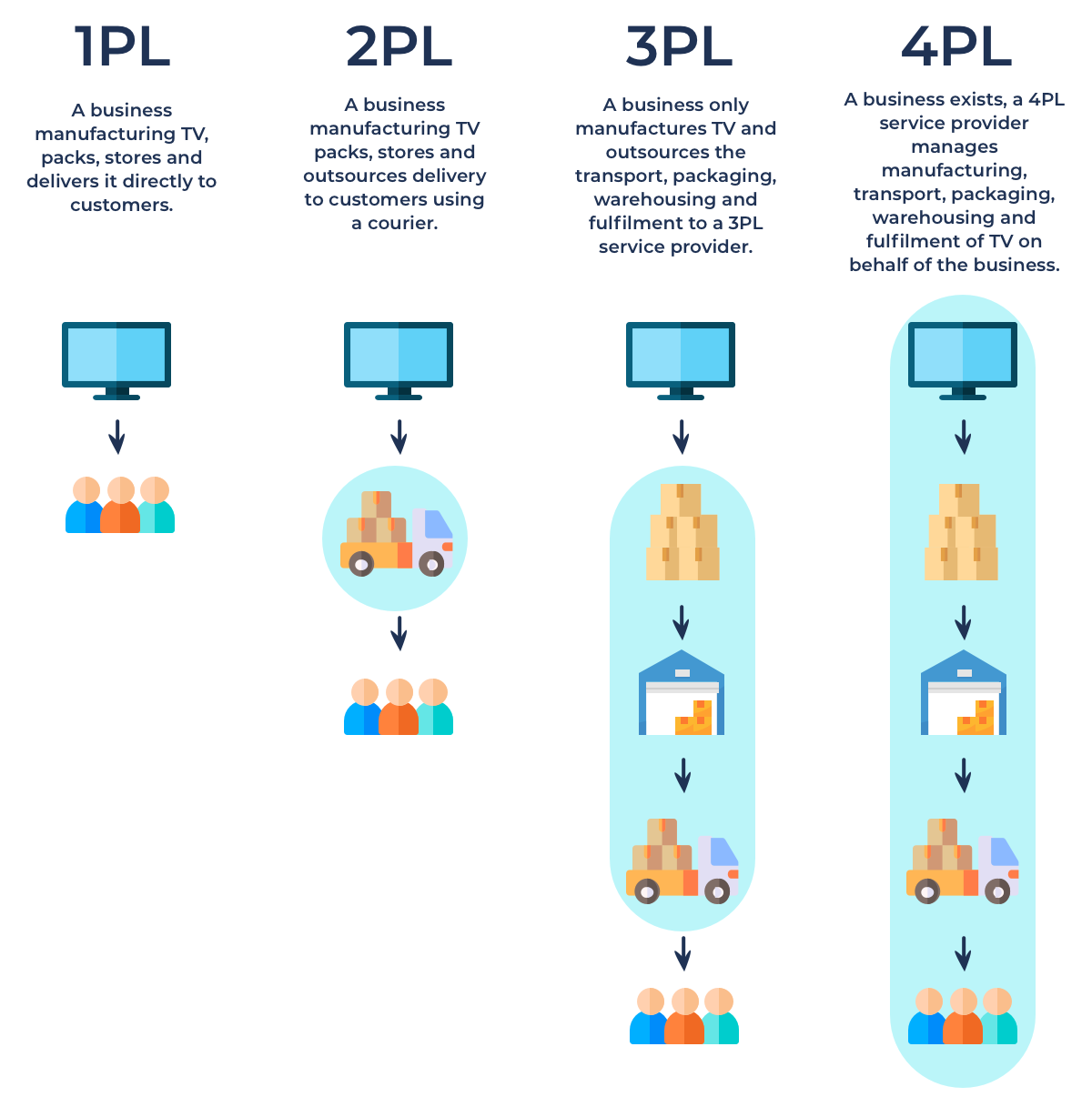
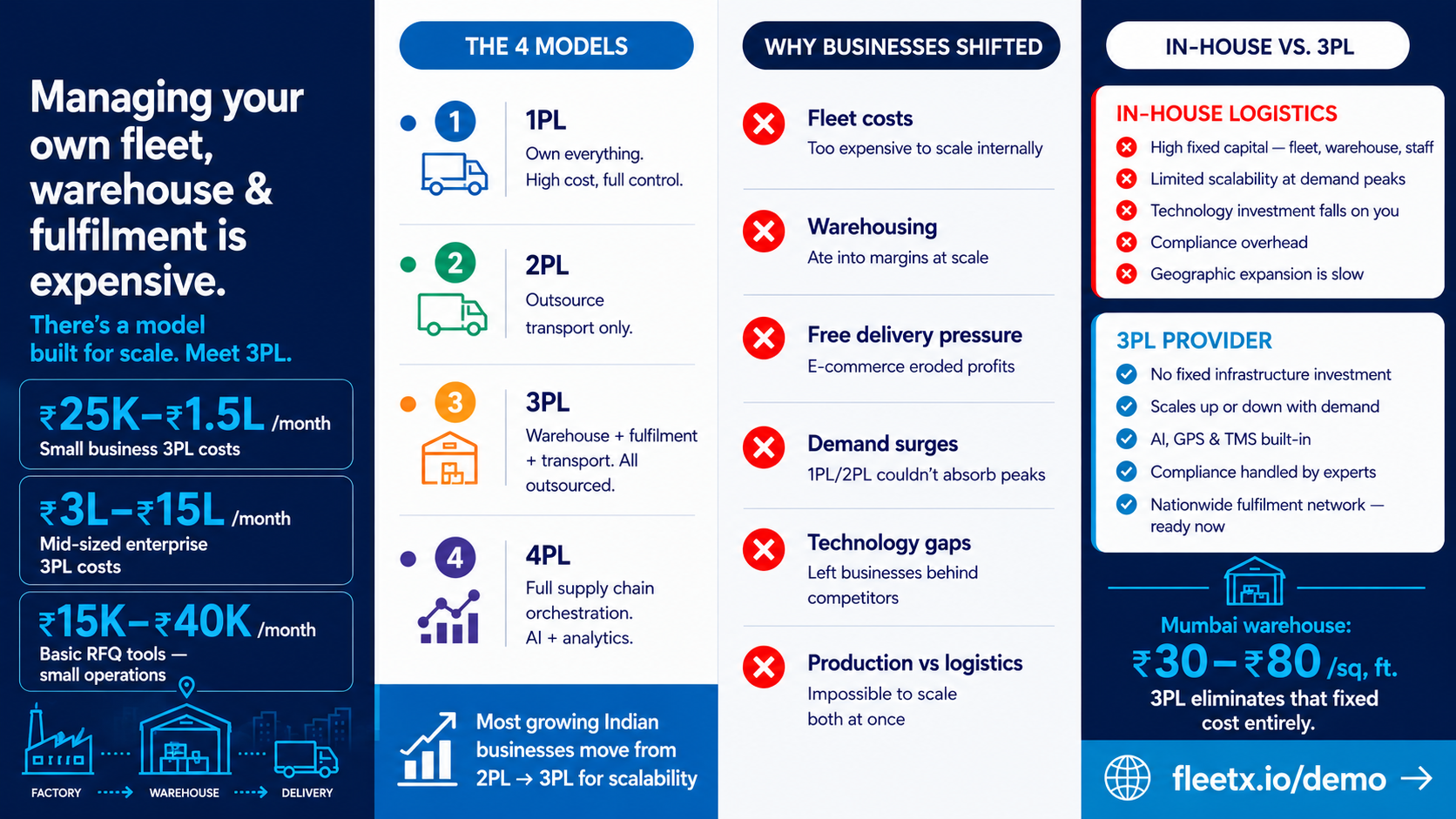
1PL vs 2PL vs 3PL vs 4PL Logistics Comparison
| Parameters | 1PL (First-Party Logistics) | 2PL (Second-Party Logistics) | 3PL (Third-Party Logistics) | 4PL (Fourth-Party Logistics) |
|---|---|---|---|---|
| Definition | A company manages its own transportation, warehousing, and logistics operations internally. | A business outsources only transportation activities to external carriers or trucking companies. | A business outsources warehousing, fulfillment, transportation, and supply chain operations to a logistics provider. | A complete logistics partner manages the entire supply chain ecosystem, technology, analytics, and vendor coordination. |
| Ownership of Fleet | Fully owned and operated by the business. | Transport fleet is owned by external logistics carriers. | 3PL provider may use owned fleets, partner fleets, or hybrid transportation networks. | 4PL providers coordinate multiple 3PLs and logistics vendors without necessarily owning fleets. |
| Warehousing Responsibility | Managed completely in-house. | Usually not included. | Warehousing and inventory management are included. | Strategically managed across multiple vendors and regions. |
| Technology Usage | Limited internal logistics software and manual operations. | Basic transportation tracking systems. | Advanced TMS, GPS tracking, route optimization, AI dispatching, and ePOD systems. | Integrated AI-driven logistics orchestration, predictive analytics, and centralized control towers. |
| Operational Complexity | Low to moderate. | Moderate transportation dependency. | High operational efficiency with scalable logistics infrastructure. | Very high strategic supply chain coordination and optimization. |
| Best Suitable For | Small businesses with localized logistics operations. | Businesses needing only transportation outsourcing. | eCommerce, FMCG, retail, manufacturing, pharmaceuticals, and automotive companies. | Large enterprises with nationwide or global supply chain complexity. |
| Cost Structure | High fixed infrastructure and fleet investment. | Pay-per-transportation model. | Flexible pricing based on warehousing, transportation, fulfillment, and shipment volume. | Strategic long-term enterprise logistics management contracts. |
| Scalability | Limited scalability due to infrastructure dependency. | Moderate scalability. | Highly scalable for seasonal demand and rapid business expansion. | Enterprise-grade scalability across regions and multiple supply chain partners. |
| Visibility & Tracking | Basic or manual shipment visibility. | Limited transport-level tracking. | Real-time shipment tracking, fleet visibility, predictive ETA, and centralized dashboards. | End-to-end supply chain visibility with AI-powered analytics and optimization. |
| Examples in India | Local distributors managing their own fleet and warehouse operations. | Courier companies and trucking contractors. | Top 3PL providers operating in Delhi NCR, Gurgaon, Mumbai, Bangalore, and Chennai. | Enterprise supply chain orchestration companies managing nationwide logistics ecosystems. |
| Main Advantage | Complete operational control. | Reduced transportation burden. | Lower logistics costs, better delivery efficiency, and scalable operations. | Centralized strategic supply chain optimization and digital transformation. |
| Main Challenge | High capital investment and operational inefficiency at scale. | Limited logistics integration. | Dependency on external logistics providers. | Complex implementation and higher enterprise-level investment. |
What is Third-Party Logistics (3PL)?
Third-Party Logistics or 3PL is essentially when a business outsources the distribution, warehousing and fulfilment of their products to an external logistics company which carries out these processes efficiently on behalf of the business.
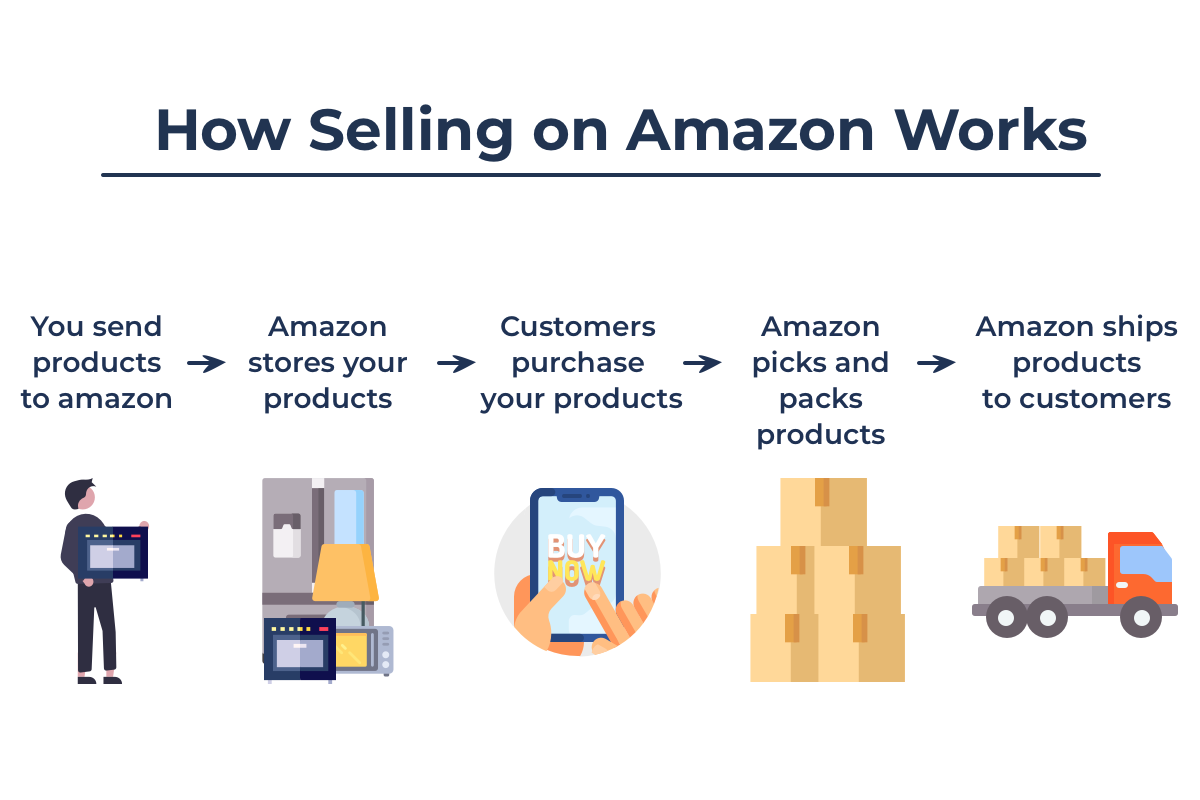
The most appropriate example of a 3PL logistics provider is Amazon. Think of all the businesses that sell their product on Amazon’s website as individual businesses that produce goods. Customers make purchases from these businesses via Amazon’s website. Once a purchase has been made the entire process of collecting the goods from the seller to deliver it to the customer who purchased it is Amazon’s responsibility.
Step 1: Inventory Management and Warehousing
Business B ships its products to Amazon at any of its warehouses based on their geographical location.
Step 2: Distribution and Packaging
Once a purchase has been made by a customer from business B, the business is notified, the order is processed & packaged in their warehouse, ready to be shipped.
Step 3: Fulfilment and Delivery
The order is shipped from the warehouse through their network of fulfilment centers, eventually to the end customer. A 3PL logistics system is more consumer-oriented. It relies on the expertise and network of these logistics solutions providers to make a business’ supply-chain process much more efficient and cost-effective.
Why did businesses shift to 3PL providers?
The growing consumer demands require a more customer-centric logistics service
Production of goods has increased over the years to match the rising demand from consumers resulting. This led to businesses being unable to manage the production and transport of the goods efficiently. The biggest challenge came from E-commerce, which led to a never-seen-before demand for goods, especially in the retail sector.
People began purchasing goods in record numbers from tens of thousands of websites and marketplaces. Millions of orders and returns are being processed every day. Although this was good for business for thousands of companies doing business online, it also presented the following set of challenges when it came to managing the logistics and supply chain of such volumes.
High Consumer Demand made logistics difficult to manage
A surge in demand for goods made it difficult for businesses to manufacture and manage the logistics of the goods as well. As a result, First-Party logistics (1PL) became unsustainable and businesses moved towards Second-Party logistics, i.e. outsourcing transportation to couriers services.
Warehousing and Storage became expensive
To stay competitive, businesses needed to produce and maintain a large stock of goods to meet demand, which required businesses to purchase or rent more physical warehouses and storage units across their delivery region. This led to a very high cost being incurred by businesses on warehousing and storages which became unsustainable for many businesses.
E-commerce offering free delivery reduced profits
With the rise in the number of e-commerce websites and online sales, many businesses and marketplaces started offering free shipping and delivery, which were being borne by businesses, cutting into their profits. Consumers became habituated to being offered free shipping, and thus, it became a trend that drove the cost of logistics for businesses even further.
Faster Shipping and Delivery became unsustainable for 2PL
Fast shipping and delivery required a more integrated form of logistics service which was more on-demand in nature. Businesses with 2PL providers were not equipped to deal with such an advanced system of supply-chain thus leading to adaptation of a more consumer-focused system of logistics.
Fleet Management became impossible
Maintaining and operating a large fleet is a cost-intensive affair. Businesses that own and operate their fleet for their supply-chain drain a lot of money to keep up with the increasing demand. Using a 3PL provider meant the logistics being taken care of by specialized companies with the most advanced fleet management technology, thus reducing overall operating cost for businesses considerably.
Failure in adapting rapid technological changes
Supply-chain is an ever-evolving industry with rapid technological changes. Being up-to-date with technological trends gets difficult for businesses whose primary focus is their products and that results in losing out to competitors.
Production vs Logistics
Logistics and Supply Chain Management for a business that sells a product is a large operation. As businesses grow and their logistics demands increase it becomes impossible to improve and manage both manufacturing and logistics which results in outsourcing of logistics operations.
What are the benefits of using a 3PL provider
3PL system of supply-chain helps tackle modern problems in supply-chain with technology
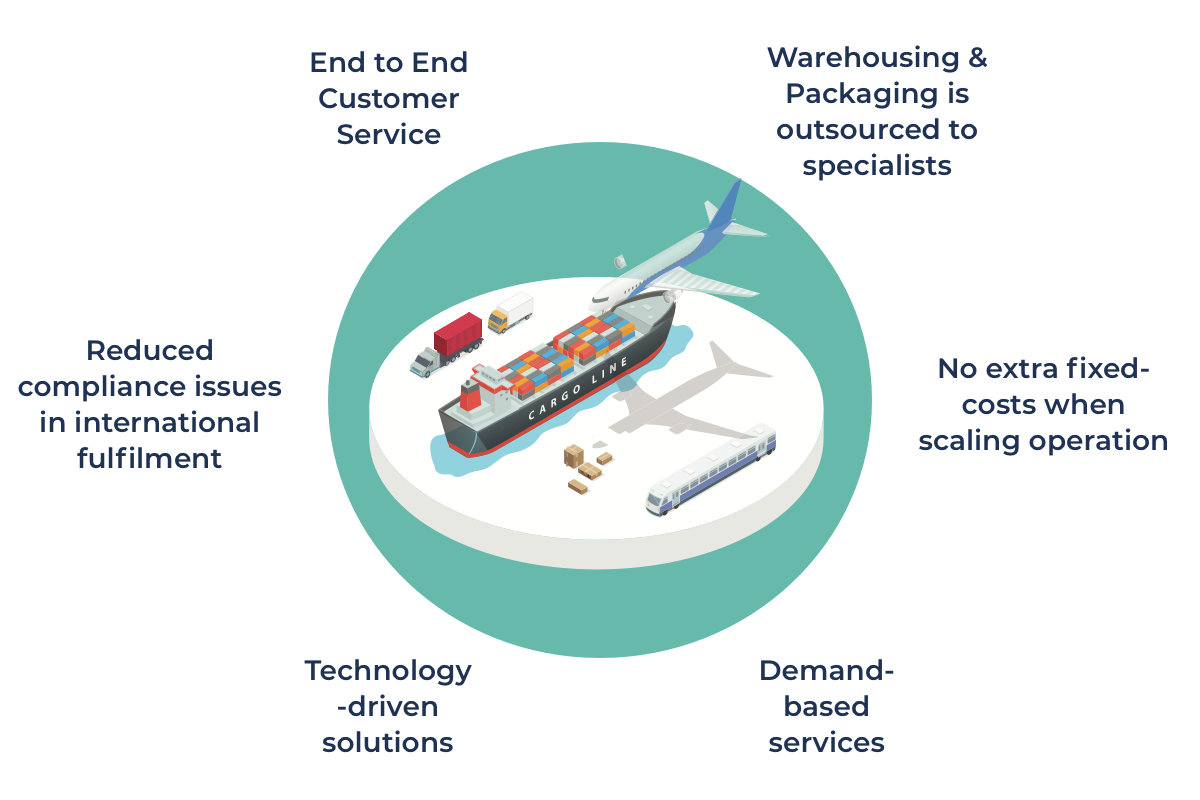
As a company grows the cost of maintaining warehouses, shipping goods, faster fulfilment, etc grows with it. Being able to offload your entire logistics operation to a 3PL provider reduces a company’s overall operating cost as the provider takes care of warehousing, packaging, fulfilment and distribution for the company. There are various other reasons why a company chooses to outsource their logistics operations to 3PL providers, let’s have a look at a few important ones.
3PL saves businesses from incurring huge fixed capital
Warehousing and Transportation Management require large fixed capital and for most growing businesses, investing such a huge amount is simply not sustainable. 3PL providers have infrastructures in place as well as own large fleets as logistics solutions are their primary business. They leverage that to make logistics more efficient and accessible.
3PL offers flexibility in terms of volume based on demand
3PL offers various levels of services based on consumer’s demand. Retail oriented businesses, especially e-commerce, have varying demands based on the season. A business that runs their logistics would need to invest more in transport vehicles and warehouses during peak season which will not be underutilized and expensive. 3PL offers on-demand service and cost flexibility based on the requirement which can save businesses huge operating costs.
3PL offers excellent customer service and experience-based solutions
3PL providers are their industry’s experts with years of experience in supply-chain management. As a result, they offer businesses reliable delivery time, better communication and tracking, minimum chances of poor packing and damaging as well as an overall improved customer experience in place to improve customer satisfaction and overall brand reliability.
3PL providers are up-to-date with the latest industry technology that improves efficiency
3PL provides companies that invest heavily in Research & Development to keep up with the latest technology which makes the logistics more efficient and cost-effective. They are early adopters of industry-leading technology in fleet management, navigation & tracking, fuel management among others which allows them to offer better and reliable services at very competitive prices that cannot be matched by 1PL or 2PL providers.
3PL providers eliminate compliance and regulatory issues for international transport for businesses
Businesses that wish to expand operations overseas or even source material from overseas run into regulatory, compliance and communication challenges different from their home country which could hinder their operation and result in heavy duties and fines. 3PL providers have a vast network and presence in countries across the globe which makes it easier for them to transport, delivery and even export goods across international borders without running into regulatory issues.