

If you run a fleet - 10 trucks or 10,000 - buying the wrong truck monitoring software will cost you more than doing nothing. This guide cuts through the noise: what the software actually does, what separates good from bad, how pricing works, and what to demand from any vendor before signing a contract.
What Is Truck Monitoring Software?
Truck monitoring software is a technology platform that gives fleet operators real-time and historical visibility into their vehicles, drivers, cargo, and costs. It combines hardware installed on the vehicle - typically a GPS tracking device, optionally cameras and fuel sensors - with a cloud-based platform that collects, processes, and presents that data as actionable intelligence.

The term is used interchangeably with fleet management software, vehicle tracking software, and VLTD (Vehicle Location Tracking Device) software in the Indian context. All refer to roughly the same category of product, though capability depth varies enormously between vendors.
At its most basic, truck monitoring software tells you where your trucks are right now. At the upper end of the market, it does far more:
- Real-time GPS tracking - live vehicle positions updated every few seconds, with geofence alerts when vehicles enter or leave defined zones.
- Driver behaviour monitoring - scoring drivers on harsh braking, overspeeding, cornering, idling, and fatigue indicators.
- Fuel management - detecting theft, measuring consumption against benchmarks, flagging anomalies.
- Trip and route management - planned vs. actual route comparison, ETA prediction, delay alerting.
- Video telematics - in-cab cameras providing event-triggered clips and driver-facing AI alerts.
- Compliance management - AIS-140 compliance, fitness certificate tracking, permit expiry alerts.
- Maintenance scheduling - predictive and preventive maintenance triggered by mileage, engine hours, or diagnostic fault codes.
- Analytics and reporting - fleet-wide cost dashboards, trip reports, driver scorecards, and executive summaries.
The value is cumulative. A fleet running basic GPS pays for the device and gets location data. A fleet running a platform like Fleetx gets GPS plus fuel intelligence, driver coaching, video proof, compliance automation, and route analytics - all in one dashboard, with AI surfacing the insights that matter rather than requiring analysts to dig through raw data.
2. Why 2026 Is a Different Market
If you last evaluated fleet software two or three years ago, the market has changed materially. Three forces have reset buyer expectations in 2026.
AI has moved from marketing language to real capability
Legacy fleet platforms were built on rule-based logic: set a speed threshold, get an alert. The current generation uses machine learning models trained on billions of trip data points to do things rules cannot. Predictive maintenance that catches failures before breakdown. Driver coaching that distinguishes habitual risk from situational risk. Fuel anomaly detection that separates genuine theft from sensor noise. Vendors who use "AI" as a branding word without underlying ML capability are easy to identify - ask them to show you a model inference, not a dashboard filter.
Regulatory pressure in India is now enforcement pressure
AIS-140 has been law since 2018, but enforcement has tightened considerably through 2025 and into 2026. State transport authorities are now actively checking VLTD compliance during permit renewals, fitness certificate inspections, and roadside checks. Fleets that treated AIS-140 as a compliance checkbox - buying the cheapest certified device and ignoring the platform - are now facing operational risk as the monitoring layer matters as much as the device certification.
Total cost of ownership, not subscription price, is the right metric
Fuel is typically 35-45% of fleet operating cost for Indian commercial fleets. A monitoring platform that reduces fuel consumption by 8-12% - a realistic number for fleets that actively use fuel management features - generates returns that dwarf the software subscription cost. Buyers who evaluate truck monitoring software purely on per-vehicle SaaS pricing are optimising the wrong variable.
3. Core Features to Evaluate
Use this section as a structured evaluation framework. Not every fleet needs every feature, but you should understand each capability and make a deliberate choice about whether it applies to your operation.
3.1 GPS Tracking and Location Intelligence
The baseline. Evaluate on update frequency (every 10 seconds vs. every 60 seconds matters in urban traffic), historical replay depth, geofence flexibility, and map quality for Indian road networks. Many international platforms use map data that is poor quality for tier-2 and tier-3 Indian cities. Verify against your actual operating routes.
Beyond raw location, look for route adherence scoring, stoppages detection with duration logging, and idle time reporting. These turn location data into productivity data.
3.2 Driver Behaviour and Safety
Driver behaviour is the lever with the fastest payback. Harsh braking, sudden acceleration, and overspeeding increase fuel consumption, tyre wear, and accident risk simultaneously. A well-implemented driver scoring system - one that drivers actually see and are coached against - typically reduces incident-related costs within 60-90 days of deployment.
Questions to ask vendors: How is the score calculated - rule-based thresholds or ML models? Can you customise weightings by route type? Is there a driver-facing mobile app? Are scores used for coaching conversations, or only for retrospective reporting?
3.3 Fuel Management
For fleets running 50 or more vehicles, fuel management ROI alone typically justifies the platform cost. Effective fuel management requires both hardware (fuel-level sensors or CAN bus integration) and software capable of distinguishing genuine theft from sensor drift, calculating consumption per trip against expected benchmarks, and flagging variance before it becomes a pattern.
Ask for a documented case study showing fuel savings from a comparable fleet size and application type - not a claimed percentage, but a specific customer result with before/after data. Any credible vendor will have this.
3.4 Video Telematics
Video telematics adoption has accelerated significantly among Indian commercial fleets in 2025-26, driven by both safety awareness and insurance pressure. The core capability is event-triggered video clips - footage automatically saved when the system detects harsh braking, collision risk, or driver distraction - combined with driver-facing alerts (audio warning when the camera detects phone use, drowsiness, or seatbelt non-compliance).
Storage and retrieval matter operationally. Cloud-based storage with indexed event retrieval is substantially more useful than SD card storage that requires physical access to the vehicle. Verify data retention periods and retrieval speed for evidence in case of disputes.
3.5 Maintenance Management
Reactive maintenance - fixing trucks when they break down - is expensive in direct repair costs and in operational disruption. Preventive maintenance scheduling tied to actual mileage and engine hours (rather than calendar dates) reduces breakdowns. Predictive maintenance using ML on fault code patterns from the OBD port is the leading edge, flagging components likely to fail before they do.
Evaluate: Can the system track maintenance across multiple service vendors? Does it manage document storage for service records? Can drivers report issues through the app that get logged against the vehicle?
3.6 Compliance and Document Management
For Indian fleets specifically, compliance tracking covers: AIS-140/VLTD certificate status, vehicle fitness certificates, road permit validity, insurance expiry, PUC certificates, and driver licence validity. Manual tracking across a fleet of any meaningful size is error-prone and creates regulatory exposure.
A platform that automates document expiry alerts and gives fleet managers a single compliance dashboard reduces administrative overhead and eliminates the risk of operating non-compliant vehicles.
3.7 Analytics and Reporting
Raw data is not useful. The value is in what the platform surfaces automatically vs. what requires manual analysis. Evaluate the default report library, the ability to schedule and distribute reports automatically, and the quality of executive-level dashboards that give fleet heads KPI visibility without needing to dig into trip-level data.
Advanced platforms offer AI-generated insight narratives - the system tells you "Fleet fuel consumption increased 7% this month; primary driver is idle time on Route NH-48, accounts for 61% of the increase" rather than presenting a table of numbers for a human to interpret.
4. How Pricing Works - And What to Watch For
Truck monitoring software is almost universally priced on a per-vehicle per-month SaaS model in India, typically bundled with hardware costs either upfront or amortised into the subscription. Headline pricing ranges from Rs. 300-400/vehicle/month at the low end to Rs. 1,500-2,500/vehicle/month for full-featured enterprise platforms.
The number that matters is not the per-vehicle rate - it is cost per rupee of value delivered. A platform at Rs. 1,200/vehicle/month that saves Rs. 4,500/vehicle/month in fuel, maintenance, and incident costs is cheaper than a Rs. 400 platform that saves nothing.
Common pricing traps to avoid
- Feature gating behind tier upgrades. Some vendors advertise a low base price that covers GPS tracking only, with fuel management, video telematics, and analytics each unlocked at higher price tiers. Map the full feature set you need to the actual price tier it sits in before comparing quotes.
- Hardware lock-in. Proprietary hardware that only works with the vendor's platform creates switching costs that inflate the effective price of the relationship over its lifetime. Understand the hardware model and whether it supports standard protocols.
- Data egress fees. Some platforms charge for API access or data exports. If you plan to integrate fleet data with your TMS, ERP, or analytics stack, confirm data portability terms upfront.
- Minimum contract duration. Annual and multi-year contracts are standard, but watch for auto-renewal clauses and notice periods for cancellation. A 90-day cancellation notice on a yearly contract can effectively lock you in for two years.
- Implementation and onboarding costs. Large fleet deployments typically have installation, configuration, and training costs that are separate from the SaaS fee. Get these itemised in the proposal, not bundled.
5. India-Specific Requirements: AIS-140 and VLTD Compliance
Any truck monitoring software deployed on Indian commercial vehicles must comply with AIS-140, the government standard for Vehicle Location Tracking Devices. This is not optional - it is a legal requirement under MoRTH (Ministry of Road Transport and Highways) mandate for all public service vehicles, goods vehicles, and transport vehicles above specified categories.
What AIS-140 requires
The AIS-140 standard specifies:
- A certified VLTD device installed on each vehicle, with tamper-evident mounting
- A panic button accessible to the driver, triggering an alert to the state transport authority's control room
- Real-time data transmission to the state command and control centre (SCCC), following the prescribed data packet format
- Two-way communication capability
- Device certification by an approved testing agency (ICAT, ARAI, or equivalent)
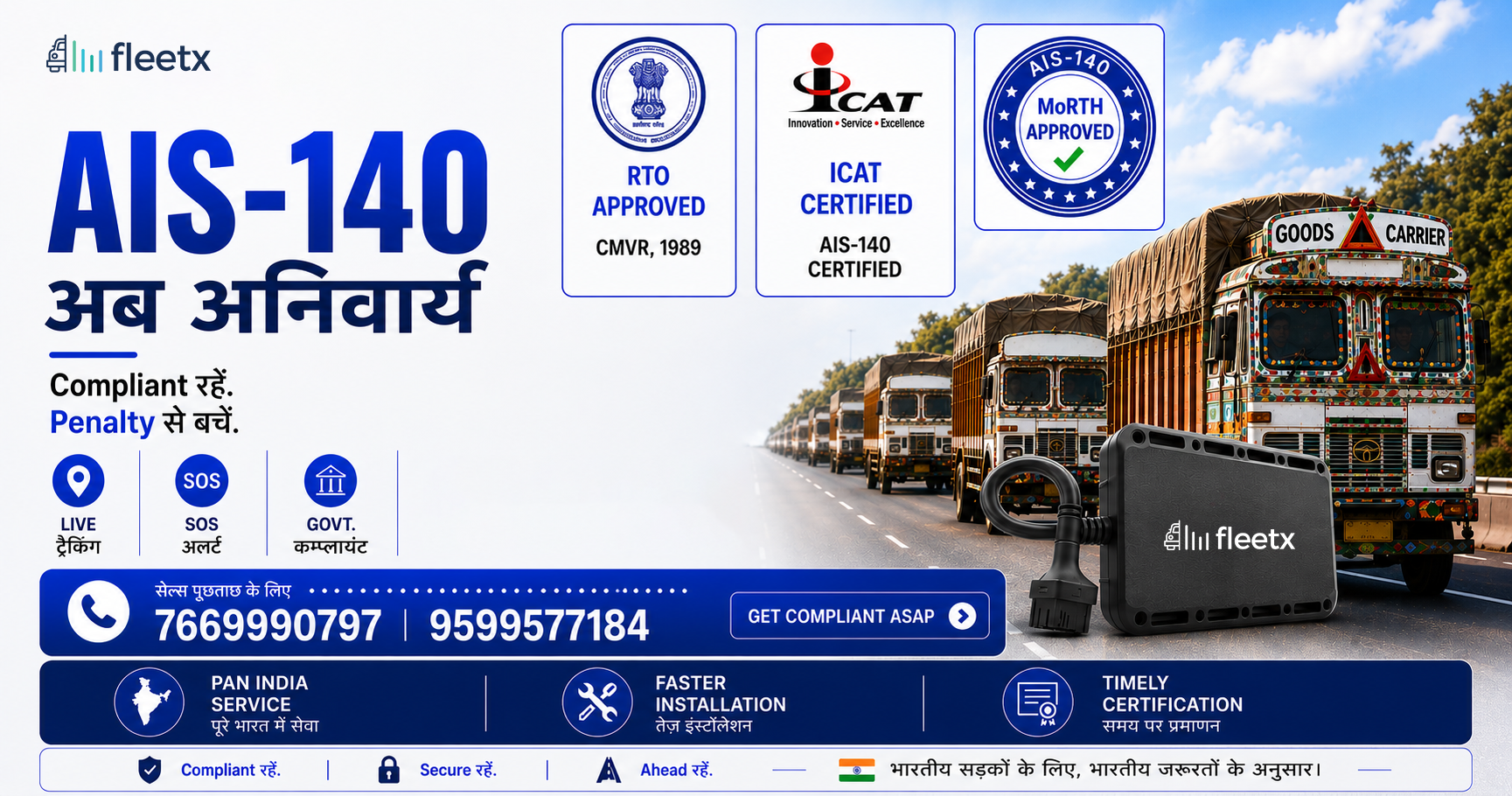
The device certification is the minimum compliance threshold. What varies between vendors is what they build on top of the AIS-140 device: whether the platform data integrates with your operations, whether the device supports value-added sensors (fuel, temperature, cameras), and whether the compliance documentation and certificate management are handled through the platform.
2026 enforcement context
State RTOs have progressively tightened AIS-140 enforcement since 2023. In several states, fitness certificate renewals now require verified VLTD compliance, and roadside enforcement of VLTD activation status has increased. Fleets operating with deactivated or expired AIS-140 devices face fines, detentions, and permit complications.
Practically, this means the compliance layer of your monitoring platform needs to track device health status, SIM connectivity, and data transmission to the SCCC - not just assume the device installed three years ago is still functioning correctly.
Free and Free-Download Options: What They Actually Give You
Searches for "truck monitoring software free" and "fleet management software free download" generate significant volume, and it is worth being direct about what these options actually deliver.
Open-source fleet management software
Open-source platforms like Traccar exist and are functional for basic GPS tracking. The software is free; the infrastructure, hosting, maintenance, integration, and customisation are not. A small fleet running 10-15 vehicles with in-house technical capability can make open-source work for basic location tracking. The trade-offs are material: no SLA, no fuel management, no video telematics, no driver behaviour scoring, no Indian compliance features, and no vendor support. Engineering time is not free.
"Free download full version" software
Desktop-installed fleet software that is sold or distributed as a downloadable application is a category that peaked in the 2010s. The products that still exist in this space are generally not maintained for current operating systems, lack mobile integration, have no real-time cloud connectivity, and are incompatible with modern SIM-based GPS hardware. They should not be considered for any commercial fleet deployment in 2026.
Freemium SaaS tiers
A small number of fleet platforms offer free tiers for very small fleets (typically 1-3 vehicles) with limited features. These are lead-generation tools, not production fleet management platforms. They can be useful for evaluating a vendor's UX before committing to a paid tier, but should not be assessed as representative of the paid product's capabilities.
How to Build a Shortlist
The market has dozens of vendors operating in India. A structured shortlist process prevents both analysis paralysis and the risk of selecting a vendor that looks credible on a demo but cannot execute at your fleet scale.
Step 1: Define your non-negotiables
Before contacting any vendor, document the features that are mandatory for your operation - not a wish list, but genuine deal-breakers. AIS-140 compliance. Fuel sensor integration. A specific map quality requirement. API access for TMS integration. Minimum fleet size experience. This list should be no longer than 6-8 items. Any vendor who cannot tick all mandatory requirements is eliminated before a demo.
Step 2: Verify references at your scale
Vendors routinely present case studies from their largest customers. What matters is whether they can point to two or three customers running a fleet of comparable size and vehicle type to yours. Ask for a direct reference call - not a written testimonial - with a fleet manager at a comparable operation. The conversation will surface implementation realities that no demo ever shows.
Step 3: Run a structured pilot
Any serious vendor will support a paid or free pilot on a defined subset of your fleet - typically 10-20 vehicles for 30-60 days. A pilot without defined success metrics is just a free trial. Define in advance what data you will use to evaluate the platform: fuel variance caught, driver score improvement, compliance documentation coverage, platform uptime, support response time. Evaluate against those metrics, not against how polished the demo felt.
Step 4: Evaluate the support model, not just the product
Fleet monitoring software failure at 2am on a cross-country haul is not a business-hours problem. Understand the support structure: Is there 24/7 coverage? What is the guaranteed response SLA for critical issues? Is there a dedicated account manager for your fleet, or does support route through a generic ticketing queue? For large fleets, the quality of post-sale support is often the primary differentiator between platforms that are technically similar.
Why Fleets Move to Fleetx
Fleetx is India's AI-native fleet management and transport platform, built from the ground up for Indian road conditions, regulatory requirements, and operational realities. It is not a GPS tracking product with analytics bolted on - it is a single integrated platform covering the full operational stack of a commercial fleet.
The distinction matters. Legacy fleet platforms were designed as hardware businesses: sell a GPS device, provide a basic web portal, repeat. Fleetx was designed as a data and intelligence business: the hardware is the input; the value is in what the AI layer does with the data at scale.
What makes Fleetx different
Who Fleetx is built for
Fleetx serves commercial fleets across India - logistics and distribution companies, transport contractors, construction and mining fleets, FMCG last-mile operations, and enterprise fleet operators managing mixed vehicle categories. The platform is production-ready at fleet sizes from 50 vehicles to 50,000 vehicles, with enterprise deployments across several of India's largest transport operators.
For fleets evaluating Fleetx specifically: request a pilot on your highest-cost routes or your highest-variance vehicle segment. Fuel savings and driver behaviour improvement on a controlled pilot subset provide a credible ROI projection for full fleet deployment.
Buyer's Checklist Before You Sign
Product
- AIS-140 / VLTD certification confirmed for Indian deployment
- All required features (fuel, video, driver scoring, compliance) confirmed in your price tier - not a higher tier
- Map quality verified against your primary operating routes (not just metro areas)
- Mobile app available for drivers and fleet managers
- API documentation reviewed if integration with TMS/ERP is required
- Data retention period confirmed and sufficient for your compliance and operational needs
Pricing and Contract
- All hardware costs - device, installation, SIM - itemised separately from SaaS fee
- Implementation and training costs confirmed
- Data portability terms confirmed - you own your data
- Auto-renewal and cancellation notice period reviewed
- Price escalation terms for multi-year contracts confirmed
Support and Operations
- Support hours confirmed (24/7 or business hours) and SLA documented
- Named account manager for your fleet confirmed post-deployment
- Platform uptime SLA reviewed (99.5% minimum; 99.9% for enterprise)
- Hardware replacement process and turnaround time confirmed
References
- Two reference calls completed with fleet managers at comparable fleet sizes
- Pilot results documented with agreed success metrics
Frequently Asked Questions
What is the best truck monitoring software in India in 2026?
There is no single answer that is correct for every fleet - the best platform is the one that matches your vehicle types, use cases, and operational scale. That said, for fleets that need genuine AI-powered insight beyond basic GPS tracking, platforms built natively for Indian operations - with AIS-140 compliance, fuel management, and driver behaviour scoring deeply integrated - consistently outperform generic international platforms or hardware-led local vendors. Fleetx ranks consistently among the top choices for mid-to-large commercial fleet operators in India, particularly for fleets where fuel management ROI is a priority.
How much does truck monitoring software cost in India?
Per-vehicle SaaS pricing typically runs Rs. 300-2,500/month depending on feature depth, fleet size, and contract terms. Hardware costs (GPS device, sensors, cameras) are either charged upfront (Rs. 3,000-15,000 per vehicle depending on configuration) or amortised into the monthly subscription. Large fleet contracts (200+ vehicles) generally attract volume pricing. Request an itemised quote that separates hardware, SaaS, implementation, and training costs.
Is truck monitoring software mandatory for commercial vehicles in India?
AIS-140 VLTD compliance is legally mandatory for all public service vehicles and commercial transport vehicles under MoRTH regulations. This means a certified GPS tracking device must be installed and transmitting data to the state command and control centre. Non-compliance carries fines, permit complications, and fitness certificate renewal issues. The monitoring platform layer beyond the minimum device requirement is not mandated, but it is where operational and financial value is generated.
Can I use free truck monitoring software for my fleet?
Open-source GPS tracking software exists (e.g., Traccar) and works for basic location tracking with significant technical investment. Free-download desktop software is effectively obsolete for modern commercial use. For any fleet operating commercially in India with more than 10 vehicles, free or freemium options do not cover AIS-140 compliance requirements, fuel management, driver behaviour coaching, or enterprise-grade support. The ROI case for paid platforms at current pricing is strong enough that cost should not be the deciding factor when evaluating whether to deploy monitoring software.
How long does it take to deploy truck monitoring software across a fleet?
Hardware installation typically runs 1-2 hours per vehicle depending on configuration complexity (basic GPS vs. fuel sensor vs. cameras). For a fleet of 100 vehicles with a parallel installation team, full hardware deployment typically takes 5-10 business days. Platform onboarding, data configuration, and user training adds 1-2 weeks. A realistic timeline to operational deployment - where fleet managers are actively using the platform and data quality is verified - is 3-6 weeks from contract signature for fleets up to 200 vehicles.
What is the difference between truck monitoring software and fleet management software?
The terms are used interchangeably in most contexts. "Truck monitoring software" often implies a focus on real-time tracking and driver/vehicle monitoring. "Fleet management software" is typically the broader category term covering the full operational stack - tracking, fuel, maintenance, compliance, dispatch, and analytics. In practice, leading platforms cover both; the terminology distinction is mostly a search behaviour artifact rather than a meaningful product category difference.
How does truck monitoring software reduce fuel costs?
Fuel savings come from multiple mechanisms. Idle time reduction: monitoring surfaces vehicles that idle for extended periods, and driver awareness of monitoring consistently reduces idle time by 15-25%. Theft detection: fuel-level sensors flagging drainage events that cannot be explained by consumption catch both driver-side theft and third-party siphoning. Route optimisation: identifying routes with abnormally high fuel consumption per km can reveal both inefficient routing and mechanical issues. Driver behaviour: reduced overspeeding and harsh acceleration directly reduce consumption. On a properly instrumented fleet, combined fuel savings of 8-15% within the first year are consistently achievable.
What hardware does truck monitoring software require?
The minimum hardware is an AIS-140 certified VLTD device with a SIM card providing cellular connectivity. Additional hardware for expanded functionality includes: fuel-level sensors (capacitive or ultrasonic) or CAN bus interface for OBD fuel data; temperature sensors for reefer/cold chain fleets; dual-facing cameras for video telematics; RFID card readers for driver identification. Hardware requirements vary by use case - a basic compliance deployment needs only the VLTD device, while a full fleet intelligence deployment will include fuel sensors and cameras across all vehicles.
What data does truck monitoring software collect, and is it secure?
Standard data collected includes: GPS coordinates and timestamps, speed, ignition status, fuel level (if sensor installed), driver behaviour events (harsh braking, acceleration, cornering), engine diagnostics, and video events (if cameras installed). Data is transmitted over cellular networks and stored in cloud infrastructure. For enterprise deployments, evaluate the vendor's data security certifications (ISO 27001 is the relevant standard), data residency (whether data is stored on Indian servers), and data access controls. Driver data should be treated as employee data with corresponding privacy policy and consent requirements.
How do I get started with Fleetx?
The fastest path is a pilot on a defined subset of your fleet - typically 20-50 vehicles on your highest-cost routes. Fleetx's team will assess your hardware requirements, configure the platform for your fleet structure, and support installation. Define your pilot success metrics upfront (fuel variance, driver score baseline, compliance coverage), run for 30-60 days, and use the results to project full-fleet ROI. Visit fleetx.io or contact the sales team to initiate a fleet assessment.
Top 10 fleet management software - how does Fleetx compare?
Fleetx consistently ranks at the top of India-focused fleet management software evaluations, particularly in categories of AI capability, fuel management depth, and AIS-140 compliance coverage. International platforms have stronger brand recognition globally but are not purpose-built for Indian regulatory and road conditions. India-origin competitors vary significantly in AI maturity - many offer GPS tracking with reporting layers rather than true ML-based intelligence. For fleets prioritising total cost of ownership and operational impact rather than brand familiarity, Fleetx is worth a direct head-to-head evaluation.
)