
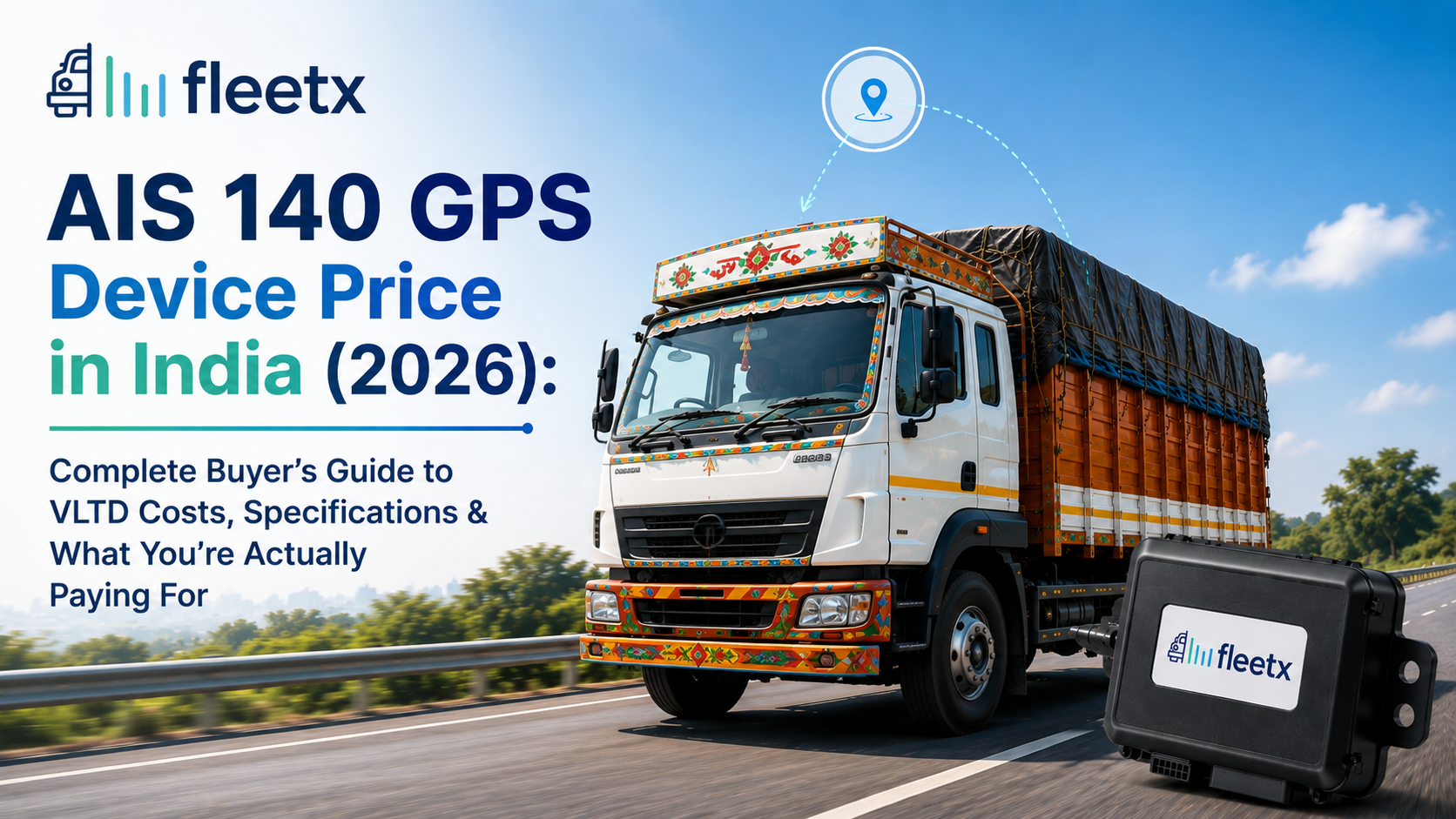
If you operate commercial vehicles in India, you've almost certainly been asked — or forced - to fit an AIS-140-certified GPS device, also called a VLTD (Vehicle Location Tracking Device). And if you've tried to compare prices across vendors, you know the experience is frustrating. One seller quotes ₹3,500. Another quotes ₹14,000. Both call their product 'AIS-140 compliant.' Both are technically correct - and both answers are incomplete without context.
This guide breaks down exactly what an AIS-140 GPS device costs in India in 2026, what the AIS-140 standard actually mandates, why prices vary so drastically, what you're truly paying for (and what hidden charges to watch out for), and how to evaluate a VLTD vendor before you sign a purchase order.
What Is AIS-140? The Standard Behind Every VLTD
AIS-140 stands for Automotive Industry Standard 140, a specification published by the Automotive Research Association of India (ARAI) under the mandate of the Ministry of Road Transport and Highways (MoRTH). It defines the minimum technical and functional requirements for a Vehicle Location Tracking Device (VLTD) fitted to commercial motor vehicles.
The AIS-140 standard was notified as mandatory in 2018 and has since gone through Amendment 2 (2023), which tightened requirements around tamper detection, power-loss alerts, and data transmission continuity. If you're buying a VLTD in 2026, you must ensure the device is compliant with the latest AIS-140 specification, including Amendment 2 provisions.
What Is the AIS-140 GPS Tracking System Required to Do?
At its core, an AIS-140 GPS tracking system must continuously transmit location data - latitude, longitude, speed, and direction - to a certified Vehicle Tracking Application hosted on state or central government servers. This data flows in near real-time and is used by RTOs (Regional Transport Offices), enforcement agencies, and transport operators themselves.
The AIS-140 VLTD is not just a GPS device in the consumer sense. It is a regulated IoT endpoint with defined protocols, certified hardware, tamper-evident housing, mandatory panic functionality, and mandated integration with India's VAHAN/IRNSS tracking infrastructure.
AIS-140 Compliance Timeline
Understanding where enforcement currently stands helps fleet operators prioritise their compliance spend:
AIS-140/VLTD Compliance Timeline in India
|
Year / Date |
Milestone |
|
June 2018 |
AIS-140
standard notified by MoRTH/ARAI |
|
April 2019 |
Mandatory
fitment for new public vehicles (buses, taxis) |
|
January
2020 |
Extended to
all new commercial transport vehicles |
|
2021–2022 |
State-level
enforcement rollout; RTOs begin VLTD verification |
|
2023 |
Amendment 2
published; stricter tamper & power-loss alerts |
|
2024–2025 |
Integration
with FASTag/VAHAN pushed; schools bus circular issued |
|
2026
(Current) |
Enforcement
tightened; renewal audits active; penalty structure notified in most states |
As of 2026, non-compliance with AIS-140 VLTD fitment requirements can attract fitness certificate rejection, challan at checkposts, and permit cancellation in several states. The window for 'grace period' compliance has effectively closed.
AIS-140 GPS Device Price in India (2026): What the Market Actually Looks Like
When fleet managers search for 'AIS-140 GPS device price' or 'VLTD device price' in India, they encounter a bewildering range. The honest answer is that there is no single price - because 'AIS-140 device' is a category, not a product. What you're quoted depends on hardware tier, bundled services, vendor margin, and regional dealer pricing.
Here is an accurate picture of the current market range, segmented by what you actually get at each price point:
Table 1 — AIS-140 GPS Device & VLTD Price Range in India (2026)
|
Device /
Solution Tier |
Low (₹) |
Mid (₹) |
High (₹) |
Key Notes |
|
Basic OEM
Hardware (device only) |
₹3,000 |
₹4,500 |
₹6,000 |
No SIM; no
platform |
|
Entry AIS-140
VLTD (device + SIM) |
₹5,500 |
₹7,000 |
₹9,000 |
1-year SIM
bundle common |
|
Standard GPS
+ Fleet Platform |
₹7,000 |
₹10,000 |
₹14,000 |
Includes
software license (1 yr) |
|
Advanced VLTD
+ Panic + I/O |
₹10,000 |
₹14,000 |
₹18,000 |
Fuel sensor
ready; CAN bus |
|
Enterprise
(multi-feature, multi-vehicle) |
₹12,000 |
₹18,000 |
₹25,000+ |
Bulk pricing,
integration, support |
AIS-140 GPS Device Price by Vehicle Category
The AIS-140 GPS tracker price also varies by the vehicle class it's designed for. A device certified for a heavy truck needs a more robust housing, wider power input tolerance, and typically larger battery backup than one for a three-wheeler.
Figure 1 — AIS-140 GPS Device Price Range by Vehicle Category (2026, India)
|
Vehicle
Category |
Price Range |
Relative
Cost Indicator (each █ ≈ 5%) |
|
2-Wheeler /
3-Wheeler VLTD |
₹3,500–₹6,000 |
███████ |
|
Light
Commercial Vehicle |
₹5,500–₹9,000 |
███████████ |
|
Medium Goods
Vehicle |
₹7,000–₹12,000 |
██████████████ |
|
Heavy Truck /
Bus |
₹9,000–₹18,000 |
██████████████████ |
|
School Bus
(CCTV mandate) |
₹14,000–₹25,000+ |
████████████████████ |
The ₹14,000–₹25,000 range for school buses reflects the additional CCTV and audio-visual surveillance requirements mandated by the MoRTH circular for school vehicle safety. This is a conditional AIS-140 requirement - it applies specifically to this vehicle category.
Why 'AIS 140 GPS Price' Ranges So Widely
The single biggest source of buyer confusion is the gap between the hardware-only price and the total solution price. Here's what drives variance:
• Hardware quality: OEM devices at ₹3,000 may use cheaper GPS chipsets with lower cold-start performance, while premium units use u-blox or MediaTek chipsets with multi-constellation support.
• SIM bundling: Some vendors quote a device price that includes a 1-year M2M SIM bundle. Others quote hardware only and charge SIM costs separately.
• Platform access: The 'GPS device' price from many vendors includes 12 months of fleet tracking platform access. Year 2 onwards, you pay a SaaS renewal — often not disclosed upfront.
• Certification vintage: Devices certified under older AIS-140 versions may be cheaper but may not comply with Amendment 2 requirements around tamper detection and power-loss alerts.
• Distribution margin: Buying directly from an OEM vs through a state-level dealer or a fleet management platform like Fleetx adds or removes 15–30% in the channel margin.
Rule of thumb: If a vendor quotes a flat ₹4,000 for a 'fully AIS-140 compliant' VLTD for a heavy truck and says that includes everything, ask for an itemised invoice. You will almost certainly find either the SIM or the platform access is missing from that quote.
AIS-140 Device Specifications: What the Standard Actually Mandates
Most buyers focus on AIS-140 GPS tracker price without first understanding what the AIS-140 device specifications require. This creates a dangerous knowledge gap - you may buy a cheaper device only to discover at an RTO fitness check that it fails a mandated requirement.
Table 2 — Mandatory AIS-140 Device Specifications & Standards
|
Parameter |
Specification |
Status |
|
GPS
Receiver |
Multi-constellation
(GPS + GLONASS) |
Mandatory |
|
Positional
Accuracy |
≤ 5 metres
CEP (circular error probable) |
Mandatory |
|
Network
Connectivity |
2G/3G/4G GSM
+ fallback SMS |
Mandatory |
|
Data
Protocol |
VLTD /
AIS-140 protocol to IRNSS/VAHAN |
Mandatory |
|
Panic
Button |
One physical
panic button; alert to control room & driver app |
Mandatory |
|
Tamper
Alert |
Tamper-evident
casing; enclosure seal with unique marking |
Mandatory |
|
Power
Input |
10–30 V DC
(vehicle battery); internal battery backup ≥ 4 hrs |
Mandatory |
|
Operating
Temperature |
-20°C to
+70°C |
Mandatory |
|
IP Rating |
IP65 minimum
(dust and water resistant) |
Mandatory |
|
Storage |
Minimum 7-day
local data storage when network unavailable |
Mandatory |
|
ARAI/ICAT
Certification |
Device must
carry type-approval from authorised lab |
Mandatory |
|
Audio/Video
(CCTV) |
Optional but
required for school buses under MoRTH circular |
Conditional |
|
Fuel
Sensor Integration |
Analogue/digital
I/O port for fuel level input |
Optional |
|
CAN Bus
Interface |
OBD/CAN for
vehicle health data |
Optional |
The Tamper-Evident Requirement: Why It Matters for Pricing
One of the most commonly misunderstood AIS-140 specifications is the tamper-evident casing requirement. Some earlier VLTD products advertised themselves as 'plug and play' devices — meaning they could be installed and removed easily without tools. Under AIS-140, this is explicitly non-compliant for commercial vehicles. A certified VLTD must have:
• A unique marking or seal on the enclosure
• An alert transmitted to the control room if the device is disconnected or tampered with
• Power-loss alert triggered within seconds of vehicle battery disconnection
Devices that meet this requirement cost more than simple tracker dongles. If you see an AIS-140 GPS device price of under ₹3,000 in 2026, you should ask specifically about the tamper certification. Cheap devices may carry an older AIS-140 type approval that predates the Amendment 2 tamper requirements.
AIS-140 Certification: ARAI, ICAT and Type Approval
Every device sold as AIS-140 compliant must carry a valid type-approval certificate from an authorised Indian testing body - primarily ARAI (Automotive Research Association of India) or ICAT (International Centre for Automotive Technology). The certificate has a validity period and a specific device model scope.
When evaluating vendors, always ask for the AIS-140 certificate number and verify it against the official ARAI/ICAT database. This is the single most important compliance check before any purchase.
• Certificate should reference the exact device model you are buying.
• Check that the certificate has not expired - type approvals are not permanent.
• Ensure the certificate covers the vehicle category you intend to deploy for.
• For Amendment 2 compliance (2023 onwards), the certification date must be post-amendment.
The Real Cost of VLTD Ownership: Hidden Charges Exposed
The AIS-140 VLTD price you see on a vendor's website is almost never the total cost you will pay. For fleet operators managing 50, 100, or 500 vehicles, the gap between headline device price and true cost of ownership (TCO) can be enormous. Here is a complete picture:
Table 3 — True Cost of Ownership: One-Time vs Recurring VLTD Expenses
|
Cost Item |
One-Time
(₹) |
Recurring
(₹) |
Notes |
|
Device
hardware (ARAI-certified) |
₹3,000 – ₹18,000 |
— |
One-time per
vehicle |
|
Installation
& commissioning |
₹500 – ₹1,500 |
— |
Higher for
trucks vs 2W |
|
SIM /
cellular data plan |
— |
₹150 – ₹350/mo |
Dedicated M2M
SIM |
|
Fleet
tracking platform license |
— |
₹200 – ₹800/vehicle/mo |
Depends on
feature tier |
|
VLTD state
registration fee |
₹500 – ₹2,000 |
Nil (renewal annual) |
Varies by
RTO/state |
|
Annual
maintenance contract (AMC) |
— |
₹500 – ₹1,200/yr |
Hardware
warranty extension |
|
Replacement
battery (after 3–4 yrs) |
₹300 – ₹600 |
— |
Internal
backup cell |
|
Data
integration / API access |
₹0 – ₹10,000 |
₹0 – ₹2,000/mo |
TMS/ERP
integration costs |
Three-Year Total Cost of Ownership Comparison
To make an informed procurement decision, fleet managers should compare vendors on a 3-year TCO basis rather than upfront device price. Here's how the numbers typically stack up across three deployment tiers:
Table 6 — 3-Year Total Cost of Ownership (TCO) per Vehicle — AIS-140 VLTD
|
Cost
Component |
Basic Tier |
Standard
Tier |
Enterprise
Tier |
|
Device
hardware |
₹5,000 |
₹9,000 |
₹16,000 |
|
Installation |
₹700 |
₹1,200 |
₹1,500 |
|
SIM/data (3
yrs × 12 mo) |
₹7,200 |
₹9,000 |
₹10,800 |
|
Platform
license (3 yrs) |
₹7,200 |
₹18,000 |
₹28,800 |
|
AMC (3 yrs) |
₹1,500 |
₹2,400 |
₹3,600 |
|
VLTD
registration |
₹800 |
₹1,000 |
₹1,500 |
|
3-Year
Total Cost |
₹22,400 |
₹40,600 |
₹62,200 |
|
Monthly
avg per vehicle |
₹622 |
₹1,128 |
₹1,728 |
This analysis reveals something important: for a mid-sized fleet, the platform license cost over 3 years can exceed the hardware cost by 2–3x. Choosing a vendor purely on device price without understanding the long-term SaaS commitment is a common and expensive mistake.
For fleets of 25+ vehicles, negotiate a multi-year lock-in discount on the platform license at the time of hardware purchase. This is where significant savings (15–25%) are achievable.
AIS-140 GPS Recharge and SIM Costs: The Recurring Trap
The concept of 'AIS-140 GPS recharge' has emerged in the market as vendors and resellers charge annual or bi-annual recharges for data plan continuity. This is effectively an M2M SIM data renewal - but it's not always clearly disclosed as a separate cost at purchase time.
What to watch for:
• SIM lock-in: Some AIS-140 VLTD devices use locked SIM slots that only accept the vendor's M2M SIM. This removes your ability to switch to a cheaper data plan.
• Auto-deactivation: Devices that don't receive a timely recharge may auto-deactivate, causing a compliance gap and a potential fitness certificate issue.
• Recharge rates vs market: Some vendor SIM plans charge ₹400–₹500/month per device when comparable M2M plans are available at ₹150–₹180/month.
AIS-140 GPS Tracker Specifications: Evaluating Technical Quality
Beyond the mandatory minimum specifications, AIS-140 GPS tracker specifications vary considerably in quality. Here's what to evaluate when comparing devices at a similar price point:
GPS Engine and Positional Accuracy
Not all GPS chipsets are equal. The AIS-140 standard mandates ≤5 metres positional accuracy (CEP), but the practical performance across devices varies based on the chipset, antenna quality, and firmware optimisation.
• Multi-constellation support (GPS + GLONASS + Galileo): Faster cold-start (< 60 seconds vs 2–3 minutes), better urban-canyon performance in cities like Delhi or Mumbai.
• Antenna design: External antenna devices outperform embedded antenna devices in multi-storey parking, container yards, and tunnel scenarios.
• Hot-start time: A quality device achieves hot-start position fix in under 5 seconds. Budget devices may take 30–90 seconds.
Communication and Data Transmission
The AIS-140 GPS tracking system requires reliable data transmission to the state VLTD platform. Network performance of the installed device directly determines your compliance score.
• 4G LTE with 2G fallback: Essential for long-distance transport vehicles that traverse variable coverage zones.
• SMS fallback protocol: For network blackout zones, AIS-140 requires SMS as a fallback. Not all budget devices implement this correctly.
• Data queue and replay: Quality devices queue data locally when offline and replay it in the correct timestamp sequence when connectivity is restored. This prevents false data gaps in your compliance log.
• AIS-140 protocol stack: The device must speak the correct VLTD data protocol - not just standard NMEA or proprietary formats. Verify this explicitly.
AIS-140 Panic Button: Requirements and Real-World Performance
The AIS-140 panic button is one of the most scrutinised specifications - particularly for passenger transport, school buses, and women's cab services. Requirements include:
• Physical button that must be accessible to the driver and co-driver.
• Alert transmitted to the designated control room (operator and state VLTD server) within seconds.
• Alert must include vehicle identity, location, time, and driver ID.
• Button must be non-bypassable: cannot be disabled by software or configuration.
In practice, the response quality of the panic alert - not just the alert transmission - depends on whether the fleet operator has a 24/7 control room or is relying purely on the state VLTD platform's monitoring. Platforms like Fleetx that provide real-time VLTD tracking with a fleet management layer enable operators to act on panic alerts instantly, with driver call-back, route deviation flags, and escalation workflows - capabilities that go well beyond the hardware mandate.
Blackbox and Data Storage in AIS-140 Devices
The terms 'blackbox AIS-140' and 'blackbox GPS' appear frequently in the market and refer to the local data logging capability of the VLTD. Under AIS-140, the device must store a minimum 7 days of trip data locally for replay when connectivity is lost.
Quality blackbox implementations log:
• GPS coordinates at configurable intervals (1 second to 5 minutes)
• Speed, direction, ignition status, and battery voltage
• Panic button events with timestamp and coordinates
• Tamper and power events
Budget devices often implement the minimum 7-day storage requirement on cheap flash memory with high failure rates under temperature extremes. In hot climates like Rajasthan or Gujarat, where in-cabin temperatures can exceed 70°C, hardware-grade storage matters.
AIS-140 Approved GPS Devices: How to Verify Before You Buy
India's market for GPS tracking devices has both genuine AIS-140-approved GPS devices and a long tail of hardware that carries the label without full current compliance. Here is a reliable verification process for fleet managers and procurement teams:
- Request the ARAI or ICAT certificate number for the exact device model.
- Cross-check the certificate on the official ARAI testing laboratory database (arai.in) or ICAT portal.
- Verify the certificate covers your vehicle category (passenger transport, goods vehicle, school bus, etc.).
- Check the certification date against Amendment 2 (2023) - older certifications may not cover updated tamper and power-loss requirements.
- Ask for a sample device and test connectivity to the state VLTD portal before bulk purchase.
- Request references from RTO-verified fleet operators in your state who have passed fitness checks using the device.
AIS-140 VTS vs Third-Party Fleet Tracking: Understanding the Stack
There is an important architectural distinction that buyers often conflate: the AIS-140 VTS (Vehicle Tracking System) required for government compliance is separate from the fleet management platform used for operational analytics, route optimisation, driver behaviour, and fuel monitoring.
A well-designed AIS-140 VLTD deployment sends data to:
• The state/central VLTD platform - mandatory, for compliance and enforcement access.
• The operator's own fleet management platform - for operational intelligence, cost control, and driver safety.
Platforms like Fleetx operate as a fleet intelligence layer on top of the AIS-140 GPS tracking system, enabling operators to move beyond mere compliance into active fleet optimisation. This means fuel savings through route deviation alerts, driver safety scores, real-time ETA, and integrated TMS - all anchored on the same VLTD hardware that powers your AIS-140 compliance.
Buying AIS-140 GPS Devices for Commercial Vehicles: A Practical Guide
VLTD for Commercial Vehicles: Key Procurement Criteria
Procurement of VLTD for commercial vehicles at scale requires a more rigorous process than a consumer GPS purchase. The following table provides a structured scorecard for evaluating vendors:
Table 4 — AIS-140 VLTD Vendor Evaluation Scorecard
|
Evaluation
Criterion |
Weight |
What to
Check |
|
ARAI/ICAT
certification proof |
25% |
Ask for
certificate number & expiry date |
|
AIS-140
protocol compliance |
20% |
Confirm VAHAN
/ state VLTD portal integration |
|
Network
uptime SLA |
15% |
Demand ≥
99.5% uptime commitment in writing |
|
Data
retention & local storage |
10% |
Minimum 7-day
offline log confirmed |
|
Panic button
response time |
10% |
End-to-end
alert delivery < 30 seconds |
|
After-sales
& RMA policy |
10% |
Swap-out
time, on-site visit SLA |
|
Platform
& API capabilities |
5% |
Open API, TMS
integration, mobile app |
|
Total cost of
ownership (3 yr) |
5% |
Hardware +
SIM + platform + AMC |
AIS-140 GPS Tracker Installation: What to Know
The AIS-140 GPS tracker installation process is not a simple self-fit operation. Unlike consumer trackers, AIS-140-certified VLTDs must be installed by an authorised dealer or installer who:
• Registers the device on the state VLTD portal with vehicle chassis number and RTO details.
• Applies tamper-evident seals with unique markings.
• Tests connectivity to both the state VLTD server and the operator's fleet platform.
• Issues an installation certificate that may be required at fitness check.
Attempting to self-install an AIS-140 VLTD and registering it on the portal without an authorised installer can lead to registration rejection and compliance gaps. In some states, the installation must be performed at an authorised service centre listed on the state transport department's website.
AIS-140 GPS Tracker App: What Fleet Managers Actually Use
The AIS-140 GPS tracker app experience varies significantly. The state VLTD portal typically provides only a basic vehicle location viewit is not designed for operational fleet management.
For day-to-day fleet operations, operators need:
• Live map with vehicle trails, geo-fencing alerts, and ETA calculations
• Driver behaviour analytics - harsh braking, over-speeding, route deviation
• Fuel consumption monitoring with anomaly alerts
• Trip history with playback and exportable reports
• Driver and vehicle document expiry alerts (licence, fitness, insurance, permit)
• Integrated panic alert notification with driver escalation workflow
A platform built natively around AIS-140 GPS tracking - rather than retrofitted onto it - delivers far more operational value than managing compliance and operations from separate tools. The goal is to turn mandatory compliance hardware into a strategic asset for fleet cost control and service quality.
AIS-140 Compliance in 2026: What Fleet Operators Need to Know Now
AIS-140 Compliance Requirements: Current State
The AIS-140 compliance regime in 2026 is meaningfully stricter than it was in 2019–2021. Several developments have tightened enforcement:
• FASTag-VLTD linkage: Several states have begun linking VLTD data with FASTag records, enabling automated identification of non-compliant vehicles at tolls.
• VAHAN integration: The national VAHAN database now tracks VLTD fitment status as a pre-condition for fitness certificate issuance in most states.
• Amendment 2 rollout: Devices certified only under the original AIS-140 (pre-2023) may face scrutiny at fitness checks in states that have adopted Amendment 2 enforcement.
• Data quality audits: Some state transport authorities are conducting random audits of VLTD data quality - checking for implausibly static positions, data gaps, or tamper events.
AIS-140 Certification vs AIS-140 Compliance: A Critical Distinction
There is a difference between a device that is AIS-140 certified and a vehicle that is AIS-140 compliant. Certification refers to the hardware's type approval. Compliance refers to whether the installed device is active, transmitting correctly to the state VLTD platform, and maintaining a valid data record. You can have a certified device installed on a vehicle that is non-compliant because the SIM has lapsed, the device has been tampered with, or the data stream has an error.
Maintaining compliance requires:
• Active VLTD registration on the state portal
• Continuous SIM and data plan validity
• No unresolved tamper alerts
• Regular health checks of the device's data transmission quality
• Renewal of type-approval certificates if the vendor updates the device
AIS-140 Amendment 2: What Changed
For fleets upgrading from older VLTDs, understanding AIS-140 Amendment 2 is critical. The key changes introduced include:
• Stricter tamper detection: The amendment specifies that the device must transmit a tamper alert within 30 seconds of enclosure breach, with a GPS coordinate attached to the event.
• Power loss alert: Mandatory real-time alert to the control room and state platform when the vehicle battery is disconnected.
• Data continuity: Devices must demonstrate a minimum 99% data uptime over any rolling 30-day period.
• Enhanced panic button: The alert must now include driver ID as well as vehicle ID in the transmitted data package.
ARAI-Approved GPS Devices: Market Landscape and What to Avoid
The market for ARAI-approved GPS devices in India includes both established automotive electronics manufacturers and a long tail of smaller OEMs and resellers. Several patterns characterise the lower end of the market that buyers should be aware of:
Common Red Flags in the AIS-140 GPS Device Market
• Certification on a different model: The certificate shown applies to a slightly different hardware variant. Always request a certification matrix that maps certificate to exact device model number.
• Expired type approvals: Certificates issued before 2023 may not cover Amendment 2 requirements. Sellers sometimes continue selling certified-but-outdated stock.
• Software-level 'compliance': Some devices transmit data in a proprietary format and use a middleware layer to translate to AIS-140 protocol. This is a grey-area compliance approach that may not pass RTO scrutiny.
• Unlicensed dealers: In several states, device installation must be performed by a dealer registered with the state transport authority. Unauthorised installations may face rejection at the fitness check.
• Non-existent after-sales support: A device that fails 8 months into a fitness year may leave a vehicle off-road if the vendor has no RMA process.
Questions to Ask Any AIS-140 GPS Device Vendor
- What is the certificate number, which testing body issued it, and when does it expire?
- Is the device compliant with AIS-140 Amendment 2 (2023)?
- Which state VLTD portals is the device currently integrated with and what is your onboarding SLA?
- What is your SIM lock policy - can I use a third-party M2M SIM?
- What is your device replacement/RMA policy and turnaround time?
- Do you have a fleet management platform? Is it included in the price, and what are Year 2+ costs?
- Can you provide three fleet operator references in my state who have successfully passed fitness checks with this device?
AIS-140 GPS Tracking Beyond Compliance: The Operational Value Unlock
Most fleet operators view their AIS-140 VLTD as a compliance cost — a mandatory expense to keep vehicles on the road. The more productive framing is to treat the compliance hardware as the foundation of a fleet intelligence infrastructure that generates measurable returns.
What AIS-140 GPS Tracking Data Can Power
The continuous location and vehicle data stream from an AIS-140 GPS tracking system feeds operational capabilities far beyond compliance reporting when connected to a capable fleet platform:
• Fuel monitoring and loss prevention: GPS-based fuel consumption modelling can identify driver-level fuel anomalies, idle time, and route-based consumption benchmarks. For a fleet of 100 trucks burning an average ₹15,000/month in diesel, a 10% fuel saving yields ₹18 lakh/year.
• Driver behaviour management: Over-speeding, harsh braking, and nighttime driving flags from VLTD data reduce accident risk and insurance premium exposure.
• Route optimisation: Real-time and historical GPS data enables route efficiency analysis — particularly valuable for milk-run logistics, last-mile delivery, and inter-city trip planning.
• Predictive maintenance: Vehicle odometer, ignition cycle data, and idle patterns can flag maintenance needs before breakdown occurs.
• Customer service SLAs: Live ETA sharing, delivery confirmation geofencing, and exception alerts all become possible when the VLTD data is connected to a TMS or logistics platform.
Fleetx and AIS-140 GPS Tracking: Compliance as a Starting Point
For fleet operators evaluating GPS tracking platforms, the question is not just 'which device is cheapest?' but 'which solution gives us the best operational return on the compliance hardware we're required to install anyway?'
Fleetx integrates with AIS-140-certified VLTD hardware to deliver a full fleet management layer: real-time GPS tracking, driver safety analytics, fuel monitoring, digital trip logging, and TMS integration - built specifically for India's commercial transport market. The platform supports the AIS-140 GPS tracking data flow to state VLTD portals while simultaneously providing the operational intelligence layer that enables fleet managers to run leaner, safer, and more profitable operations.
The key shift in mindset: your AIS-140 compliance budget is not purely a regulatory cost. It is the capital deployment that funds your fleet's data infrastructure. The platform you choose to sit on top of that infrastructure determines whether that infrastructure generates a return.
Fleet operators who treat AIS-140 VLTD fitment as an opportunity to build a GPS-first operating model consistently outperform those who treat it as a regulatory checkbox.
Making the Final Decision: AIS-140 GPS Device Buying Checklist
Before issuing a purchase order for AIS-140 GPS devices for your fleet, run through this final checklist:
Hardware Compliance
• ARAI or ICAT certificate verified for exact device model
• Amendment 2 (2023) compliance confirmed in writing
• Tamper-evident casing and panic button tested
• IP65 rating confirmed; temperature range matches deployment region
Connectivity and Data
• 4G LTE + 2G SMS fallback confirmed
• State VLTD portal integration live and tested
• 7-day offline data storage with replay confirmed
• SIM flexibility - no mandatory SIM lock or acceptable market-rate SIM
Cost Transparency
• Year 2 and Year 3 platform costs quoted in writing
• SIM/data plan costs itemised separately
• AMC and replacement policy documented
• 3-year TCO calculated and compared across at least two vendors
Vendor and Support
• RMA turnaround time committed in SLA
• State-specific authorised installer network confirmed
• Customer references verified in your state/region
• Fleet management platform capability assessed for operational needs
The AIS-140 GPS device price in India in 2026 ranges from under ₹4,000 for basic hardware to over ₹25,000 for fully-loaded enterprise solutions - and neither extreme tells the complete story. What actually matters is total cost of ownership over three years, verified AIS-140 certification under the current standard, including Amendment 2, platform quality, and whether the vendor can support your fleet at scale.
For commercial vehicle operators, the VLTD device is no longer optional - it is the foundational data infrastructure for your fleet. The question is whether you treat it purely as a compliance cost or as the starting point for a GPS-enabled operating model that generates real returns through fuel savings, route efficiency, driver safety, and service quality.
Fleet operators who get this right don't just pass RTO fitness checks - they build a data advantage that compounds over time.
Frequently Asked Questions About AIS 140 GPS Device Price
What is the best AIS 140 GPS device price range in India for most fleet operators? ⌄
What is the top AIS 140 GPS device price in Delhi for school buses and commercial fleets? ⌄
How much does AIS 140 GPS installation cost in Gurgaon logistics fleets? ⌄
What is the best AIS 140 GPS device for trucks in Mumbai? ⌄
Why are some AIS 140 GPS devices priced below ₹2,000? ⌄
What are the recurring costs after buying an AIS 140 GPS device? ⌄
Can AIS 140 GPS devices reduce fuel costs for Indian fleets? ⌄

%3A%20Complete%20Buyer's%20Guide)